

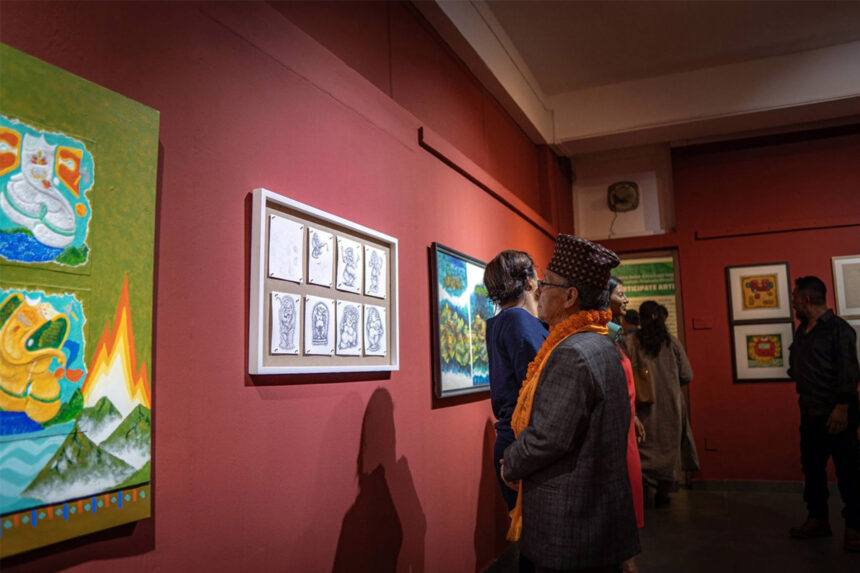
The 9th Himalayan Art Festival brings together more than 160 Nepali artists at Nepal Art Council
There are exhibitions that invite us to look at paintings, and then there are exhibitions that ask us to wander through an entire landscape of artistic imagination. The 9th edition of the Himalayan Art Festival, currently underway at Nepal Art Council, Babarmahal, belongs to the latter. Spread across the gallery’s expansive floors, the exhibition brings together more than 160 Nepali artists, creating an extraordinary confluence of generations, artistic languages, mediums and ideas.
From the established masters who have shaped the course of Nepali modern art to younger artists searching for new visual vocabularies, the festival presents a remarkably diverse picture of contemporary Nepali artistic practice. Abstraction meets figuration, mythology encounters modernity, traditional imagery converses with experimental forms, while memory, culture, technology, nature and identity repeatedly emerge as recurring threads.
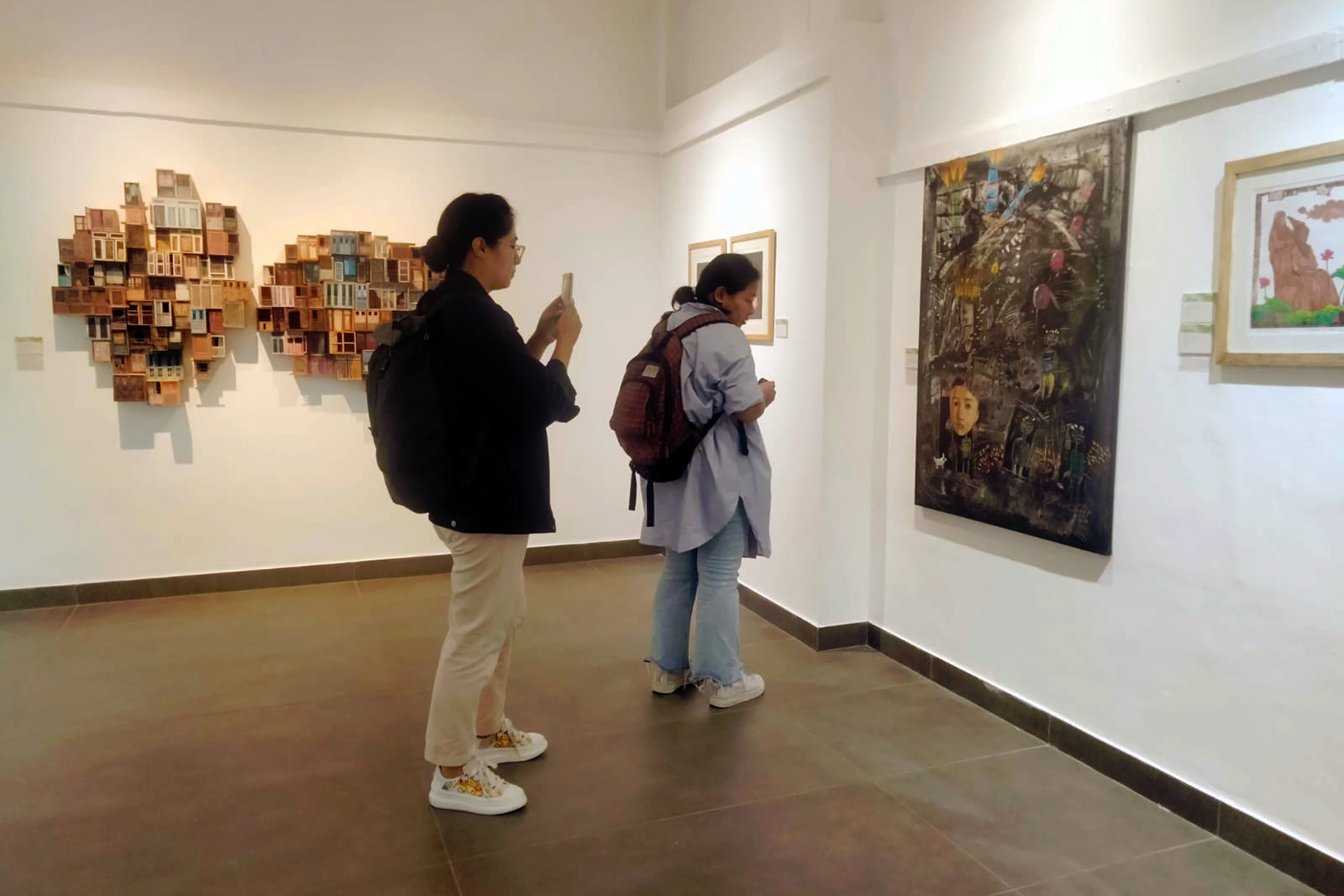
The result is less a single exhibition than a vast visual conversation-one in which different generations of artists appear to speak to one another through color, line, texture, symbolism and form.
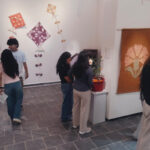
Walking into the ground floor, the gallery immediately establishes this dialogue between generations. On the right side of the main hall is a section devoted to senior and established artists whose practices have played an important role in the development of Nepali art. The works of artists such as Jeevan Rajopadhyay, Krishna Manandhar, Kiran Manandhar, Radheshyam Mulmi, Naresh Sainju, Ragini Upadhyay, Madan Chitrakar, Seema Shah and K.K. Karmacharya, among others, demonstrate the extraordinary range of approaches that have emerged within Nepali art over the decades.
The works move effortlessly between abstraction and figuration, between contemporary interpretations and traditional subjects. Each artist appears to carry a distinct artistic history, yet their works come together within the exhibition as fragments of a larger narrative-the continuing evolution of Nepali art.
Across the hall, a dedicated space celebrates the work of maestro artist Batsa Gopal Vaidya. His paintings draw deeply from traditional visual and spiritual vocabularies. Having studied at the J.J. School of Art, Vaidya developed a distinctive artistic language over the years, transforming traditional symbols into compositions filled with mystery and visual poetry.
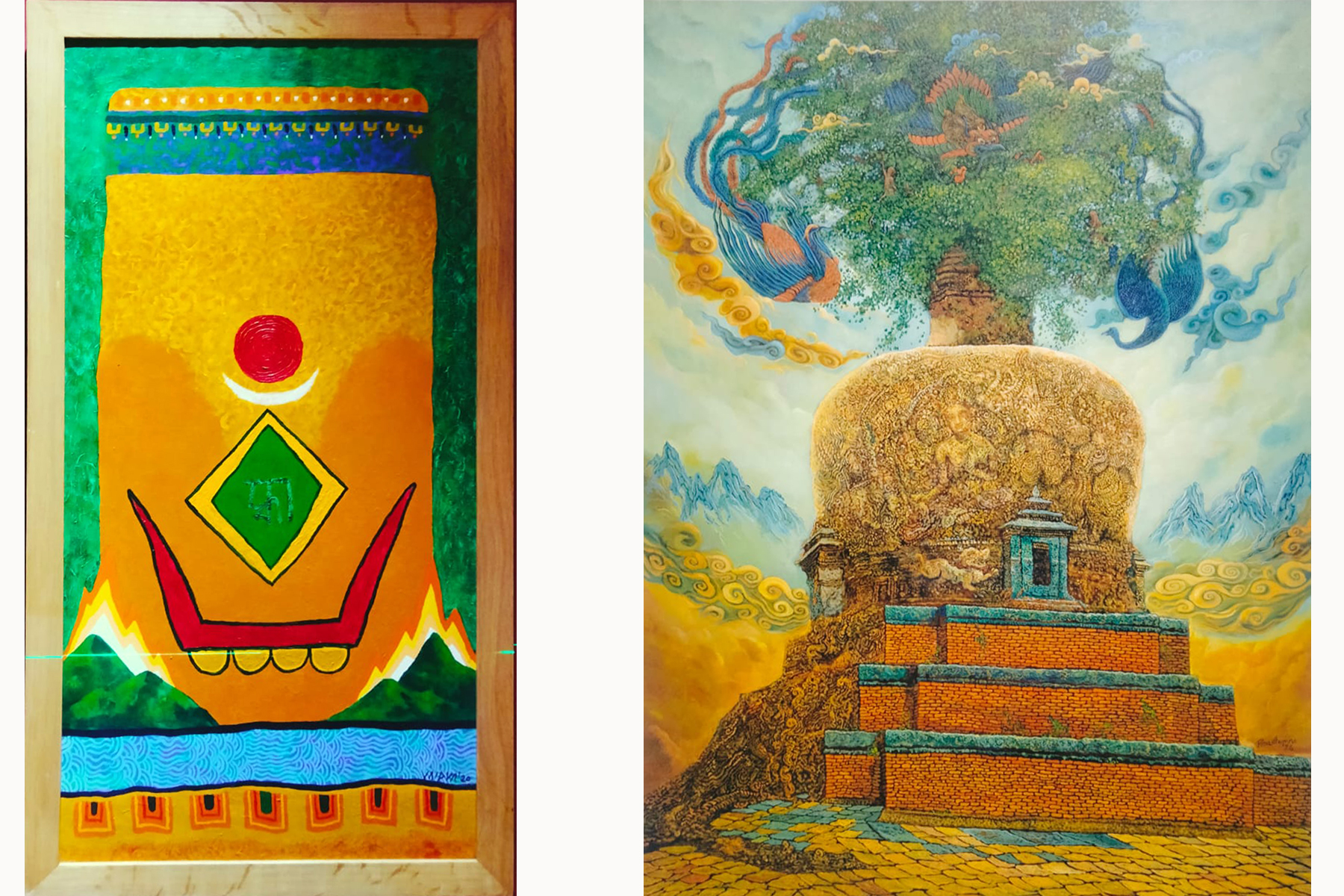
Talismanic forms, deities and especially images of Ganesha frequently inhabit his paintings. His characteristic color palette and mystical imagery create an atmosphere in which the familiar begins to appear enigmatic. His works do not merely reproduce traditional motifs; rather, they seem to invite viewers into a symbolic world where mythology, spirituality and imagination coexist.
If the ground floor provides a glimpse into the legacy of Nepali art, the first floor opens a window into its continuing transformation.
Here, the works of young and active artists demonstrate how contemporary practitioners are looking at culture, memory, technology, nature and human existence through increasingly personal perspectives.
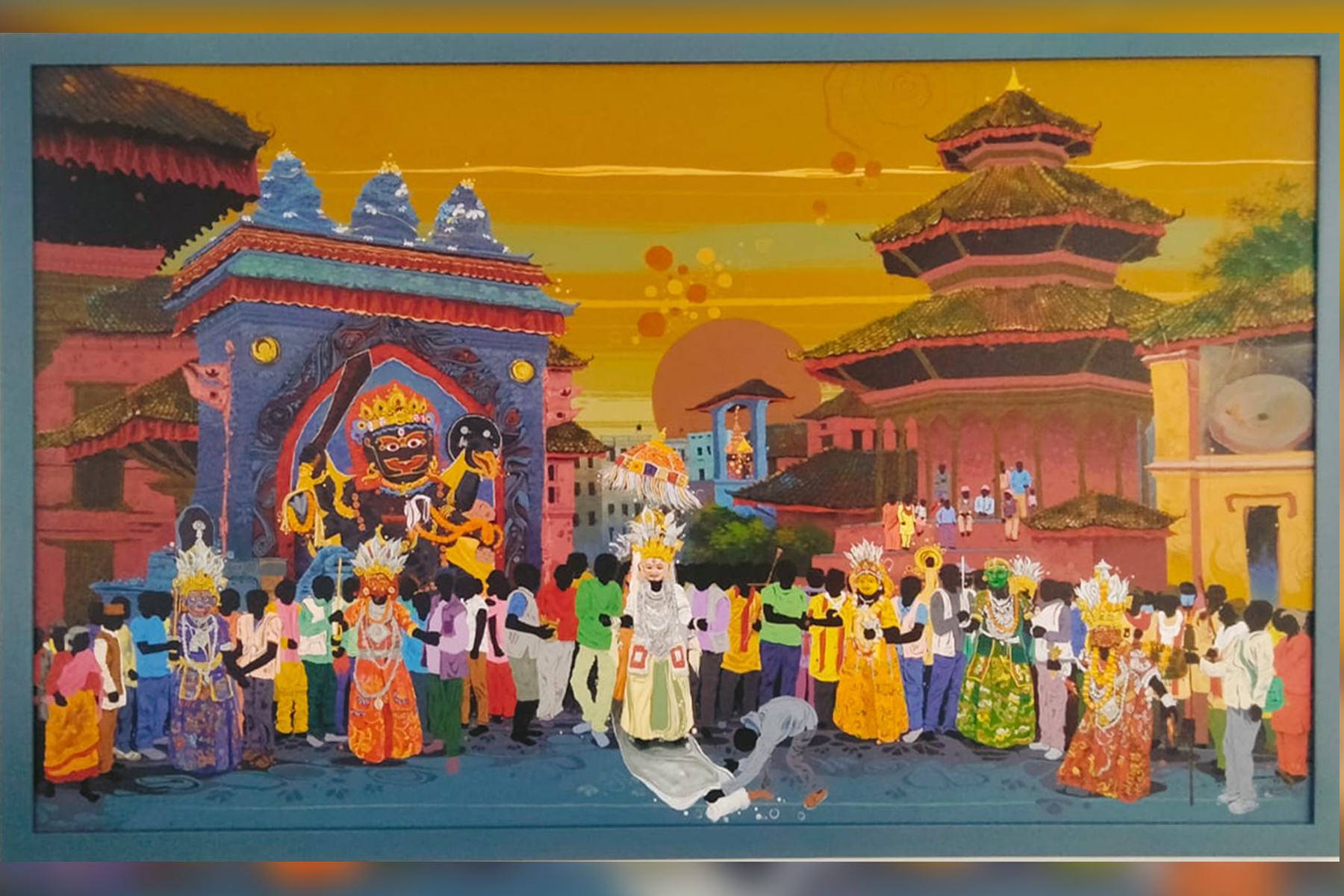
Rajan Panta’s engagement with cultural heritage immediately catches the eye. His work transforms familiar cultural references into a visual language that feels both rooted and contemporary. Similarly, Muna Bhadel’s paintings reveal an evolving artistic sensibility, allowing viewers to trace the changes and experimentation that have gradually shaped her practice.
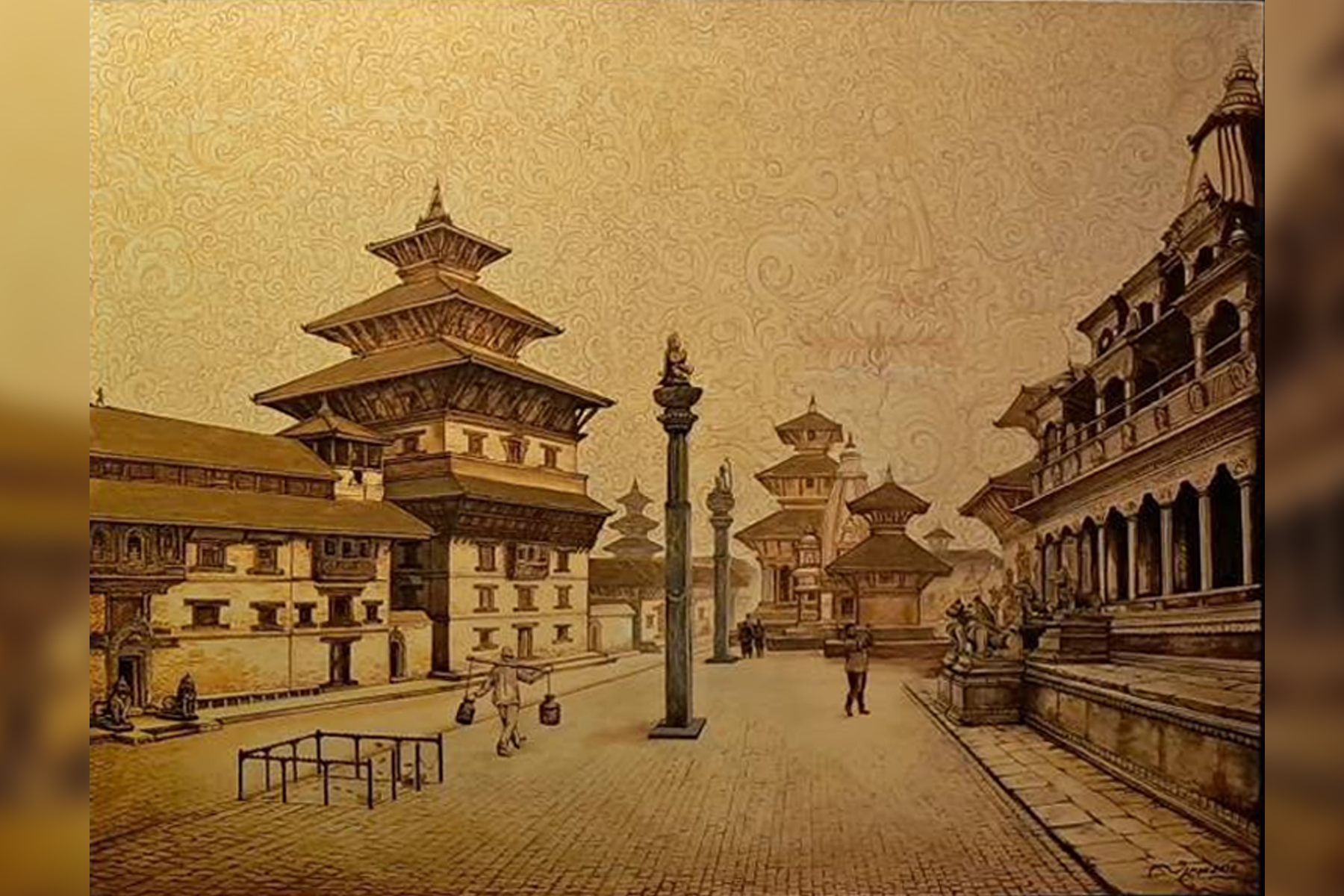
One encounters a different kind of visual experience in the work of Manish Dhoju, whose pencil-and-charcoal drawing appears almost labyrinthine. The ancient durbar seems to emerge through a maze of lines, encouraging the viewer to travel through the architecture rather than simply look at it. The delicacy of the drawing creates an illusion of stepping into an old architectural world preserved through memory.
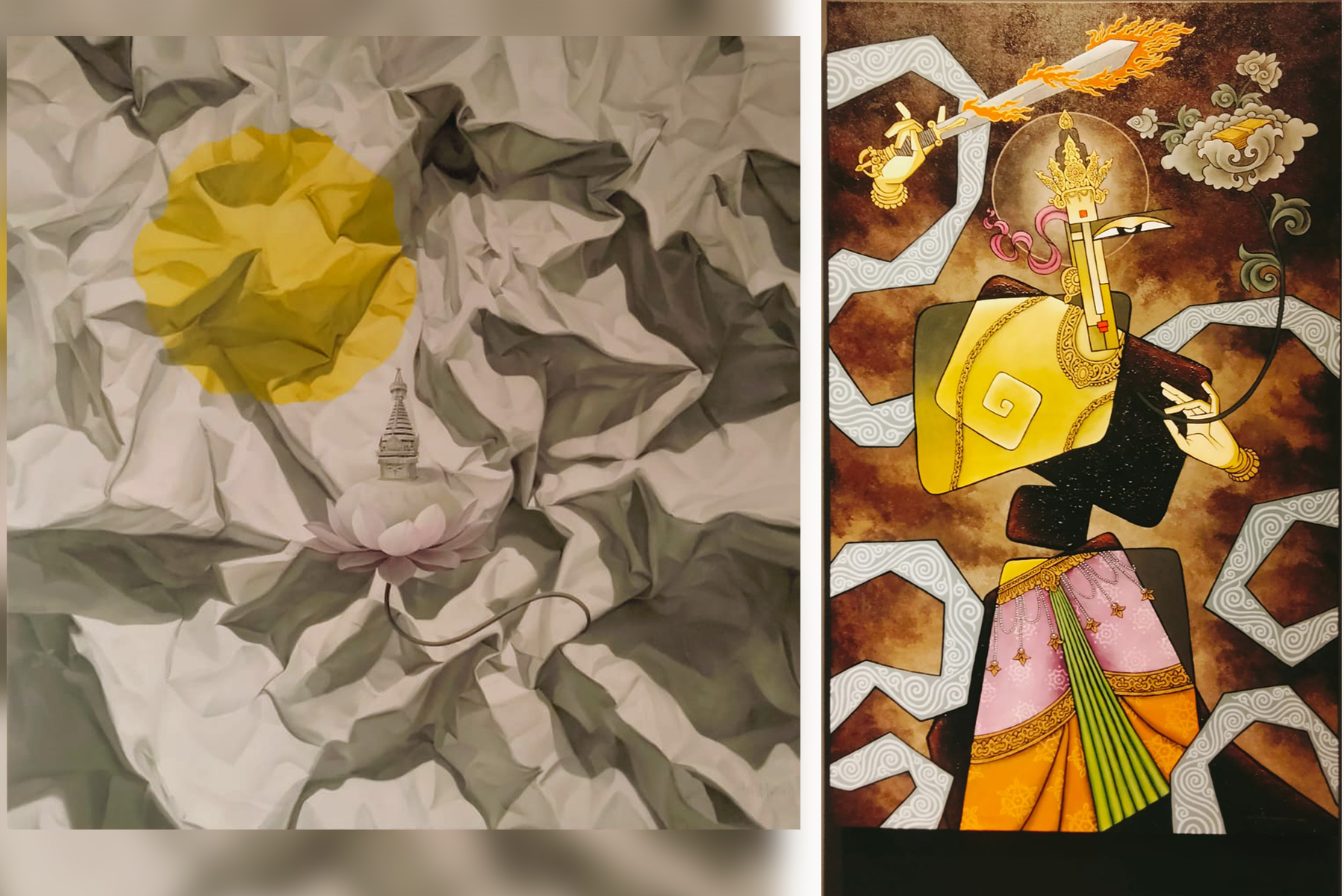
Anil Shahi, a lecturer at Kathmandu University, approaches memory through a different vocabulary. His paper-plane imagery moves through a zigzagging, cloud-filled space, while subdued grays and fading tones evoke a sense of nostalgia. The paintings appear to carry the atmosphere of something remembered rather than something simply observed.
In Wang Lama’s paintings, light becomes an essential element. The hills he depicts are shaped through subtle relationships between illumination and shadow, creating landscapes that feel both observed and emotionally remembered.
Technology and humanity enter the conversation through Roshan Pradhan’s continuing exploration of robots and human beings. His paintings examine the increasingly blurred boundaries between the organic and the technological, offering a striking reflection on coexistence in an age in which machines have become inseparable from human life.
For Pradhyumna Shrestha, imagination emerges through the relationship between nature and culture. His work reflects an attempt to understand the natural world not as something separate from human existence but as something deeply entangled with cultural memory.
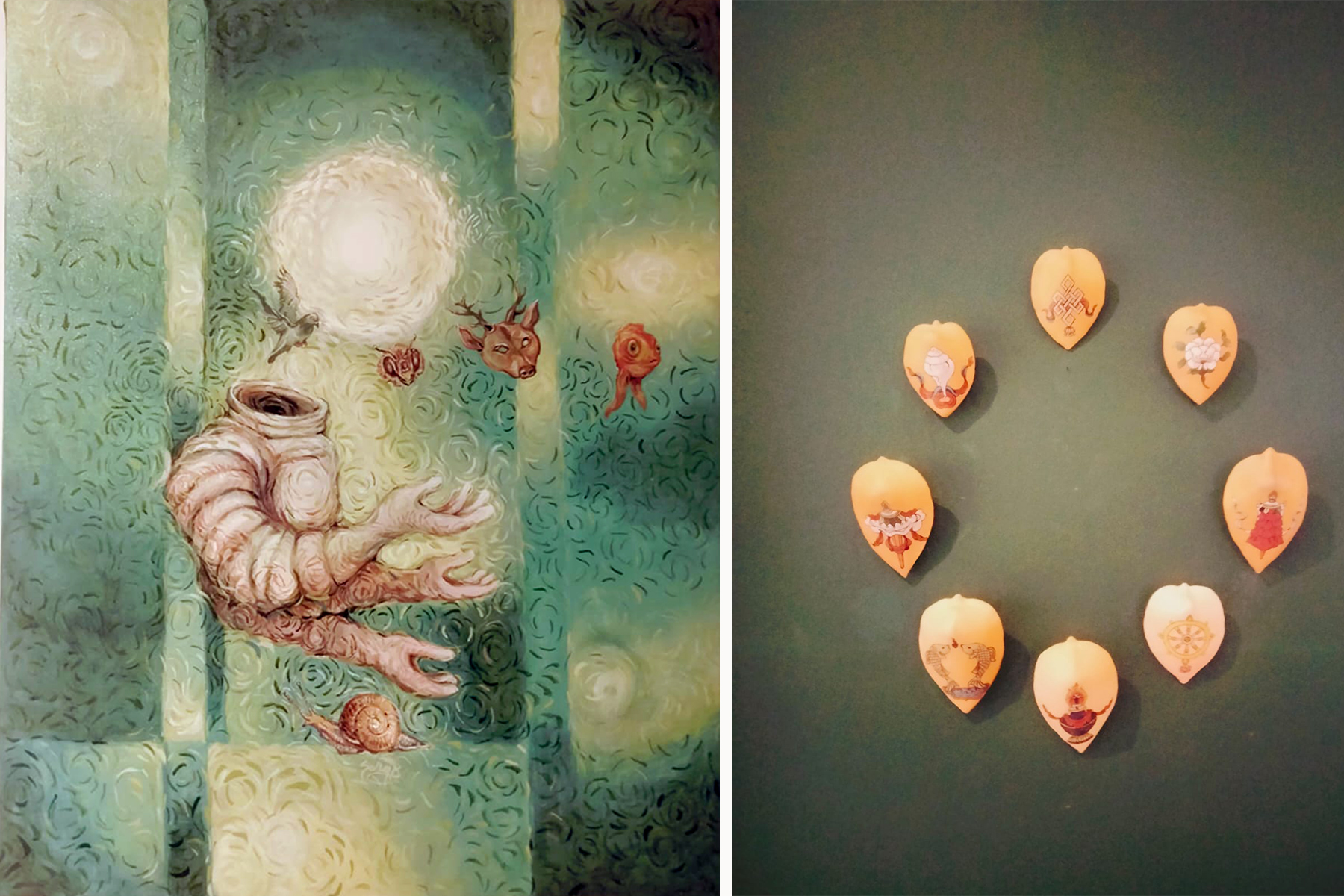
The exhibition then moves into another visual register with S.C. Suman’s engagement with the ancient narratives of the Ramayana. The scriptures become a source of imagery and interpretation, allowing an old cultural narrative to enter a contemporary gallery space.
Sagar Manandhar, meanwhile, moves away from conventional painting surfaces and embraces clay as an experimental medium. His work demonstrates how material itself can become part of an artistic vocabulary. Clay, with its tactile and earthy quality, becomes a means through which abstraction is physically experienced.
The theme of coexistence takes another form in the works of Saroj Bajracharya. His recurring blue tones create a spacious universe in which the human figure, water and galaxy appear to share the same visual territory. The astronaut becomes more than a figure in space; it becomes a symbolic presence contemplating existence within an immense universe.
The cultural sketches of Sujan Dangol, an artist and lecturer at Kathmandu University, offer yet another distinctive visual language. His largely monochromatic representations of cultural heritage are often accompanied by the symbolic presence of a golden sun or moon. Through restraint in color, his works give architectural and cultural forms a quiet, almost meditative presence.
Sandhya Silwal turns to paper-cut techniques to explore spiritual themes. The delicacy of the medium complements the contemplative nature of her subject, demonstrating once again how material and meaning can become inseparable in an artwork.
One of the more pointed works in the exhibition belongs to printmaker Bidhyaman Tamang. A frog holding a large pesticide bottle appears to pose a deceptively simple question: To whom does the land belong? Beneath its satirical surface lies a larger reflection on ownership, human intervention and the fragile relationship between people and the natural world. Rendered largely in monochromatic tones, the work quietly unsettles the viewer.
Anmari Tamang, known for her experimentation with clay, also presents a distinctive sculptural form created especially for the festival. Her work adds another tactile dimension to a floor already rich in experimentation.
Elsewhere, traditional paintings return viewers to the realm of deities, sacred imagery and spiritual aesthetics. These works provide an important counterpoint to the experimental practices surrounding them, reminding us that contemporary Nepali art continues to maintain a strong relationship with its cultural and religious heritage.
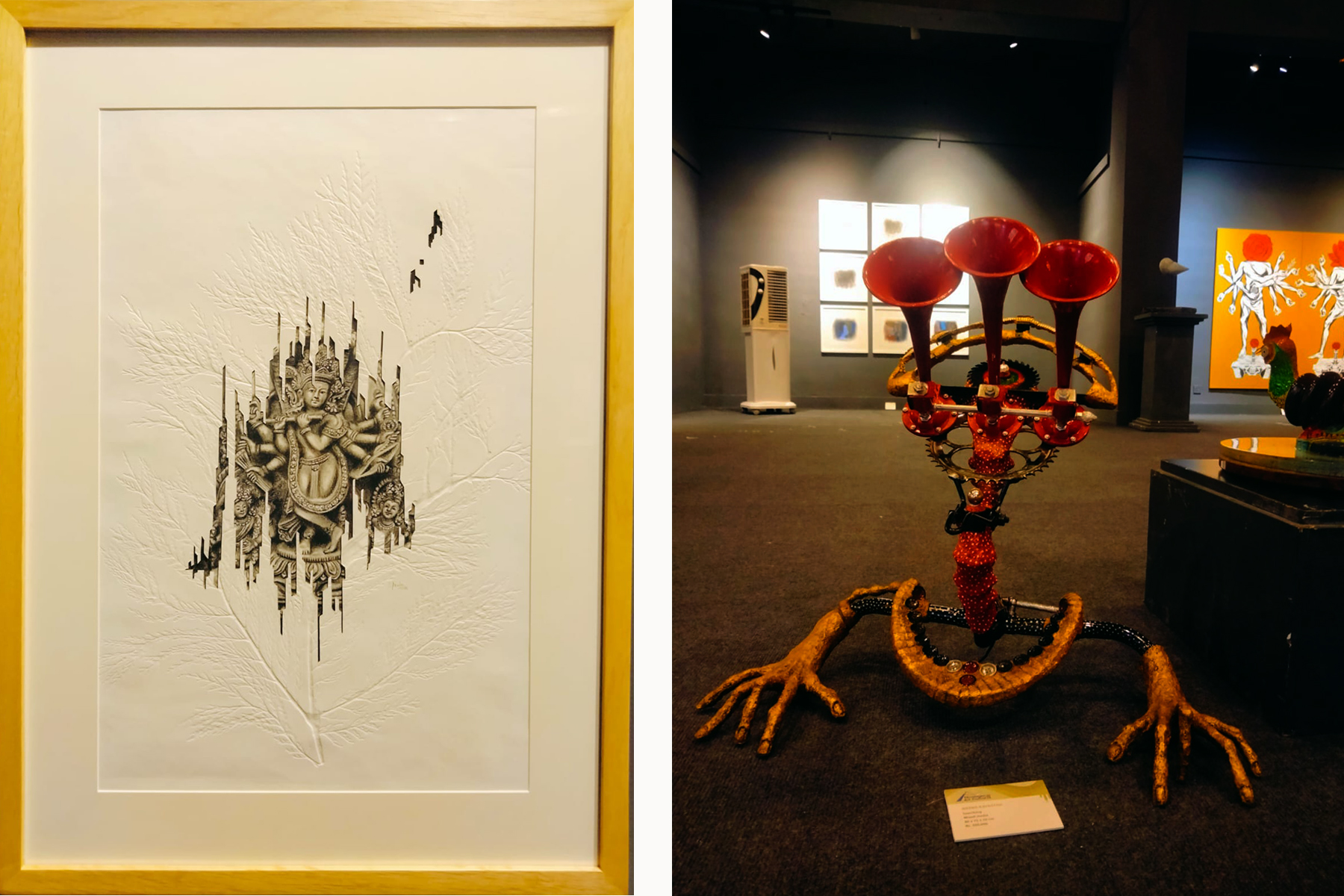
At another section of the floor, Roshan Bhandari continues his exploration of the relationship between abstraction and figurative expressionism. His works occupy an intriguing space between recognizable forms and abstract gestures, revealing the continuing possibilities that exist between the two approaches.
The idea of individuality receives a fascinating treatment in Rabindra Shrestha’s fingerprint series. Fingerprints are universal yet completely individual; they appear similar at first glance but reveal their uniqueness upon closer inspection. Through this deceptively simple visual idea, the artist turns a biological mark into a meditation on identity and difference.
The second floor continues this journey through the varied artistic landscapes of Nepal.
Teesha Shrestha’s printmaking explores cultural heritage, while Mukesh Shrestha presents an unusual composition in which two figures stand against a yellow-ochre background, their faces marked by striking red floral forms. The peculiar imagery immediately creates an atmosphere of mystery.
Erina Tamrakar, Chancellor of the Nepal Academy of Fine Arts, presents a compelling portrait of a woman with a third eye. The additional eye transforms the portrait from a conventional representation of the human face into something more symbolic-suggesting perception that extends beyond ordinary vision.
The streets and alleys of Kathmandu become a stage in the work of Asha Dangol, where a masked figure appears to navigate the city’s familiar yet mysterious urban spaces.
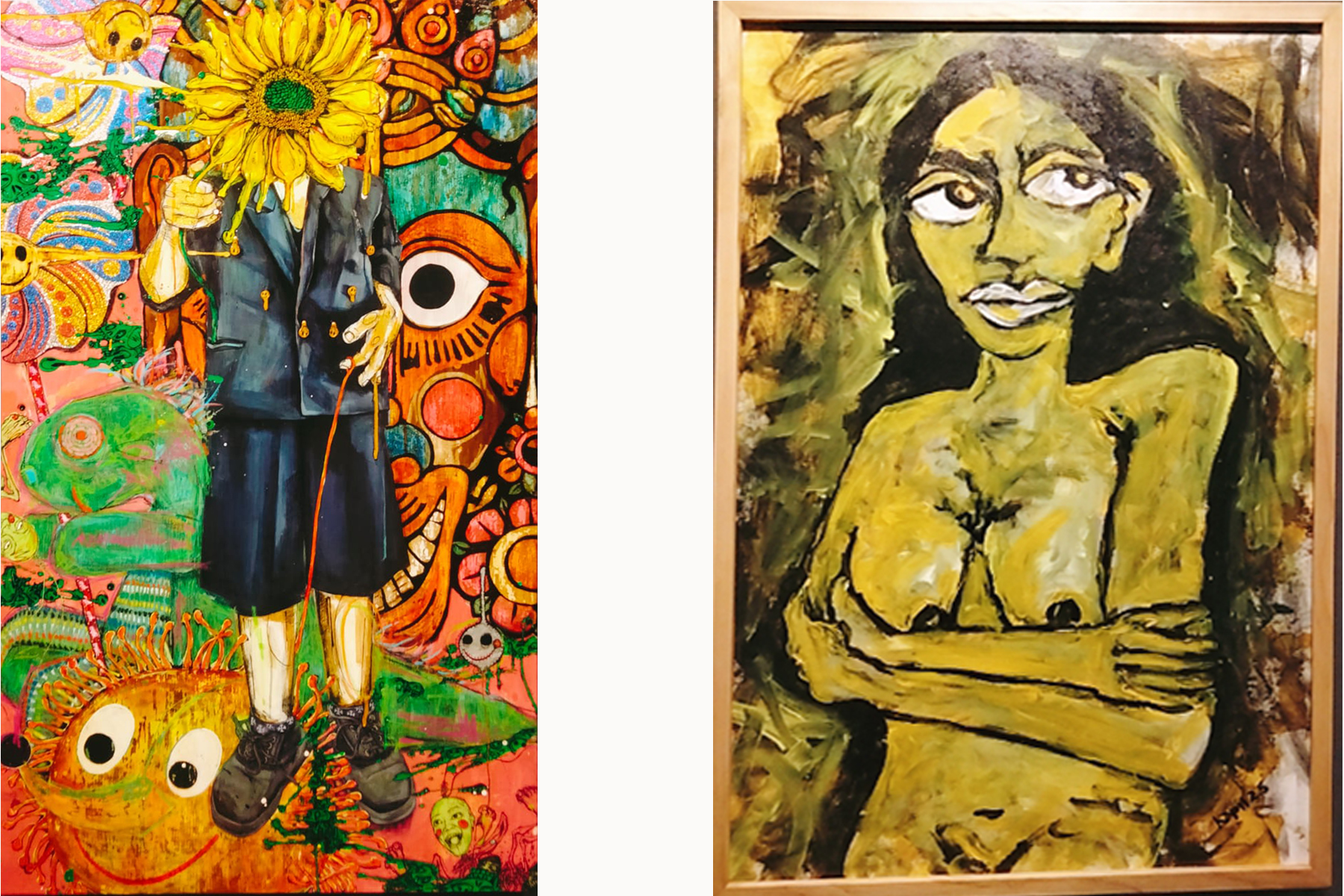
Kapil Mani Dixit presents a female figure distinguished by elongated eyes, set against a greenish background. The unusual proportions lend the work a dreamlike quality.
The passage of time becomes visible in Karma Tashi Gurung’s drawing, where aged hands and deeply marked wrinkles emerge against a dark background. The hands become records of experience-quiet reminders of labour, age and the lives carried within the body.
Ishan Pariyar turns his attention towards an ancient durbar, bathing the architectural scene in yellow hues. Fine, delicate lines give the work an almost archival quality, as though an old Kathmandu has been carefully retrieved from memory.
The theme of love receives a more intimate treatment in the work of Sabita Dangol, where emotion becomes the central subject of her visual narrative.
As viewers continue upwards, the exhibition gradually assumes another character. On the top floor, Krishna Lama’s layered compositions create imagery through accumulation. Layer upon layer appears to build a visual world, demonstrating how depth can emerge not only through perspective but through the physical and conceptual layering of an artwork.
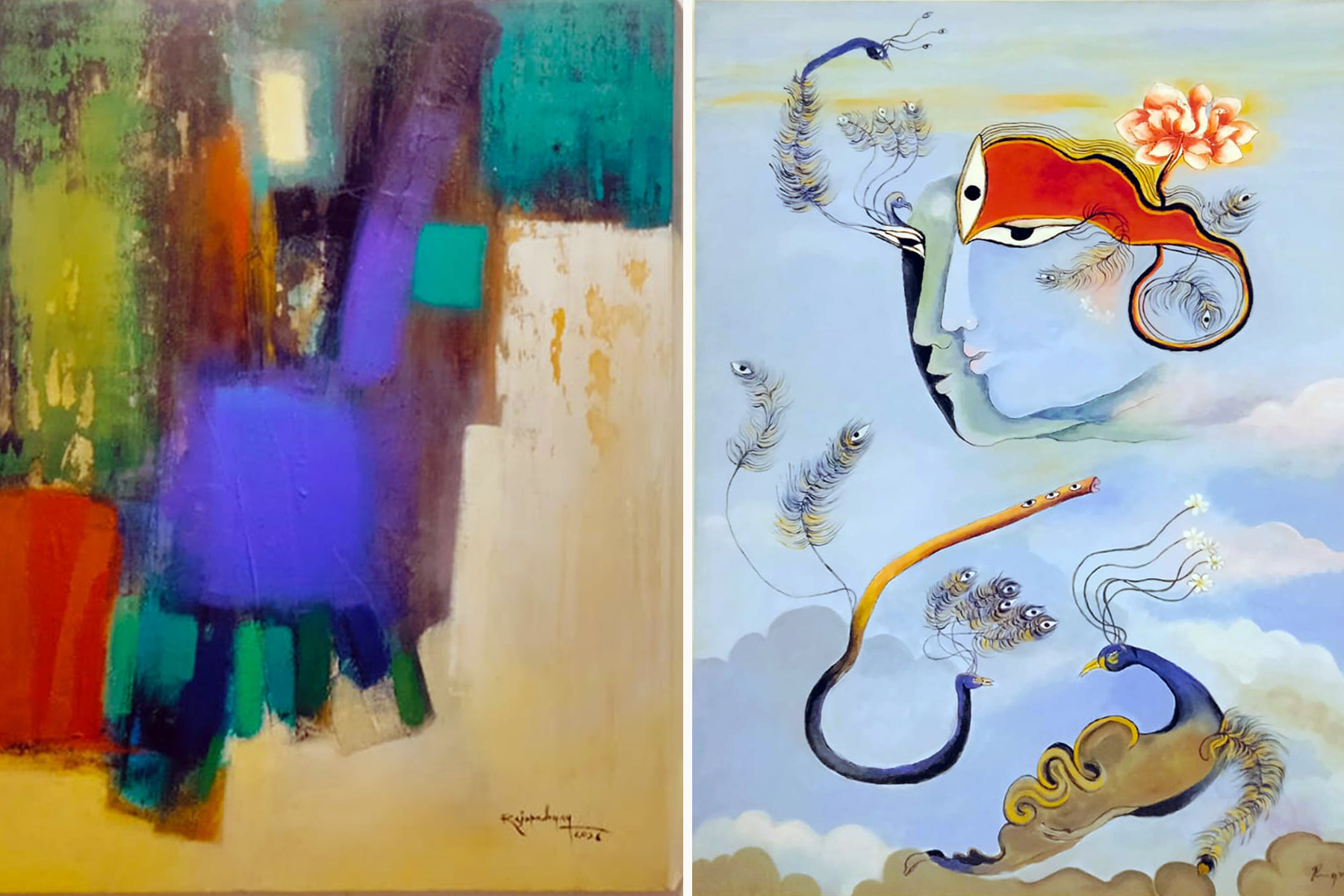
Bhuwan Thapa’s installation extends the exhibition beyond the conventional boundaries of painting. His human figure appears to be in perpetual movement, travelling towards an unseen destination. The work becomes a metaphor for the human journey itself-always moving, always searching, never entirely arriving.
What makes the Himalayan Art Festival particularly compelling is this very diversity. It does not attempt to impose a single definition of Nepali art. Instead, it allows numerous voices to exist side by side. Traditional iconography stands beside contemporary abstraction; cultural memory meets technology; mythology converses with environmental concerns; and personal experience finds expression through everything from pencil and charcoal to clay, printmaking and installation.
In that sense, the festival becomes more than an annual gathering of artworks. It becomes a living map of Nepali artistic imagination.
Curated by Bidhata K.C. and co-curated by Suresh Maharjan, the 9th Himalayan Art Festival brings together artists at different stages of their creative journeys, creating an opportunity for viewers to witness not only individual artistic practices but also the broader transformation of Nepali art.
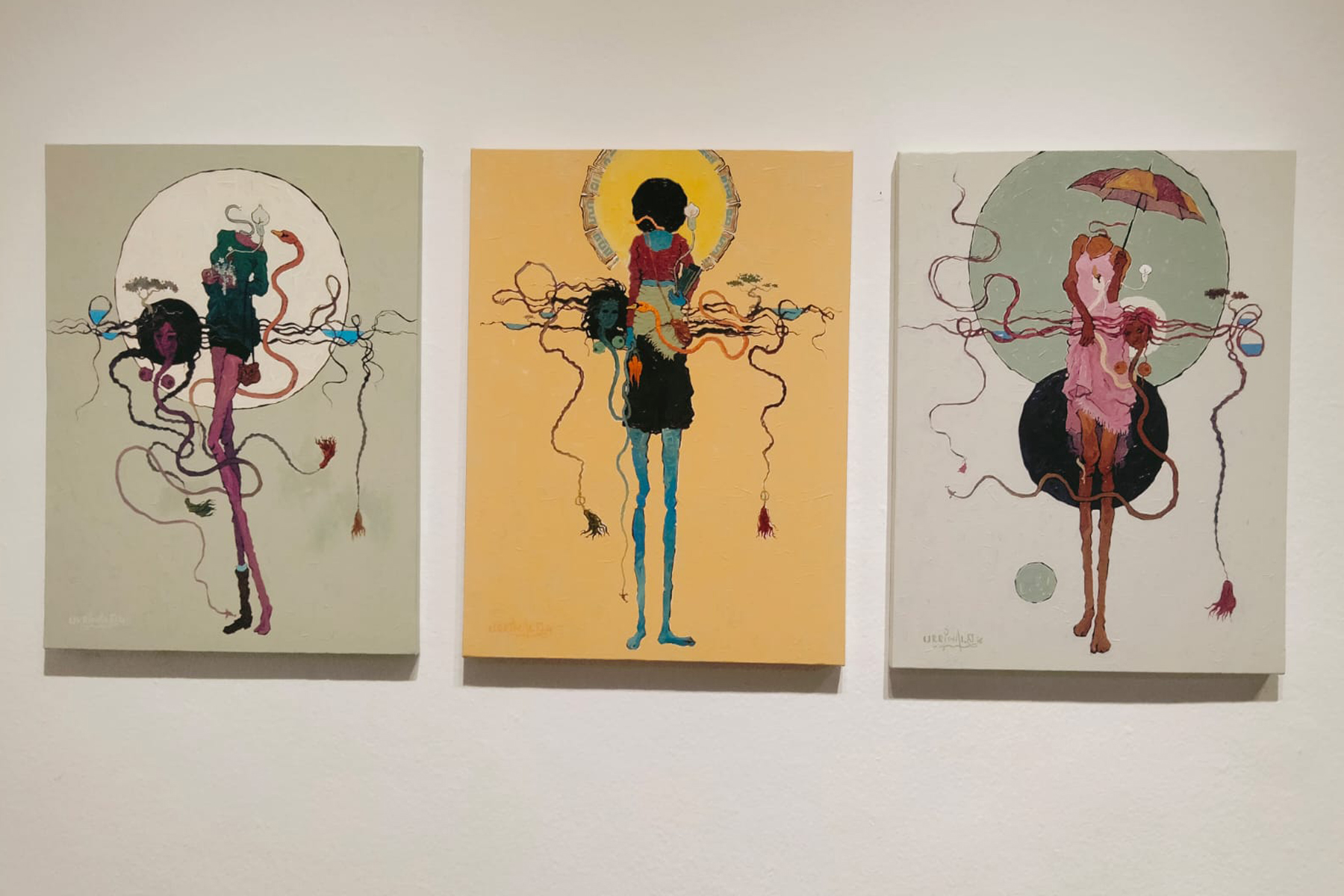
The exhibition, which began on 21 August, will remain open at Nepal Art Council, Babarmahal, until 27 August. Alongside the artworks, the festival is also hosting a range of programs, including art talks, poetry recitations and workshops, further extending the exhibition from a visual encounter into a space for conversation and participation.
With more than 160 artists occupying its different floors, the Himalayan Art Festival can sometimes feel overwhelming-and perhaps that is precisely its charm. There is no single path through the exhibition. One can move from mythology to modernity, from Kathmandu’s architectural memory to distant galaxies, from the delicate lines of a drawing to the physical weight of clay, and from the intimacy of a fingerprint to the vastness of the cosmos.
For a few hours, Nepal Art Council becomes not merely a gallery but a meeting ground of generations, memories and possibilities-a place where the past continues to converse with the present, and where the future of Nepali art quietly begins to take shape.

Leave A Comment