


What Empire Took, What Empire Left asks how museums, borders and the politics of return continue to shape the meaning of South Asian cultural heritage.
What Empires Took, What Empires Left examines the enduring consequences of colonial rule in South Asia and the ways in which its legacy continues to shape cultural identity, history, and communities. Being Held in Taragoan Next, Bouddha it encourages viewers to consider not only what colonial empires took, but also what they left behind. Colonial powers removed idols, manuscripts, textiles, and other forms of cultural heritage from their original settings and transferred them to museums, private collections, and institutions abroad. Yet, the consequences of this extraction extended far beyond the physical disappearance of objects. The disruption also affected traditional knowledge, skilled craftsmanship, local livelihoods, religious practices, collective memory, and the relationship between communities and their heritage.
The removal of a cultural object can fundamentally alter its significance. A religious idol, for instance, may appear in a museum as an artifact of artistic or historical importance, but within its original temple it could have been a living part of worship, festivals, rituals, and everyday community life. Its significance therefore lies not solely in its material or aesthetic qualities, but in the beliefs, memories, traditions, and relationships surrounding it. Once separated from this context, an object may remain physically intact while its cultural meaning becomes fragmented. The exhibition consequently draws attention to the difference between preserving an object’s physical form and preserving the living heritage that gives it purpose.
Curated by Dr. Arshiya Mansoor Lokhandwala, the exhibition emerges from more than a year and a half of research into the complex relationship between colonial history, cultural objects, and the communities from which they originated. “Is it really easy to repatriate an object?” asks Dr. Arshiya Mansoor Lokhandwala. Her research raises fundamental questions about what happens when cultural objects are removed from their original environments and separated from the people, narratives, traditions, and landscapes that gave them meaning.
For Lokhandwala, repatriation cannot be understood simply as the physical return of an object to its country or place of origin. The histories surrounding an object may have been altered, fragmented, or forgotten over time. Communities may have changed, cultural practices may have disappeared or transformed, and the original context in which an object was created and used may no longer exist in the same form. The separation of an object from its original environment means losing not only its physical context but also the networks of memory, knowledge, practice, and identity that give it meaning. Even when an object is returned, the world from which it was taken may no longer exist in its original form. Repatriation, therefore, involves more than returning an object; it also requires confronting the histories and cultural relationships embedded within it.
This perspective shifts the debate around repatriation beyond questions of ownership. It opens a broader discussion about memory, identity, cultural responsibility, historical justice, and the continuing consequences of colonialism. The exhibition particularly draws attention to regions such as Bangladesh, where colonial intervention profoundly altered cultural and social histories.
The exhibition also encourages viewers to understand colonialism not merely as a process through which objects were removed and transported elsewhere, but as a system that transformed entire societies. Its consequences could be seen in the disruption of traditional industries, the weakening of local economies, the fragmentation of communities, and the erosion of indigenous knowledge and cultural practices. From this perspective, heritage cannot be treated as a collection of independent objects. It exists within living systems of people, places, practices, memories, and knowledge that are continuously passed from one generation to another. When these systems are disrupted, the loss is not simply material—it is also cultural, social, and historical.
Presented by the Saraf Foundation, the exhibition forms part of a broader commitment to examining the history, culture, and heritage of the Himalayan region. The foundation supports scholars, artists, anthropologists, architects, and researchers whose work approaches the region through diverse intellectual and creative perspectives. Through exhibitions such as this, the foundation creates a space to confront difficult and often unresolved questions surrounding heritage, ownership, identity, cultural loss, and historical responsibility. Rather than offering simple answers, the exhibition invites viewers to reconsider what it means to return an object—and whether returning an object can ever fully restore the histories and relationships that were disrupted by its removal.
Ultimately, What Empires Took, What Empires Left Behind asks audiences to look beyond the inventory of objects removed during colonial rule and consider the wider histories that accompanied them. It reminds us that cultural heritage is not simply something that can be collected, displayed, or transferred. It is deeply connected to people, places, memories, beliefs, and traditions. In the modern world, where debates surrounding repatriation and cultural ownership continue, the exhibition offers an important opportunity to reconsider how societies understand the past and how they choose to preserve, acknowledge, and restore heritage for the future.
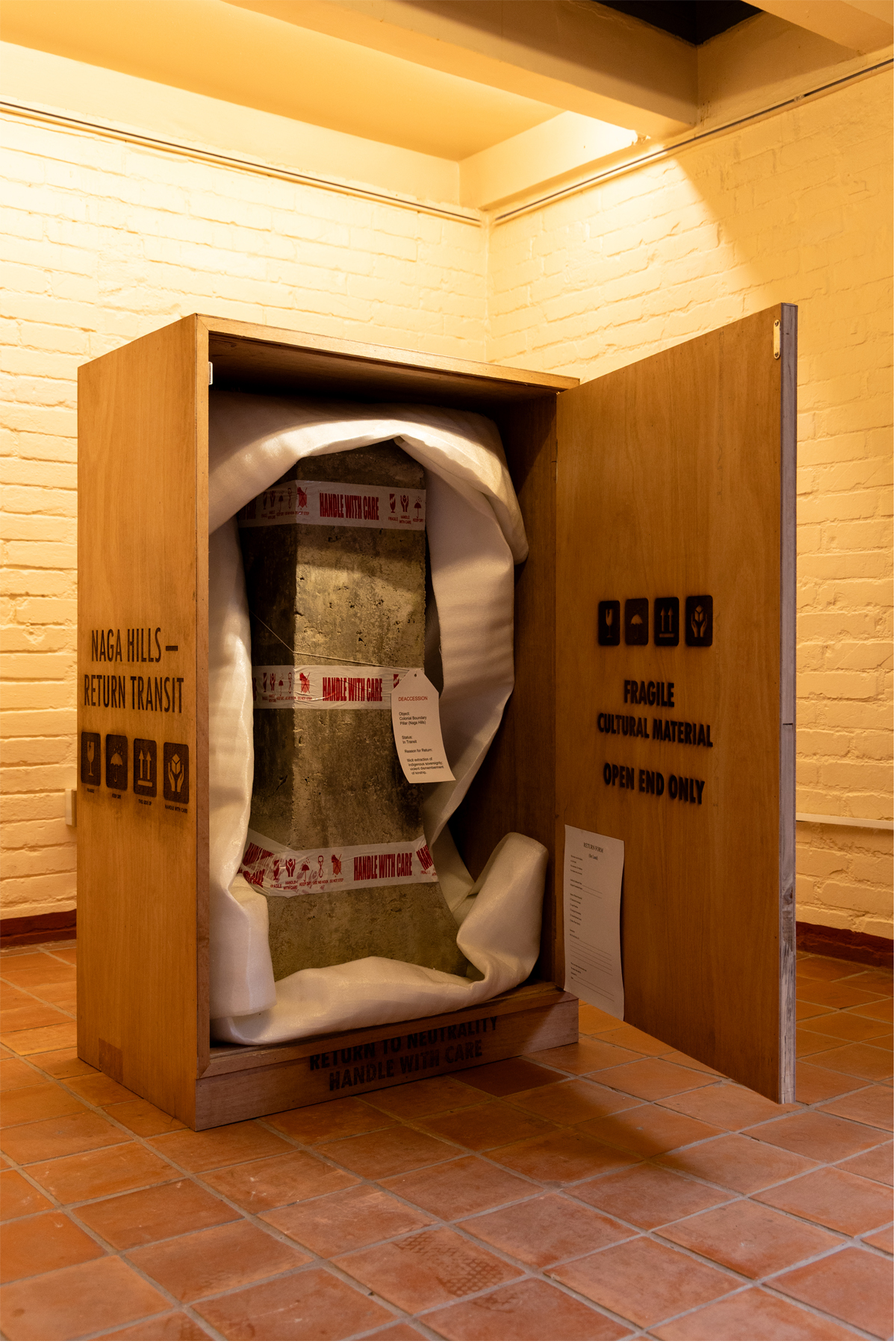
Temsüyanger Longkumer explores the idea of returning not only stolen cultural objects, but also land and territory. His work focuses on a replica of a colonial border pillar marking the boundary between India and Myanmar. The border has played a role in dividing Naga communities and territories. By presenting the border itself as an object created through colonial rule, Longkumer encourages viewers to question whether borders, like cultural objects, can also be reconsidered, changed or “returned.” His work expands the idea of repatriation beyond museums and collections and connects it with land rights, autonomy and the collective memory of communities.
Reetu Sattar’s Shabnam explores the lost and scattered history of muslin, the famous Bangladeshi textile tradition. The artwork brings together archival photographs, objects and stories connected to colonialism, inequality and the disappearance of cultural heritage. Through film and the use of the Bangla language, Sattar creates a feeling of discomfort around histories that can no longer be completely recovered. Rather than presenting the past as something that can easily be reconstructed, the work asks how fragmented histories can regain a sense of belonging and how communities can reconnect with cultural traditions that have been disrupted.
In another work, Reetu Sattar uses an old teak box as a cabinet to preserve fragments of Bangladesh’s lost muslin-making tradition. The cabinet contains cotton, seeds, weaving tools, fish skin, bone fragments and old records connected to the production of the textile. Instead of attempting to perfectly recreate a past that has already been damaged or lost, Sattar presents these fragments as reminders of the knowledge, labour and history that once surrounded muslin production. The cabinet therefore becomes more than a container for objects. It works as an archive of memory and a reminder of a tradition that cannot simply be brought back in its original form.
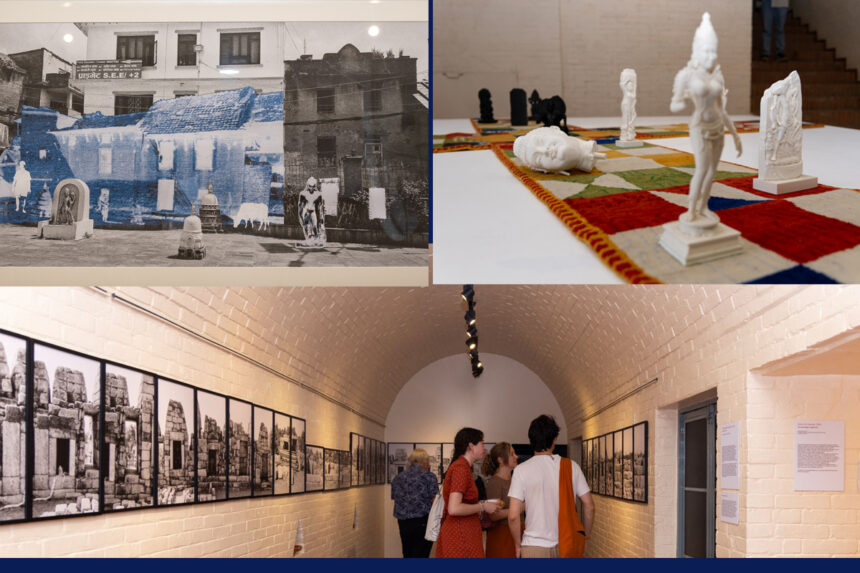
Shaurya Kumar’s 36 documents the remaining sculptures of a Yogini temple in India that was originally dedicated to 64 female divine figures. Today, only 36 sculptures have been partially reconstructed, while the others were lost through colonial extraction, trafficking, neglect and their dispersal into museums and private collections. Through monochromatic photographs of empty spaces, damaged stones and missing sculptures, Kumar focuses strongly on absence and cultural loss. The empty spaces become important because they show what is no longer there. The missing Yoginis therefore represent not only lost sculptures, but also the loss of religious traditions, feminine power and collective memory connected to the temple.
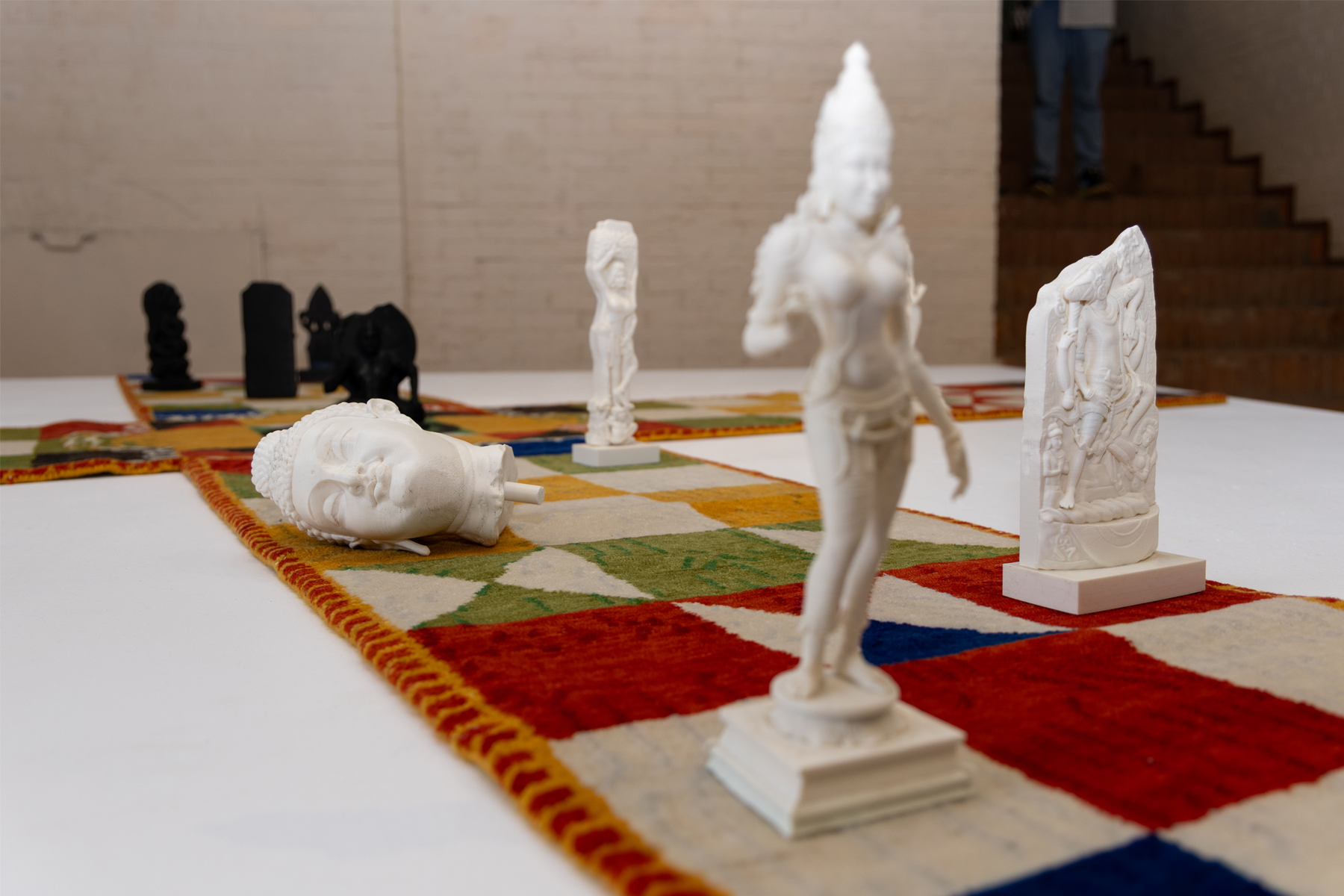
In another large-scale installation, Shaurya Kumar connects the dice game from the Mahabharata, in which Draupadi was publicly humiliated, with the looting and international trade of Indian sacred artefacts. The work includes a large handwoven wool tapestry designed like a checkerboard, along with 12 3D-printed sculptures based on newspaper and media images of displaced artefacts. The inexpensive and artificial appearance of these sculptures creates a contrast with the value placed on original cultural objects. By presenting sacred figures as pieces within a global game of buying and selling, Kumar draws attention to the way cultural heritage has been removed from the communities that once valued and cared for it. The work also raises difficult questions about ownership, value and the possibility of returning these objects.
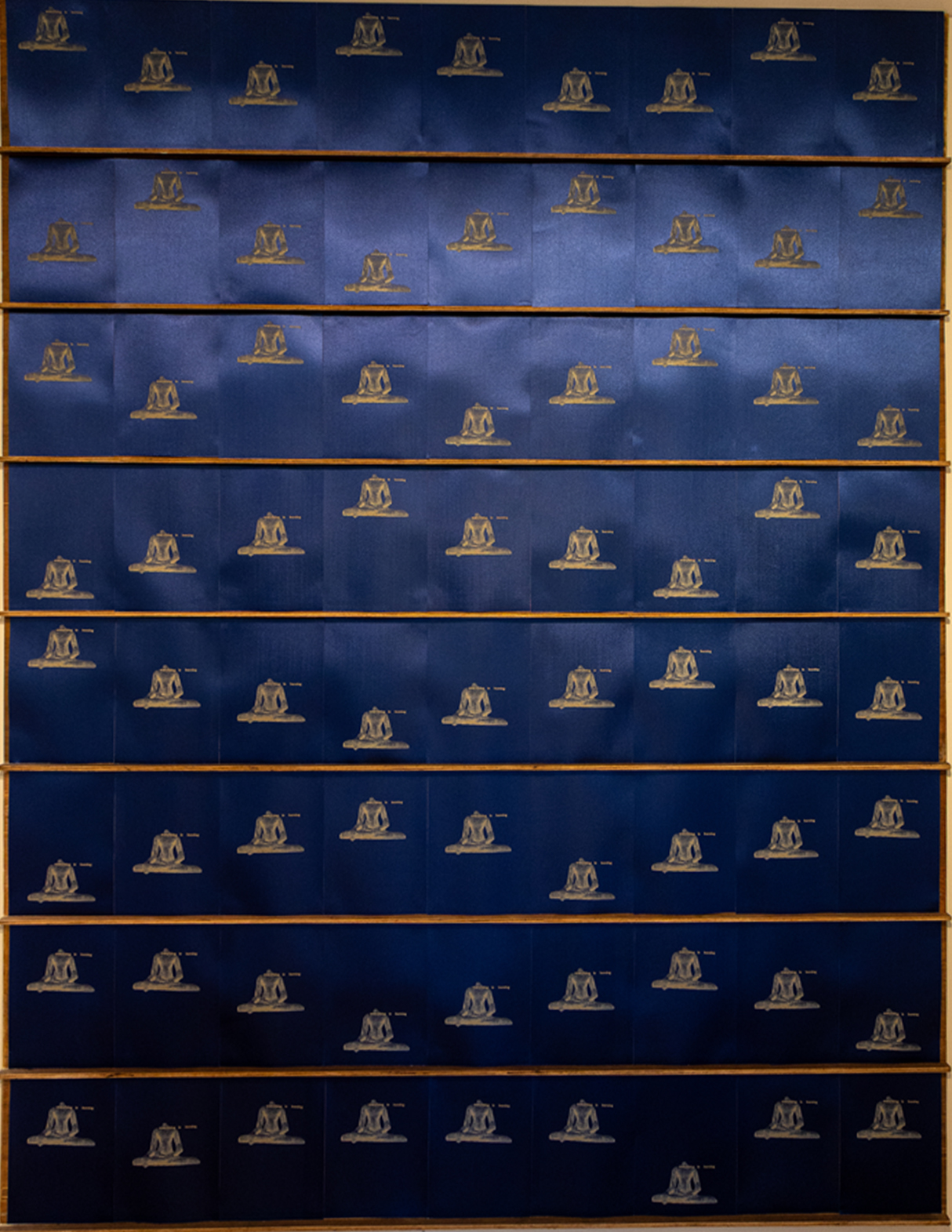
Raqs Media Collective’s Oddlyness (2024) explores the mystery surrounding damaged Buddhist sculptures. The work includes around 72 small laser engravings on silk-coated paper as well as a larger image of a headless seated Buddha. The Buddha is connected to damaged figures found on the outer walls of the Kesariya Stupa in Bihar. However, there is no clear record explaining who damaged the sculptures or exactly when the damage took place. Instead of providing the viewer with one definite explanation, Raqs leaves the question open. This approach reminds us that historical records are sometimes incomplete and that uncertainty itself can be an important part of understanding the past.
The artists also use fire as part of the process of creating the work. The image of the Buddha and the words are produced by burning the surface, leaving behind marks, heat and residue. In this way, fire is not simply a symbol within the artwork; it becomes a physical part of its creation. Oddlyness encourages viewers to think carefully about how we understand history and how we deal with things that have been damaged, forgotten or lost. It suggests that not every missing part of history can be completely explained or recovered.
Mithu Sen’s Hariel (2023) is a video based on a performance at the RISD Museum. It presents a strange and almost humorous farewell to a Gandharan sculpture of Shakyamuni Buddha. The sculpture has an incomplete history, and little is known about its earlier journey, its donor, its collector or the exact circumstances through which it eventually entered the museum. This uncertainty becomes an important part of the artwork.
Sen imagines the Buddha leaving the museum, but this imagined journey immediately raises a difficult question: where would the sculpture actually go? Its original location and history are uncertain, making a simple return almost impossible to define. Through this fictional departure, Sen explores the emotional side of cultural objects that have been separated from their past. The work suggests that repatriation is not always as simple as physically sending an object back to a particular country or place. In some cases, the original community, surroundings and history may already be difficult to trace.
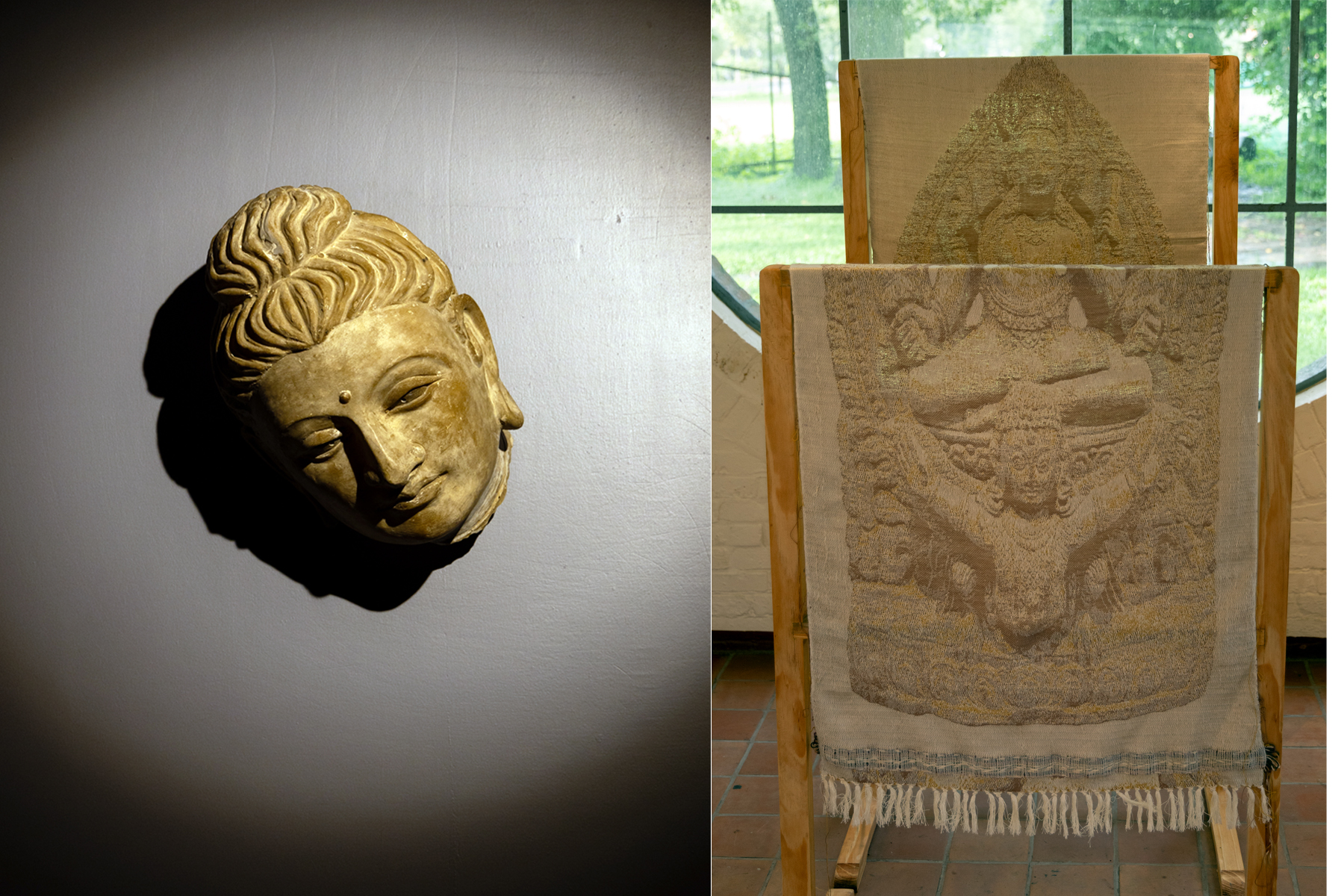
Bishal Manandhar’s Shell of Faith (2023–24) uses jacquard weaving to recreate images of Nepalese deities and ceremonial objects that are now held in museums. Rather than presenting these woven images as replacements for the original sacred objects, the work emphasizes the distance between an image and the actual object. The recreated figures allow viewers to remember what has been separated from its original setting while also reminding them that an image cannot completely take the place of the object itself.
A woven representation can help preserve the memory of a deity, but it cannot fully replace an idol that was created to receive prayers, offerings, decoration and care. Manandhar’s work therefore draws attention to the difference between preserving the physical appearance of an object and preserving its living cultural meaning. The work reminds viewers that Nepalese religious objects are connected not only to their material form, but also to the people, places, rituals and traditions that surround them.
Divya Mehra’s returnism tells the story of a sculpture that was taken from a shrine near the Ganges in Varanasi in 1913. For many years, the museum recorded the sculpture as Vishnu. However, Mehra discovered that it was actually Annapurna, the goddess of nourishment and the queen of Banaras. This mistake meant that the sculpture had lost more than its original location. It had also been separated from its correct identity, religious significance and historical context.
Mehra’s research contributed to the sculpture’s return to India. In 2021, it was ceremonially returned to Varanasi and placed in the Kashi Vishwanath Temple, allowing it to once again become part of religious life. Her work demonstrates the importance of discovering and understanding the true history of a cultural object before deciding how it should be interpreted or where it belongs. It also shows that repatriation can mean much more than transferring an object from one institution to another. When possible, it can reconnect the object with its original place, people and traditions.
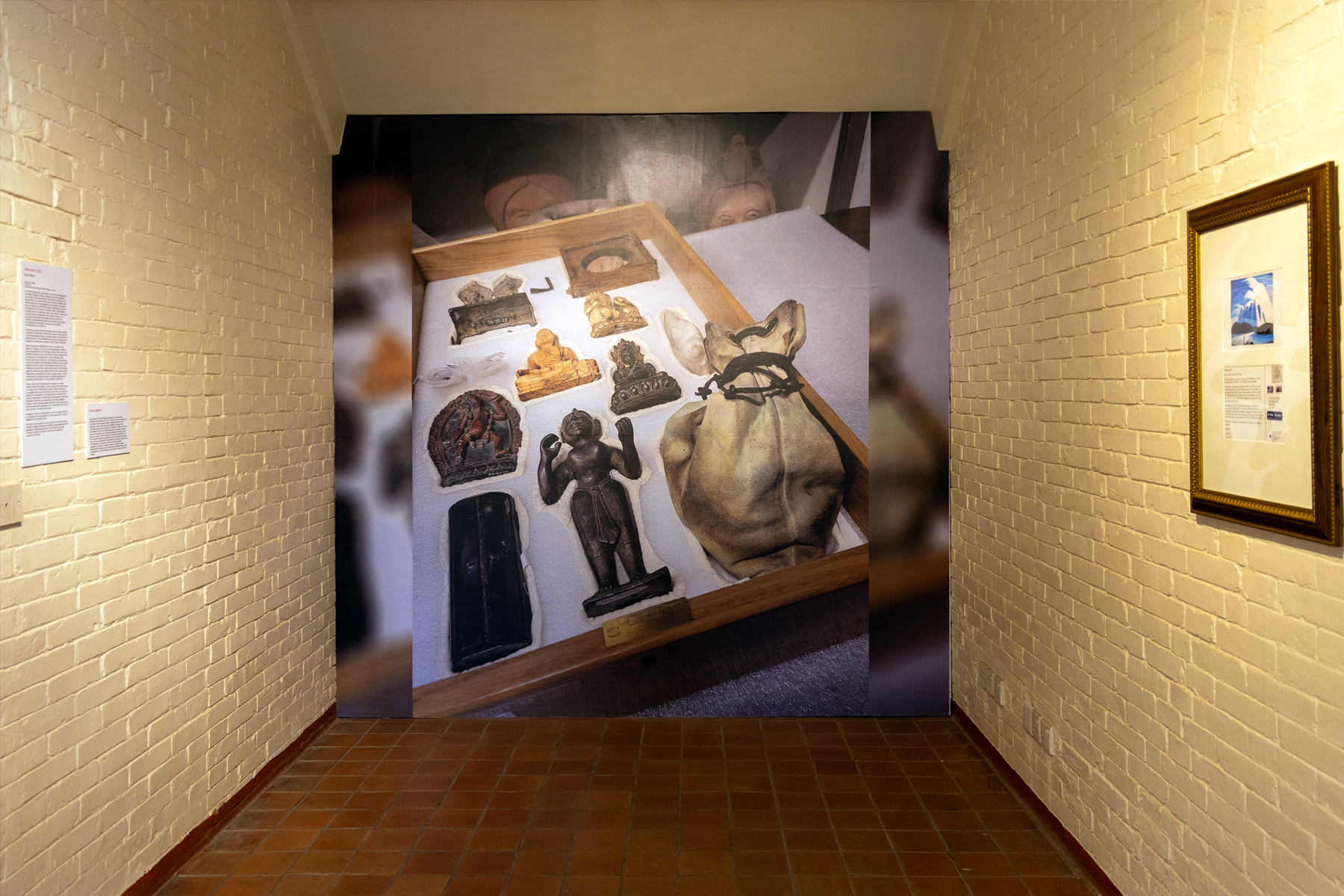
Mariam Ghani’s photographic works Removed, Limbo, Dismembered, and Spectacular examine Afghan cultural objects and archives affected by war, looting, trafficking and destruction. Her work focuses on objects whose histories have been fragmented or whose return has become difficult because of the circumstances surrounding their disappearance. Through photography, Ghani draws attention to the complicated journeys of cultural heritage and the challenges involved in restoring it.
Limbo focuses on objects that have been identified but cannot easily be returned. Dismembered examines manuscripts that have been divided between different collections and digital archives. Spectacular looks at the empty spaces left behind by the destruction of the Bamiyan Buddhas and considers how these spaces became powerful images known around the world. Together, these works show how cultural loss can exist in many forms: an object may be physically missing, divided between collections, destroyed or separated from the place where it once held meaning.
Ghani also connects the movement of cultural objects with the movement of people. Cultural objects may sometimes be kept abroad in the name of protection, while displaced people themselves can face borders, restrictions and difficulties in returning home. Her photographs therefore suggest that the movement of cultural heritage cannot always be separated from human experiences of displacement. The loss of cultural objects can also reflect the wider experience of people who have been separated from their homes, communities and histories.
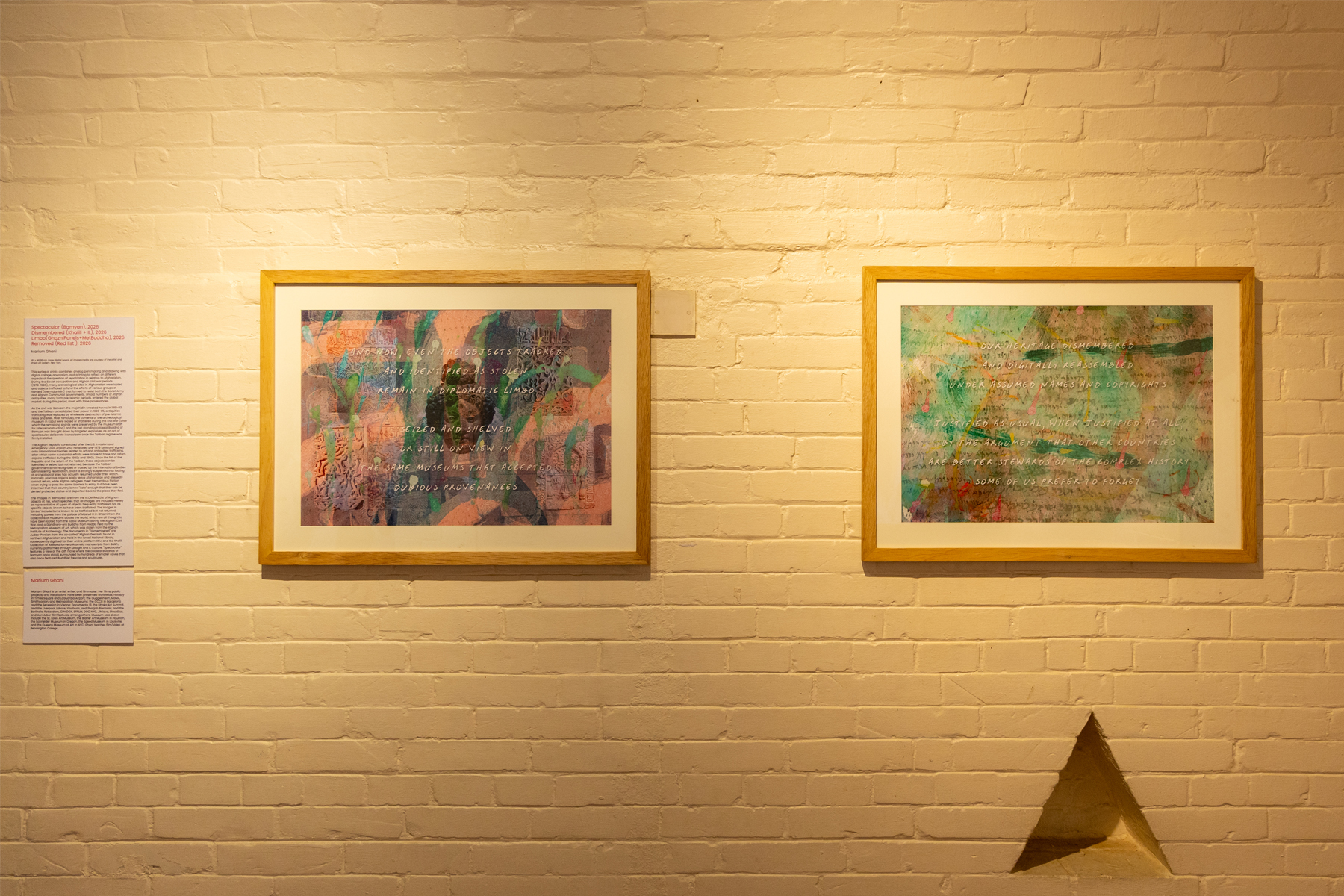
Jagath Weerasinghe’s Thira Ramanswari is home if all homes are colonial (2025) focuses on an eighth-century bronze figure of the Buddhist goddess Tara from Sri Lanka, which is now held in the British Museum. The sculpture entered the museum in 1932 through Sir Robert Brownrigg, who had served as the governor of British Ceylon. The work follows Tara’s journey through removal, transportation, measurement and classification, drawing attention to the different stages through which a sacred object can become part of a museum collection.
The work asks what it would truly mean for Tara to return to Sri Lanka. Simply moving the sculpture across a national border may not completely restore its original connection to worship, culture and community. Weerasinghe therefore looks beyond the physical idea of returning an object and considers whether its cultural and religious meaning can also be restored. The work raises the larger question of whether repatriation should involve only the movement of an object or also the restoration of the relationships and traditions connected to it.
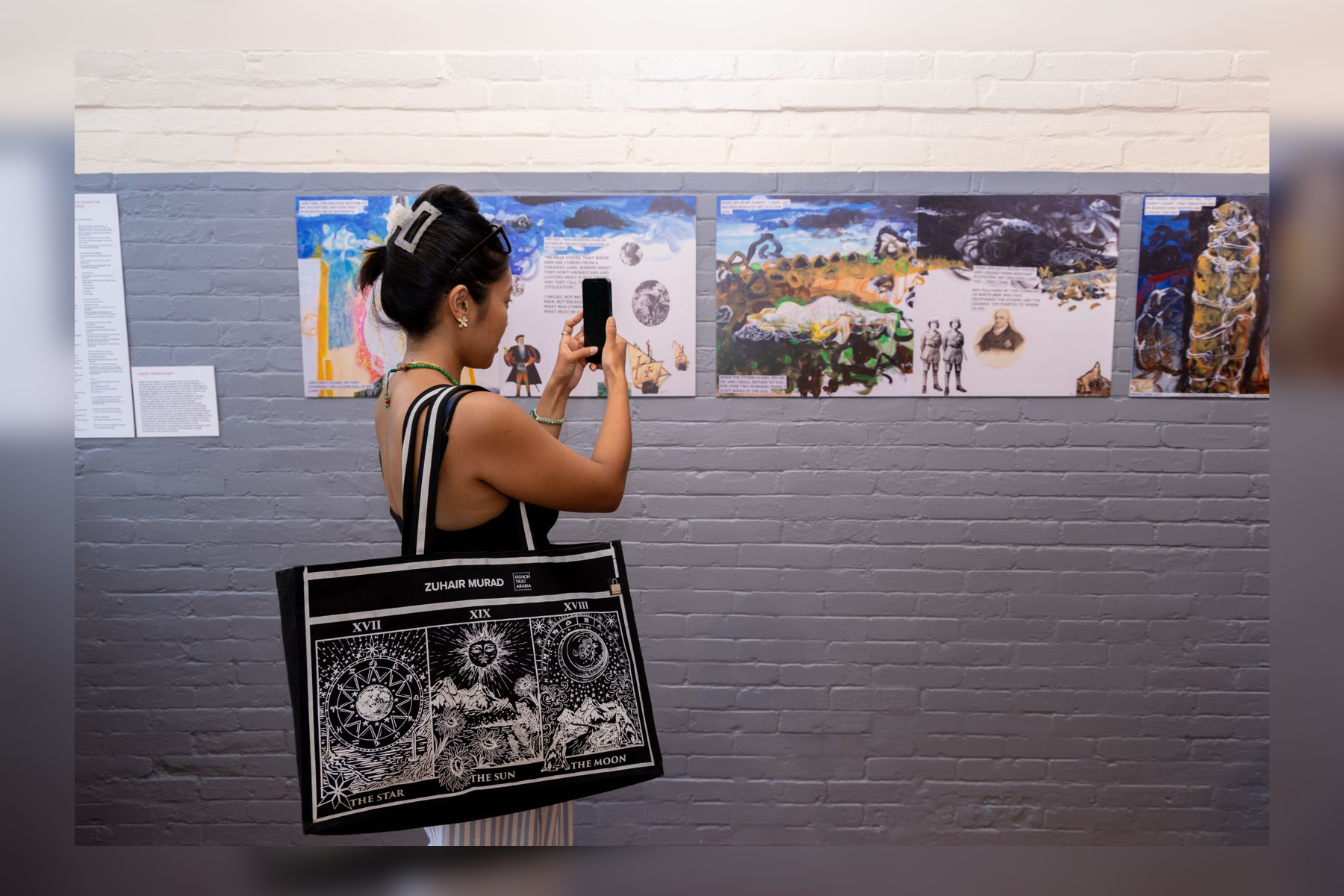
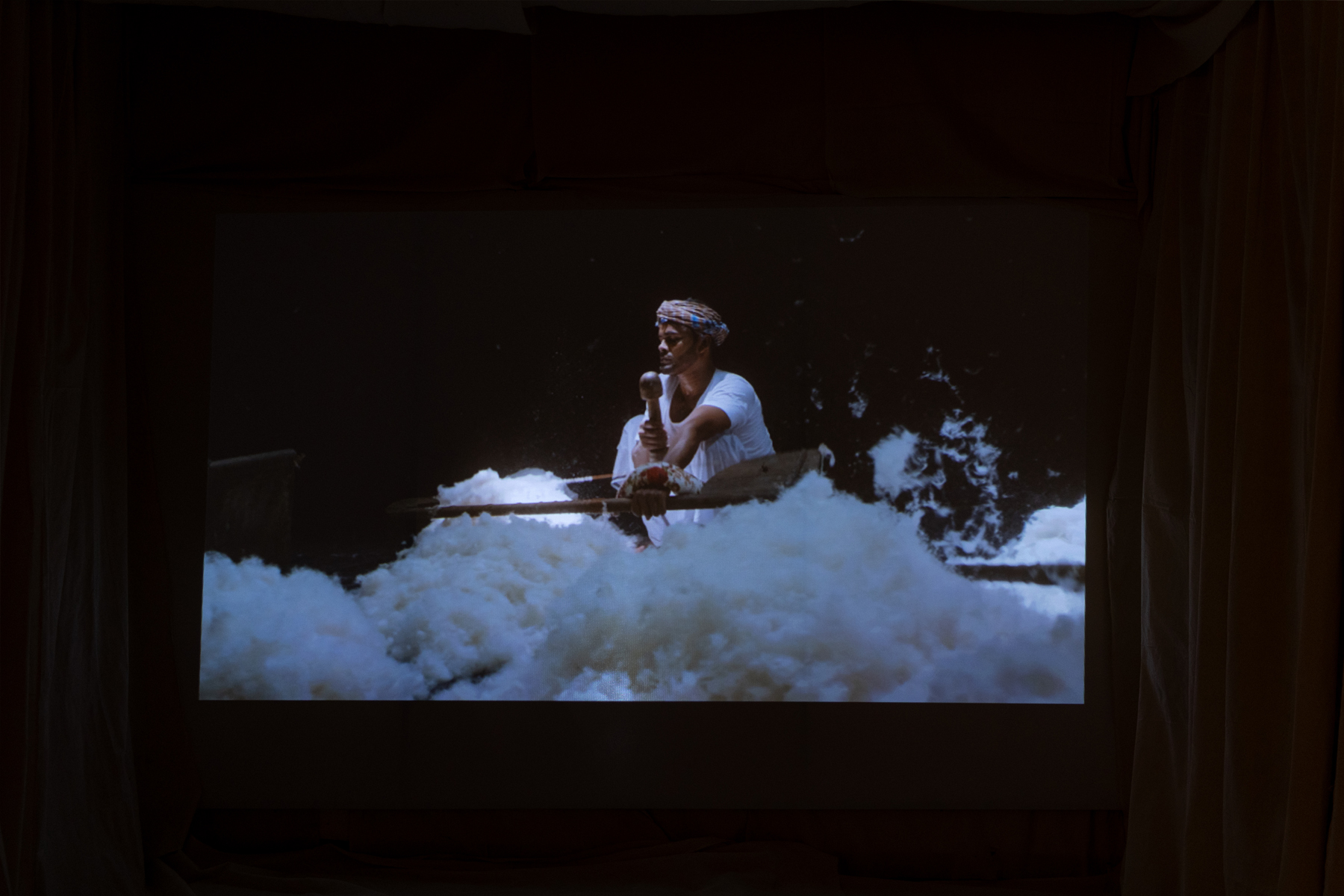
L.N. Tallur’s Interference (2019) is a slow-motion video showing workers cleaning an old rug from a palace in Gujarat. The rug was made in the late nineteenth century by prisoners who had been imprisoned during the struggle against British colonial rule. Although the video presents a simple act of cleaning, the historical background of the rug gives the scene a much deeper significance.
As the rug is cleaned, large clouds of dust rise from its surface, making the ordinary act appear unexpectedly powerful. The dust can be understood as a reminder of the stories, struggles and experiences that have remained hidden within the object over time. The sound in the video does not perfectly match the movements on screen and sometimes resembles distant explosions. This creates a connection between the quiet act of cleaning and wider ideas of violence, conflict and colonial history.
Through Interference, Tallur connects an ordinary household object with colonial history, suffering and memory. The rug is not simply an old piece of fabric; it carries traces of the people and circumstances connected to its creation. The artwork suggests that historical stories can remain present within objects even when they are no longer immediately visible. What appears to be dust may therefore also represent memories that have been buried but not completely erased.
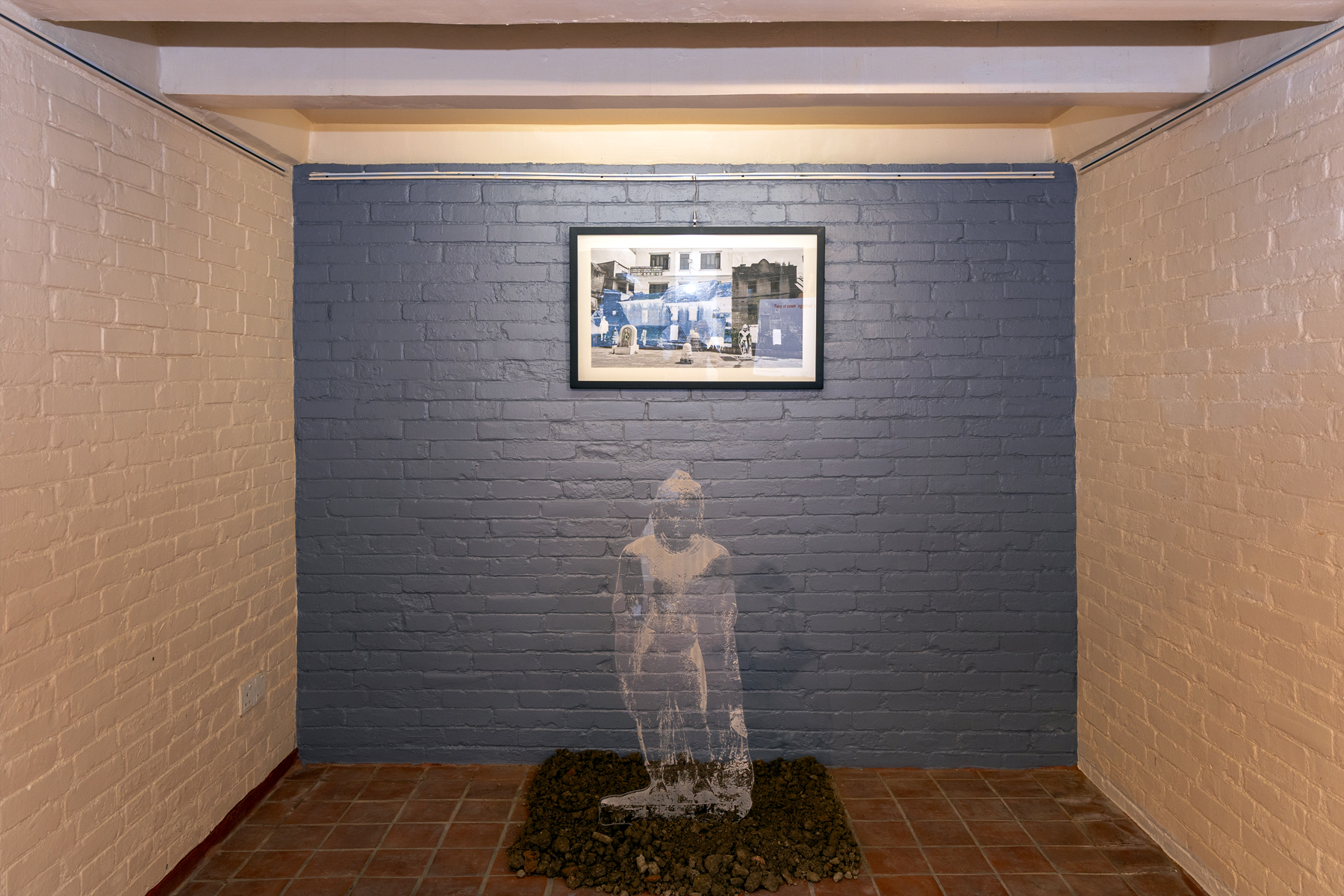
Roshan Mishra’s work explores the disappearance of sacred Devatas from their original communities and the loss of the living traditions connected to them. Through transparent representations, he conveys both physical absence and the continued presence of these figures in collective memory, rituals and cultural practices. His work questions the role of museums, collectors and urban transformation in separating sacred objects from their communities, emphasizing that heritage must be preserved not only as objects but also through the people, memories and traditions that give them meaning. Two works in the exhibition reflect these concerns, highlighting lost and forgotten cultural heritage.
One of the artwork depicts a beautiful standing Buddha from the Licchavi period, which was located on the southern side of Charumati Stupa. Mishra created the artwork partly because the historical site is close to his home and to the museum. The sculpture is featured in Lain Singh Bangdel’s catalogue of stolen Nepali images. It was lost in 1985 AD and has not been found in any known exhibition, auction house, or other location since then. Although the older community of the area still remembers the statue, much of its memory has gradually been lost among the younger generation.
Mishra created this artwork because he is concerned that Nepal’s heritage, culture, and pride connected to such objects may eventually be forgotten. Since the original sculpture has disappeared, the artwork acts as a way of bringing its memory back into the present. It shows that even when a cultural object is physically lost, its memory can continue to exist through art.
The second artwork focuses on a Shiva-Parvati statue that was originally situated in Thapahiti, Patan. The statue has also become disconnected from its original cultural setting and is now located in the British Museum. Mishra includes a QR code in the artwork. When scanned, it leads viewers to the British Museum’s website, where they can see the sculpture and learn about its present location. This creates a direct connection between the artwork, the lost heritage, and the place where the original statue is currently kept.
Through both artworks, Roshan Mishra highlights the importance of remembering Nepal’s lost cultural heritage. His works suggest that once something is lost and forgotten, it cannot be brought back easily, and its importance may only be fully understood when it is already too late.
What empire took and what empire left makes us question not only where out heritage is, but the real question arises on defining the history, authority on preserving and its connexion with community it can be honoured in. This exhibition asks collections to reconsider the memories behind cultural objects. This is not only about restoring the artefacts but ethos. As the disease of modernization continues cultural memories may dematerialize. This exhibition shows protection and preservation of the legacy bonding objects people places memories knowledge and tradition.
Fragmented histories, altered borders, weakened traditions, disrupted livelihoods, and transformed communities are often far more difficult to restore than the objects themselves. By making these absences visible, the works invite us to understand heritage not as something static, but as a living relationship—and to recognise our responsibility to preserve, reinterpret, and pass it on to future generations.

Leave A Comment