



Nearly five years ago, an architectural engineering student, wearing his large glasses and carrying a heart full of dreams, picked up a stick of charcoal and began his journey into art. What began as simple strokes on paper soon grew into a profound exploration of form, light, and meaning. After completing his degree in architecture, he turned to painting with a patient hand, letting each work unfold at its own pace. In his play with light and shadow, one could sense the same unwavering devotion that once guided masters like Rembrandt.
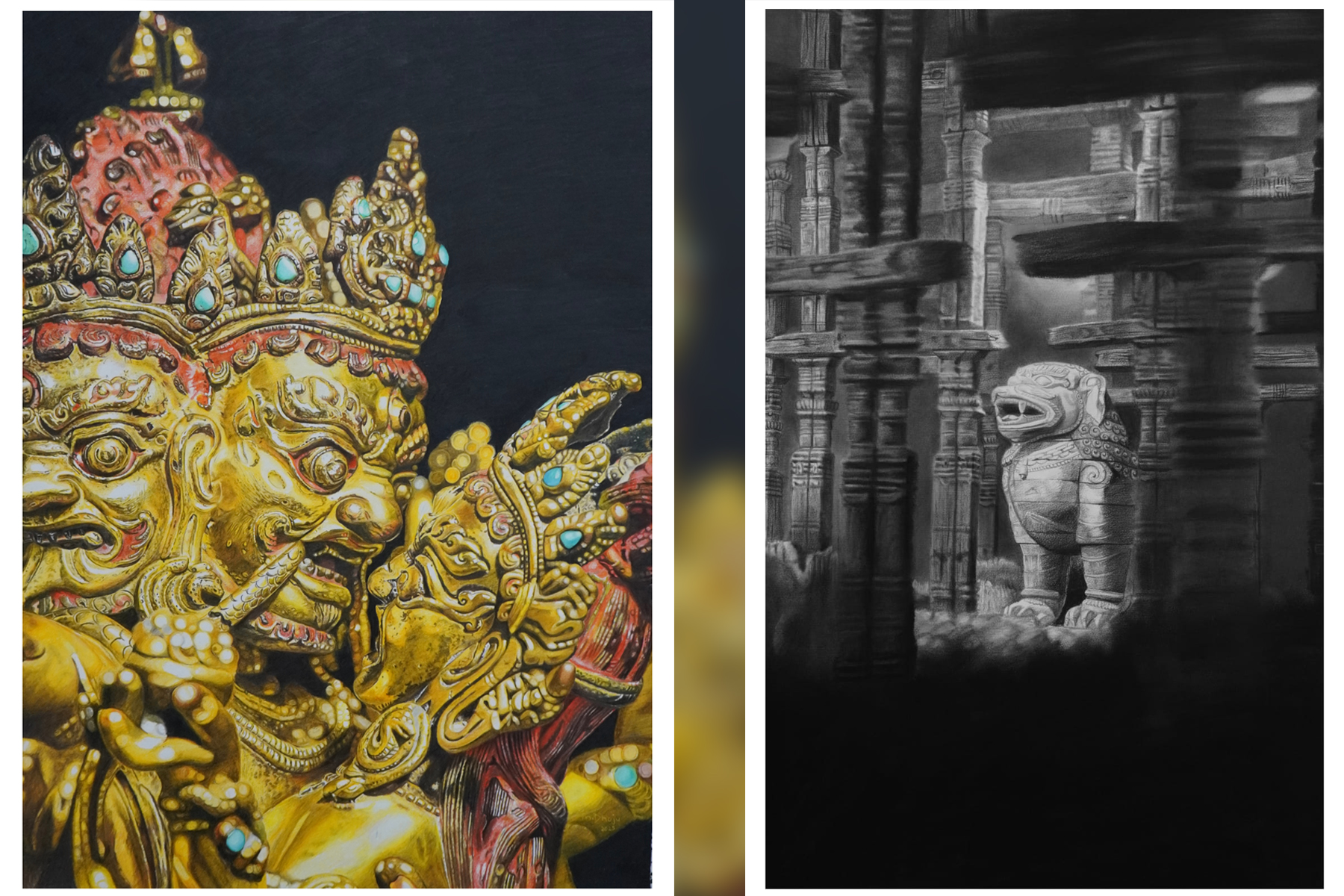
After his studies, he took a modest room at the Kathmandu Guest House-not as a traveler passing through, but as an artist in a quiet residence. Day after day, he could be found in the studio, immersed in his work with unshakable passion. His dedication did not go unnoticed-many admired the persistence in his craft, and collectors began to see his paintings as treasures worthy of gracing their homes. This artist is none other than Manish Dhoju, now presenting his latest collection, Divine Realms, at Takpa Gallery, Lazimpat. Through this exhibition, he seeks to explore the sacred essence of our world and the mysteries of realms beyond.
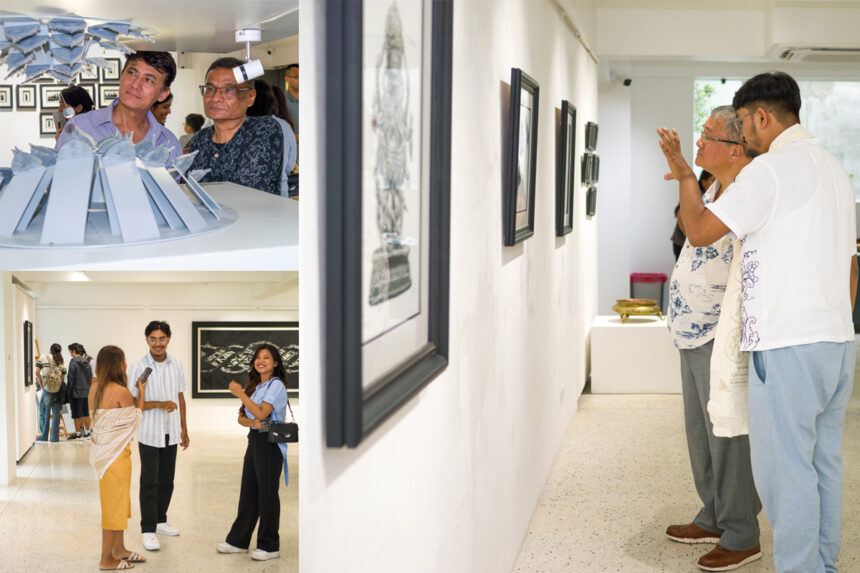
Upon stepping into the gallery, one is immediately embraced by the quiet power of Dhoju’s creations. Each painting on the wall holds the weight of day-perhaps monthss-of patient devotion. The care in every detail is almost tangible, as if the works themselves breathe in the stillness of the room.
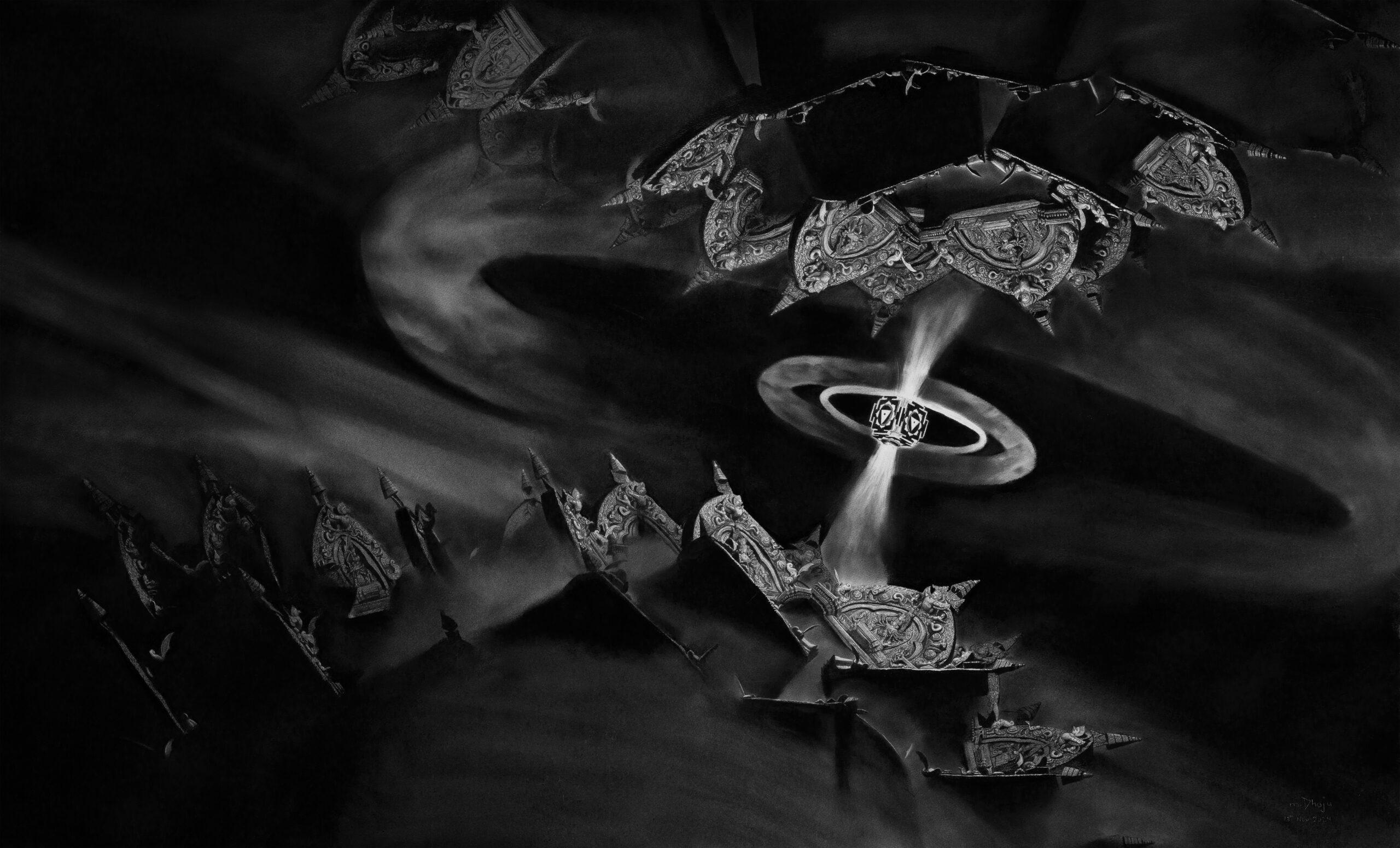
The first piece to greet visitors, on the left as they enter, is Shakti: A Genesis of Life. At its heart lies a radiant Shakti Yantra, from which a beam of light flows outward, wrapping the canvas in a glow that speaks of divine creation itself. The precision of its geometry and the softness of its radiance feel like a prayer captured in form.
Just a few steps further, another work waits to captivate-Nasa Dyo, an homage to the god of music. “In the Newar tradition,” Dhoju explains with a gentle smile, “when people begin learning a new musical instrument, they dedicate their learning to the divine. That is what I wanted to share with my audience.” The painting, alive with reverence, seems to carry the echo of ancient melodies.
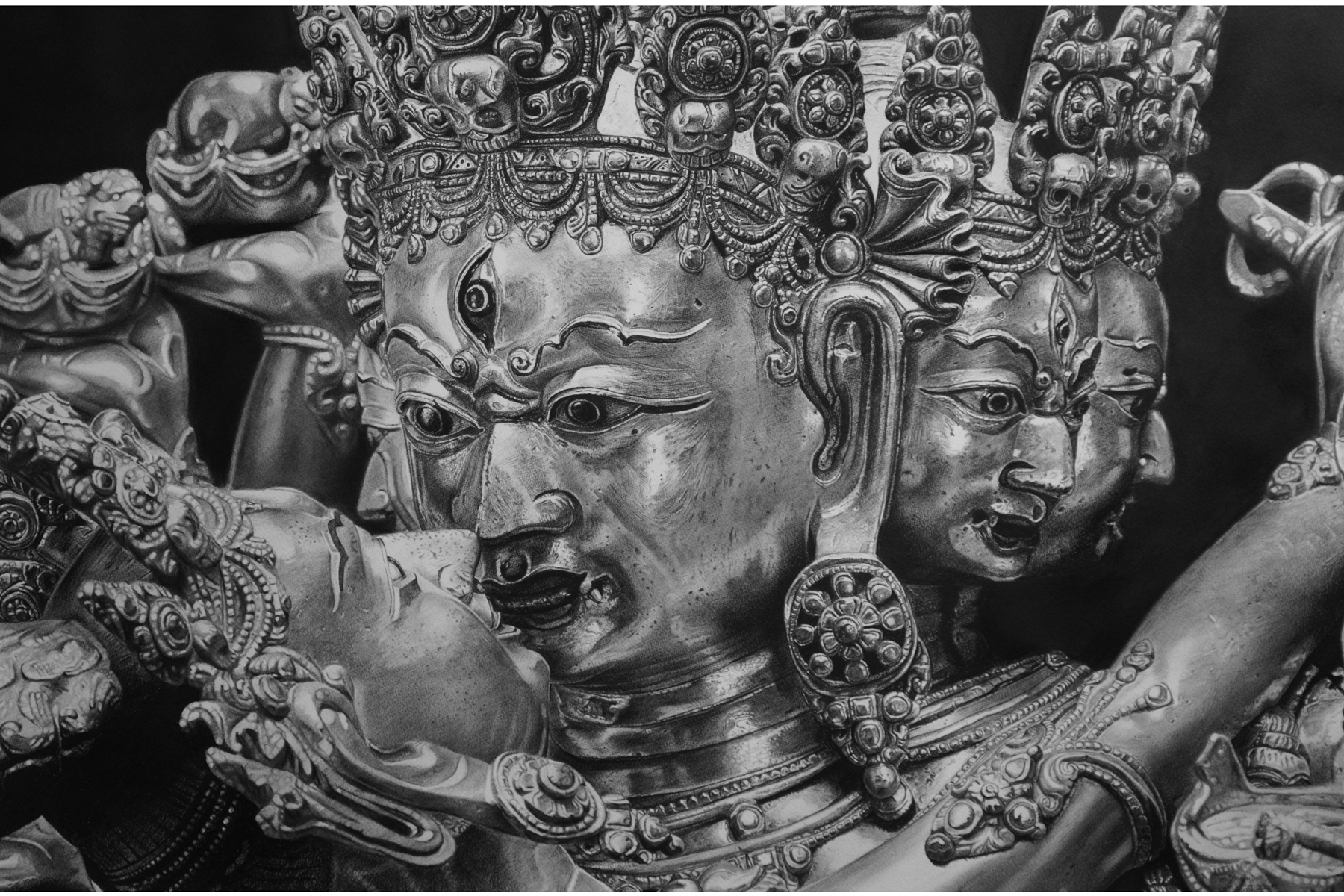
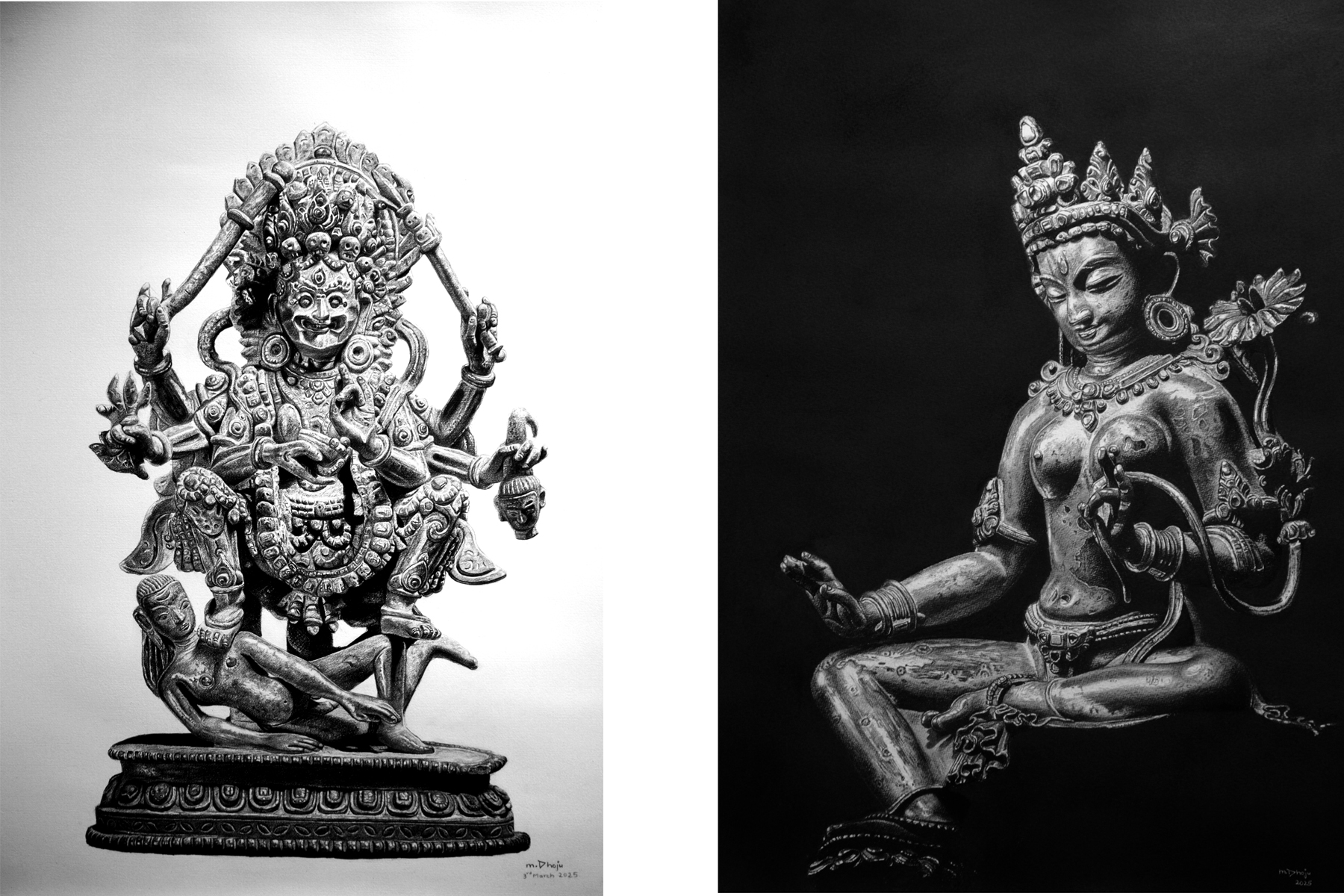
Equally striking are Kapaldhara and Mahavajra, both rendered entirely in charcoal. Their depth and detail are so profound that they seem almost alive, as if the sacred symbols might shift or breathe if you looked long enough. Such works reveal not only the artist’s skill but a rare kind of discipline-an ability to infuse stillness with life.
Another charcoal piece portrays a guardian lion at the entrance of a temple. “This image,” Dhoju recalls, “was from Bhaktapur Durbar Square a long time ago. That temple was destroyed during the earthquake and has never been rebuilt.” The lion stands as both a sentinel and a memory, guarding a space that now exists only in history and in art.
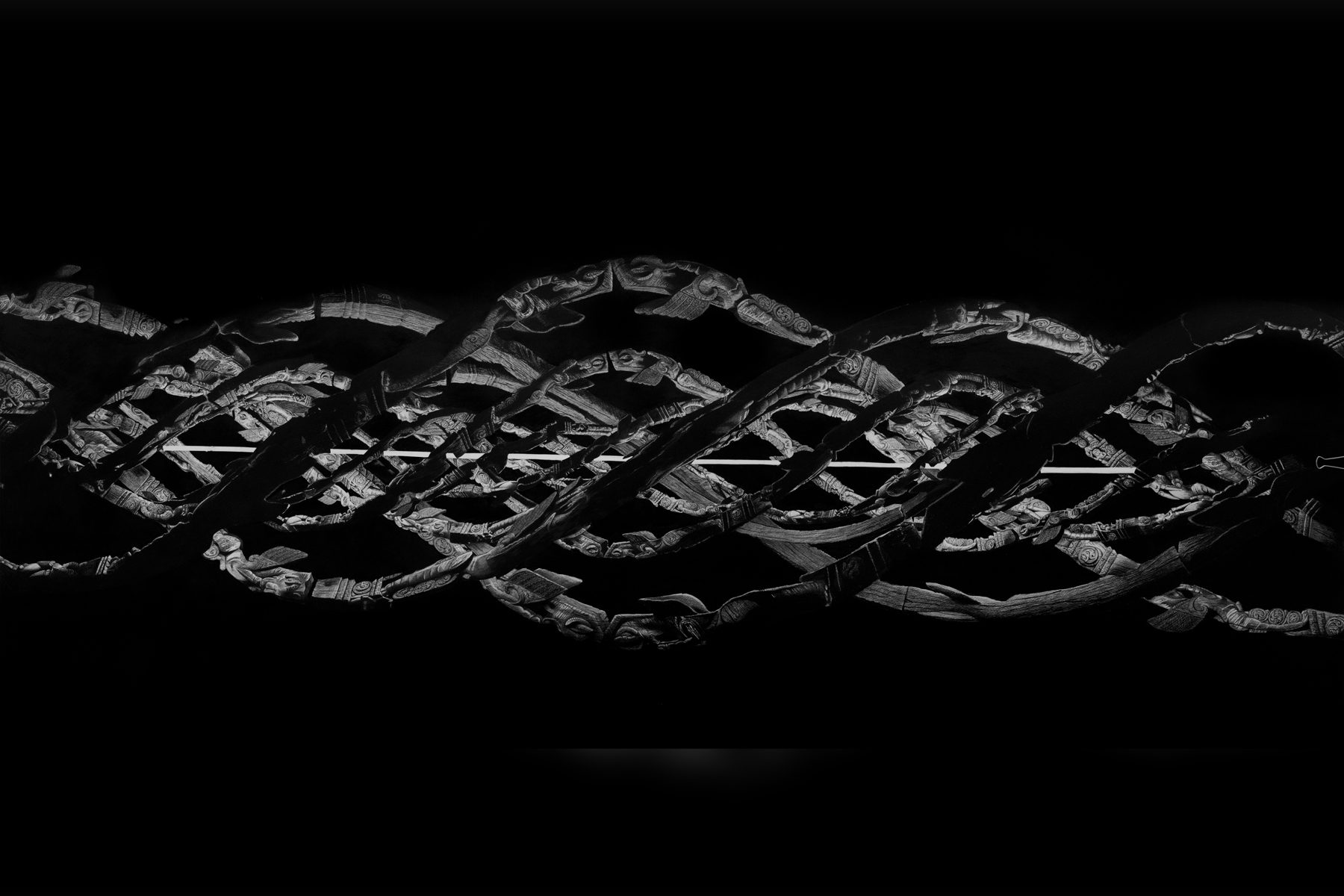
One of the most compelling works in the exhibition is The Endless Pursuit, inspired by the Shiva Purana. In it, Dhoju depicts the ancient tale: Vishnu and Brahma, in a dispute over their power, seek the truth from Lord Shiva. Shiva becomes a boundless beam of light-the Jyotirlinga-and challenges them to find its beginning and end. Vishnu, in the form of a boar, descends into the depths and returns humbled, unable to find its base. Brahma, transformed into a swan, claims falsely to have found its origin. Angered by the deceit, Shiva severs one of Brahma’s heads. “This story,” Dhoju reflects, “reminds us all of the value of humility.” The canvas, rich with symbolic light and shadow, makes the lesson linger.
The exhibition also showcases works in pencil, each revealing Dhoju’s meticulous approach. In response to the frequent question-“How many pencils have you used?”-he has framed a small display of worn-down pencils, their stubs and shavings quietly testifying to years of labor.
Throughout the room, art lovers move slowly from piece to piece, drawn in by the harmony of vision and craft. There is a quiet celebration in the air-a shared recognition of the extraordinary talent before them.
For those who find themselves near Lazimpat this month, Divine Realms at Takpa Gallery is not an experience to miss.
Exhibition Dates: August 2 – August 30, 2025
Closed on Mondays

Leave A Comment