


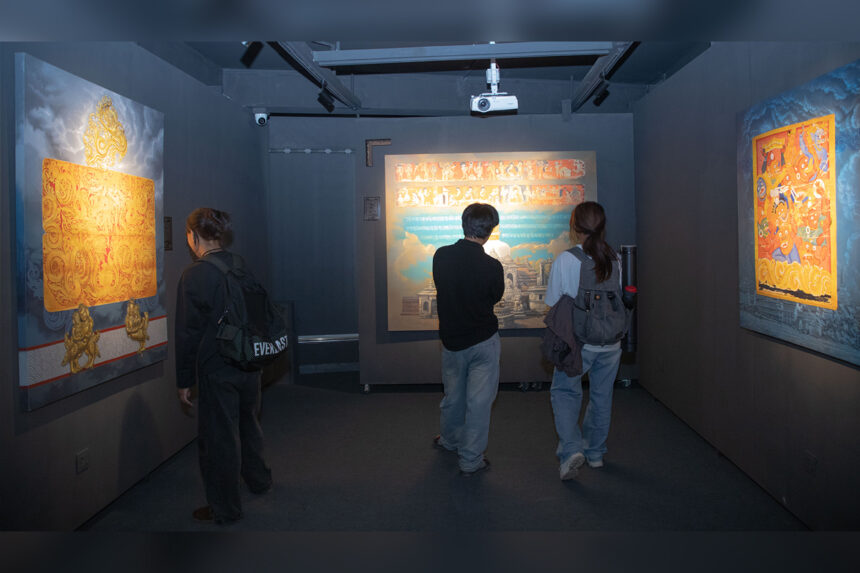
The quiet halls of 108 Gallery, Durbarmarg, have been transformed into a space of memory, devotion, and artistic contemplation through the solo exhibition of artist Krishna Gopal Shrestha, a distinguished lecturer at Srijana College of Fine Arts. Running from 12 June to 12 July, the exhibition unfolds as a visual dialogue between Nepal’s ancient cultural legacy and the sensibilities of contemporary art. Shrestha’s paintings are imbued with archetypal imagery, fragments of medieval manuscripts, and sculptural forms deeply rooted in the Kathmandu Valley’s rich religious and artistic traditions. His artistic language is marked by a harmonious interplay of the ancient and the modern, where historical motifs are not merely reproduced but re-imagined with a fresh and evocative sensibility.
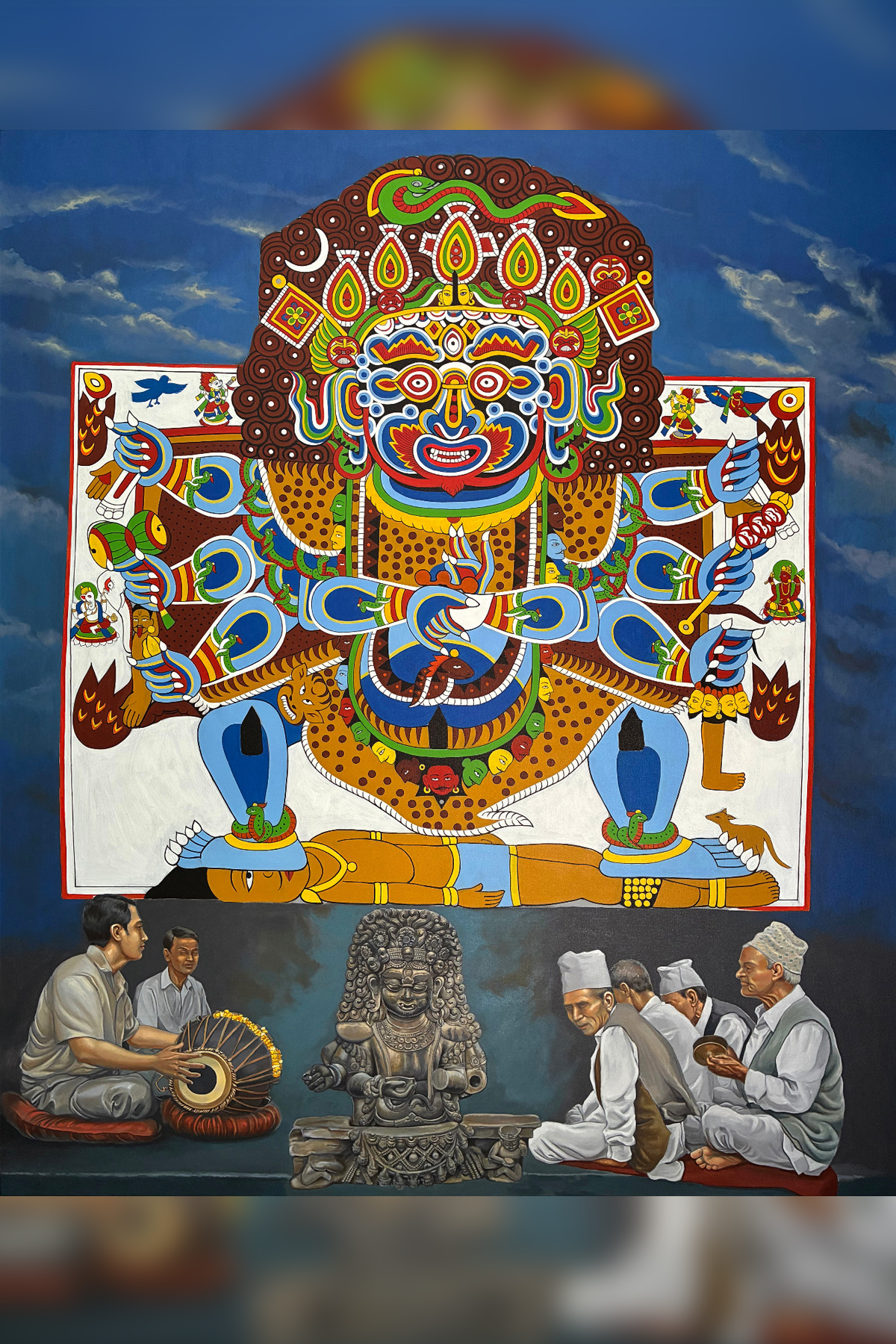
Among the most captivating works in the exhibition is his monumental painting of Masan Bhairav, an extraordinary composition that seamlessly merges Nepalese religious iconography, traditional mural aesthetics, and contemporary cultural narrative. The work draws inspiration from the celebrated mural of Masan Bhairav found in the Chandeshwari Temple of Banepa, yet the artist does not merely replicate the sacred image; he breathes into it a renewed vitality and emotional depth.
At the center of the canvas stands the formidable figure of Bhairav, revered as one of the fiercest manifestations of Lord Shiva. His visage radiates both awe and mystery, embodying divine wrath as well as cosmic protection. Below this imposing deity, a gathering of devotees is depicted immersed in devotional hymns. The rhythmic resonance of Newari musical instruments—the dhime, bhusya, and cymbals-seems almost audible as the musicians offer their songs in reverence. At the heart of this congregation rises a wooden sculpture of Bhairav, creating a fascinating dialogue between the painted and the sculpted, the earthly and the divine.
The composition is remarkable for the way it captures not only the sacred mural tradition but also the living cultural spirit of the Valley. During Newari religious festivals, such scenes of communal singing and devotion are ubiquitous, transforming courtyards and temple squares into vibrant arenas of faith and festivity. Shrestha immortalizes this atmosphere with remarkable sensitivity, allowing the viewer to feel the pulsating energy of ritual and the timeless continuity of tradition. It is this evocative quality that makes the painting particularly spectacular-a work that transcends representation and becomes an experience in itself.
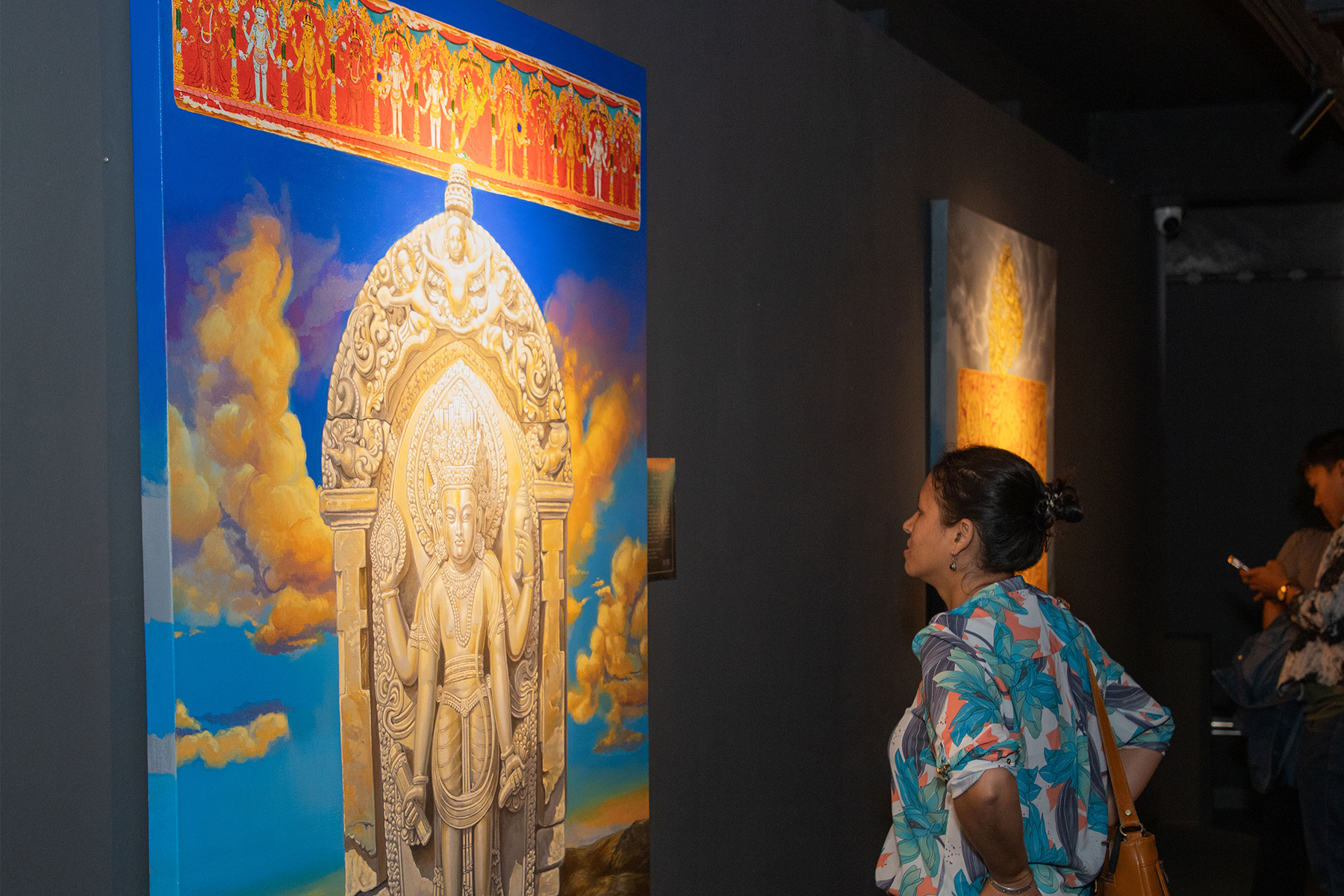
Equally fascinating is Shrestha’s painting of Narayan, a sublime meditation on Nepalese religious heritage and artistic continuity. In this work, the artist masterfully fuses the visual vocabulary of traditional manuscript painting with the grandeur of monumental stone sculpture. Occupying the center of the canvas is an exquisitely rendered four-armed deity, inspired by medieval Nepalese Hindu sculpture. The figure exudes serenity and majesty, standing gracefully within an intricately carved Torana-the ornamental arch adorned with celestial beings, mythical creatures, and luxuriant floral motifs that have long been hallmarks of Nepalese sacred art.
The upper half of the painting reveals another layer of cultural memory: the delicate presence of an ancient manuscript. Its inclusion enriches the composition, evoking the long and uninterrupted tradition of Nepalese illumination and sacred literature. The juxtaposition of manuscript imagery with sculptural grandeur creates a compelling visual rhythm, inviting viewers to contemplate the many forms through which devotion has been expressed across centuries.
The painting gains even greater significance when viewed through the lens of Newari religious tradition, in which twelve different manifestations of Narayan are worshipped throughout the year. This cyclical devotion, intimately woven into the social and spiritual life of the Valley, resonates profoundly within Shrestha’s work. His Narayan is therefore not simply a deity confined to stone or scripture; it is a living presence, carrying within it the echoes of festivals, prayers, and collective memory.
Through these remarkable paintings, Shrestha emerges as an artist who bridges epochs. He neither romanticizes the past nor abandons it in pursuit of modernity. Instead, he creates a fertile meeting ground where history converses with the present, where sacred traditions acquire new meanings, and where viewers are invited to rediscover the enduring beauty of Nepal’s artistic and spiritual heritage.
Kaliyadaman is yet another mesmerizing work that Shrestha has created for this exhibition, a painting that effortlessly transports the viewer into the mythical realm of Hindu cosmology. According to the artist, the work is inspired by an ancient palm-leaf manuscript illustrating the legendary episode of Lord Krishna subduing the venomous serpent Kaliya. Yet, rather than merely reproducing the ancient narrative, Shrestha reinterprets it with a poetic sensibility that bridges centuries of artistic tradition.
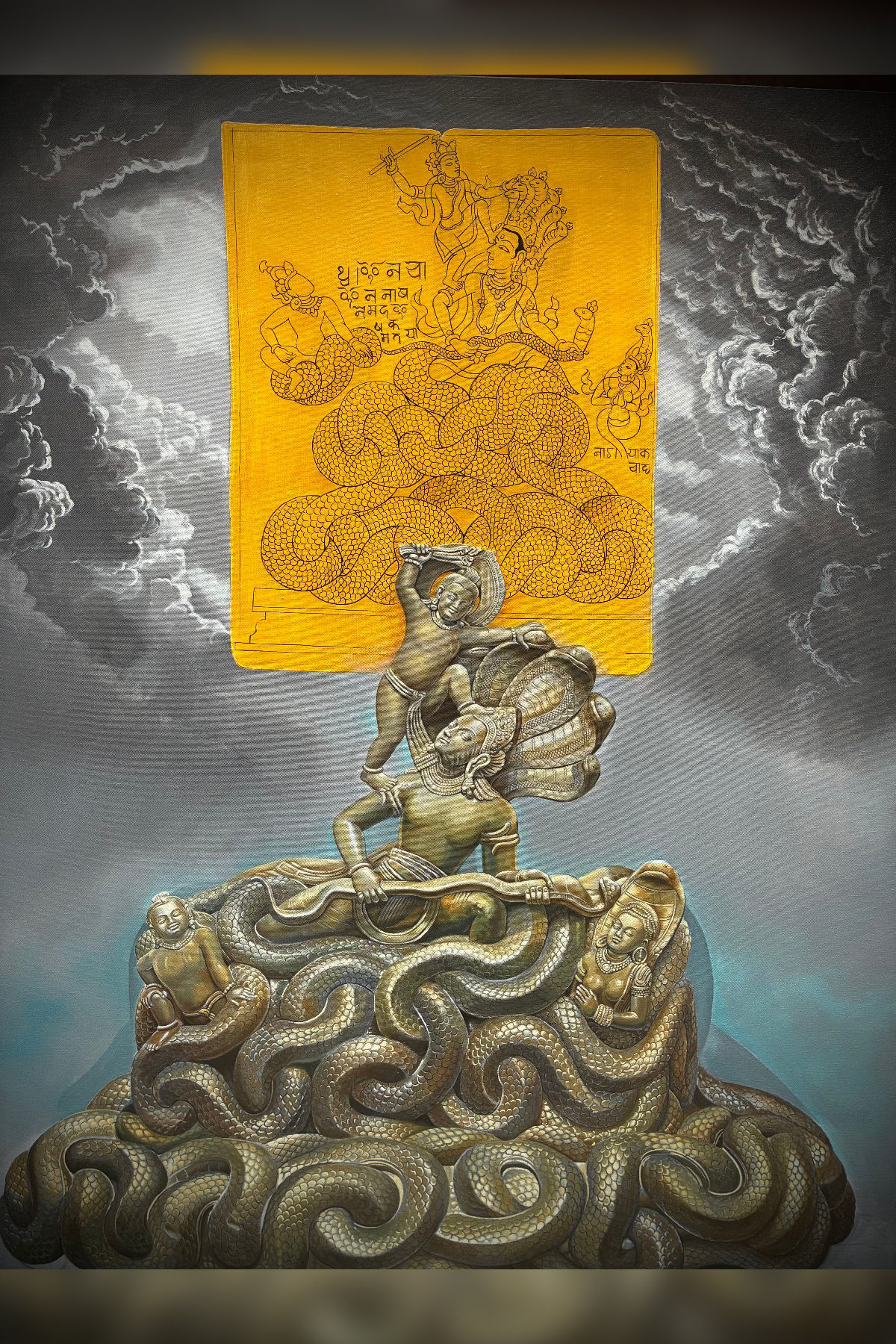
The upper section of the painting is dominated by an enlarged manuscript folio rendered in luminous golden-yellow hues. Delicate line drawings and flowing Nepal Bhasa scripts unfurl gracefully across its surface, evoking the fragile beauty and sacred aura of ancient manuscripts preserved through generations. Emerging from this textual landscape is the triumphant figure of Krishna, poised elegantly atop the many hoods of the serpent Kaliya. His posture exudes serenity rather than aggression, transforming the scene into an enduring symbol of the victory of divine wisdom over chaos, darkness, and evil. The swirling forms of the serpent and the rhythmic arrangement of the manuscript create a harmonious visual symphony where mythology, history, and spirituality converge.
Another compelling work in the exhibition is Indra, a painting that masterfully combines sacred iconography, sculptural traditions, and the historic cityscape of the Kathmandu Valley. The central figure is the Hindu god Indra, rendered in the refined elegance of the traditional Paubha style. Seated majestically upon his celestial elephant, the deity radiates an aura of divine authority and benevolence. He is adorned with intricate jewelry, flowing garments, and a resplendent halo whose luminous glow symbolizes wisdom, compassion, and spiritual power.
The artist’s meticulous attention to detail is evident in the ornate floral borders and the vibrant crimson backdrop, both of which are hallmarks of classical Newari religious art. Yet the work is not confined to the conventions of tradition. In the background, soft drifting clouds dissolve into distant mountain ranges, creating a dreamlike atmosphere where heaven and earth seem to coexist in perfect harmony. The cityscape of the Valley quietly emerges beneath this celestial expanse, grounding the divine within the familiar landscape of Nepal and reminding viewers of the intimate relationship between faith, place, and everyday life.
Equally fascinating is Pancharaksha, a work inspired by the historic city of Patan and its immeasurable spiritual wealth. In this painting, Shrestha weaves together spiritual heritage, architectural grandeur, and traditional artistic expression into a contemporary visual tapestry that is at once meditative and celebratory.
The upper register of the composition is adorned with exquisitely carved wooden struts and a manuscript painting that features a serene image of the Buddha seated in meditation, flanked by two attendant figures. Warm shades of orange, vermilion, and gold illuminate the sacred imagery, creating a striking contrast against the tranquil blue sky that surrounds them. The composition evokes not only the physical beauty of Patan’s temples and monasteries but also the enduring spiritual atmosphere that permeates the city.
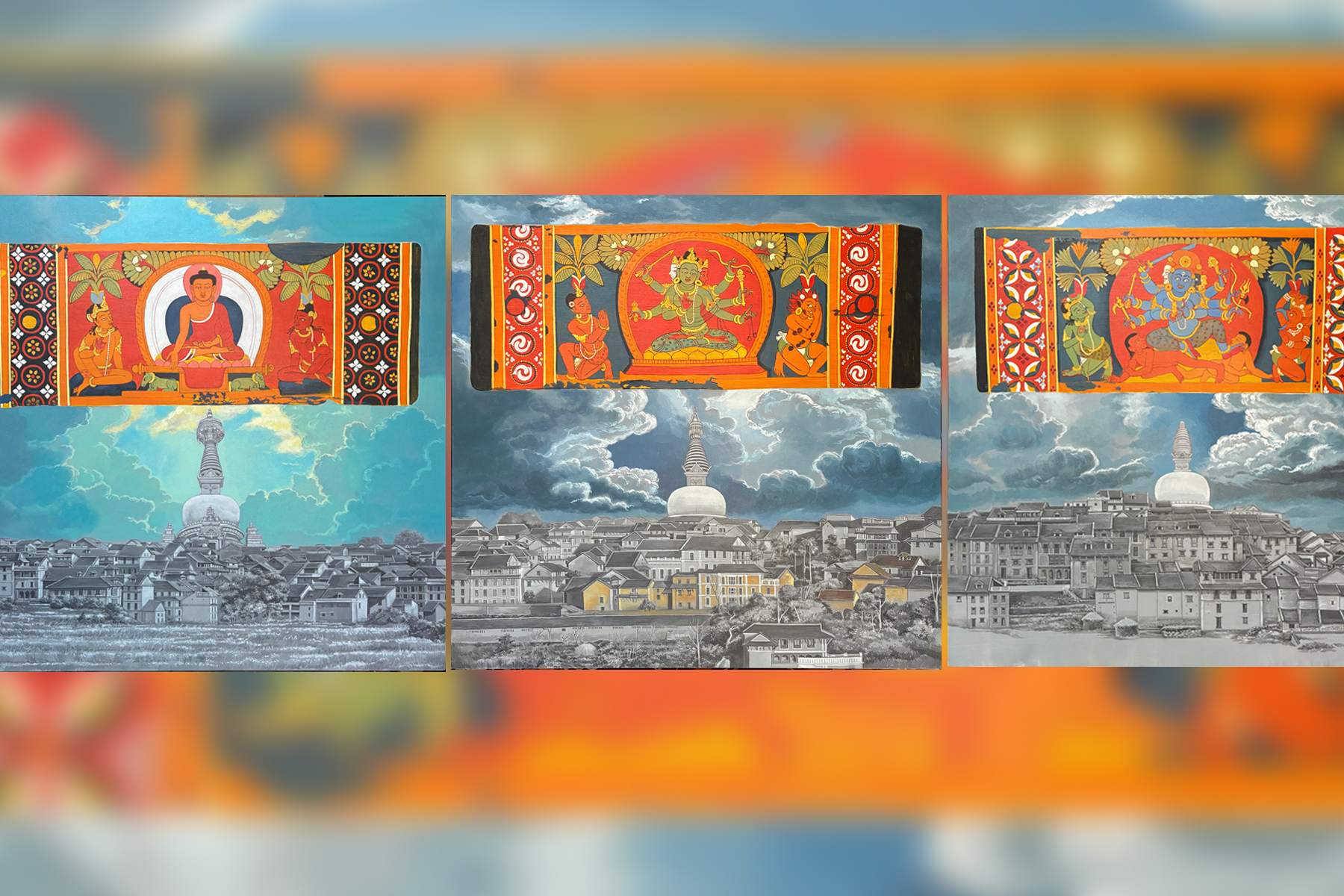
The manuscript image itself is profoundly captivating. The Buddha, rendered in radiant yellow, is draped in a flowing crimson robe and seated upon a delicate mauve lotus throne upheld by two graceful green horses. Behind him rests a deep blue cushion, while his aureole glows in white and yellow, streaked with fiery red flames that signify enlightenment and spiritual radiance. His right hand extends outward in the gesture of charity and compassion, while his left hand rests gently upon his lap in serene contemplation.
On either side of the Buddha sit two crowned and richly adorned male figures. Relaxed in posture and seated upon ornate cushions, they appear absorbed in a sacred discourse. One is painted in luminous yellow and the other in deep red, their contrasting colors enriching the harmony of the composition. The presence of the Buddha within a Pancharaksha manuscript is deeply significant, for according to tradition, it was he who first recited the five sacred charms or protective spells that constitute the revered text. Shrestha’s inclusion of this imagery therefore serves not only as an artistic homage but also as a reaffirmation of Nepal’s living spiritual heritage.
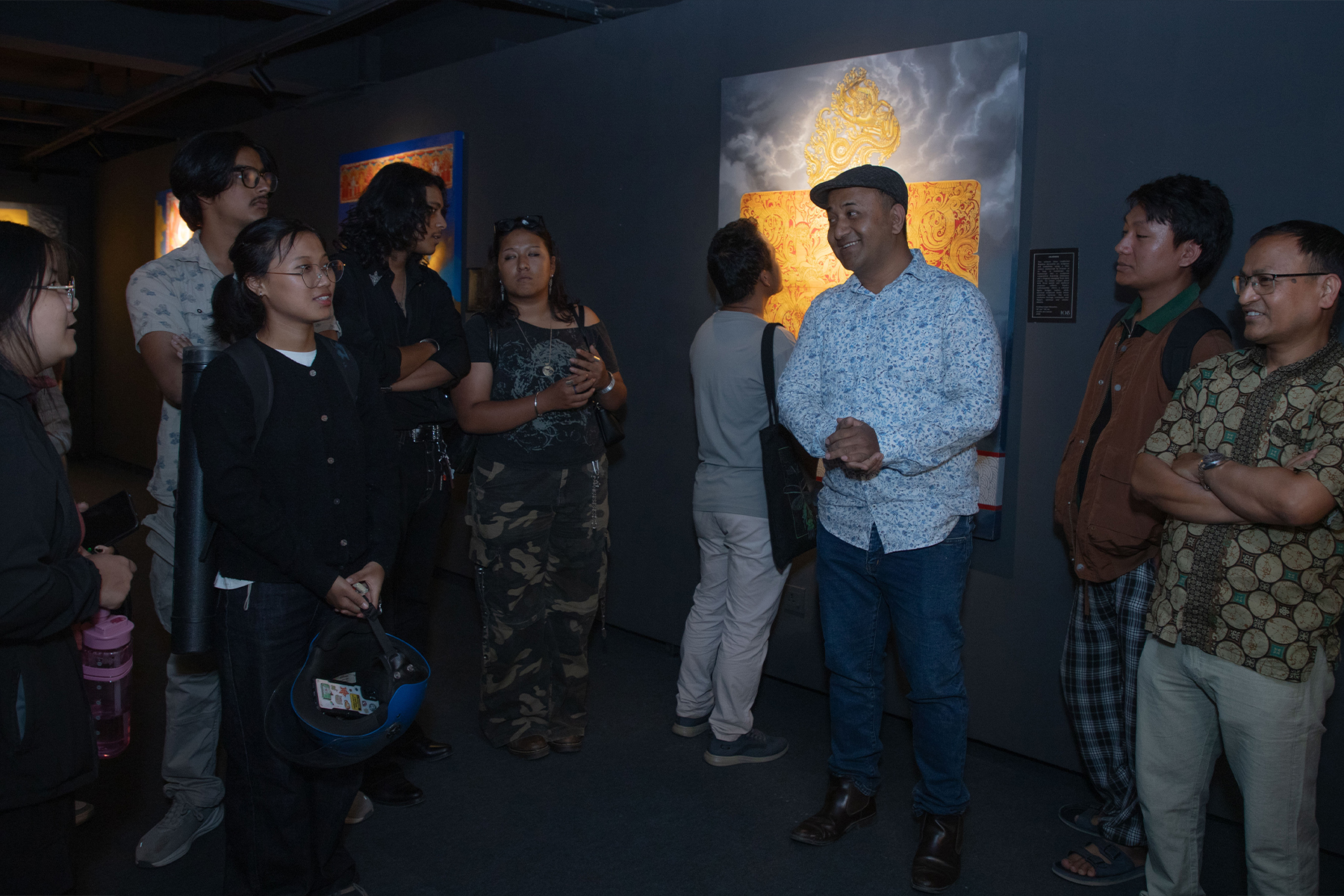
Among the visitors to the exhibition, Shreejan Rajbhandari spoke with particular admiration about the artist’s oeuvre. “I have known Krishna Gopal Shrestha’s artworks for a long time,” he remarked. “Since he also worked as an illustrator, one can clearly perceive the extraordinary finesse in his drawings. His mastery over color palettes and compositional balance is remarkable. More importantly, his paintings compel us to pause, reflect, and rediscover the richness of our own cultural heritage.”
Indeed, Shrestha’s paintings do far more than depict myths, manuscripts, or monuments. They awaken dormant memories, revive sacred narratives, and invite viewers into a timeless world where art becomes a bridge between the past and the present, the earthly and the divine.
Certainly. Here is a more lyrical, evocative, and richly descriptive version of your text that aims to enchant the readers while preserving the historical and artistic essence of the artworks.
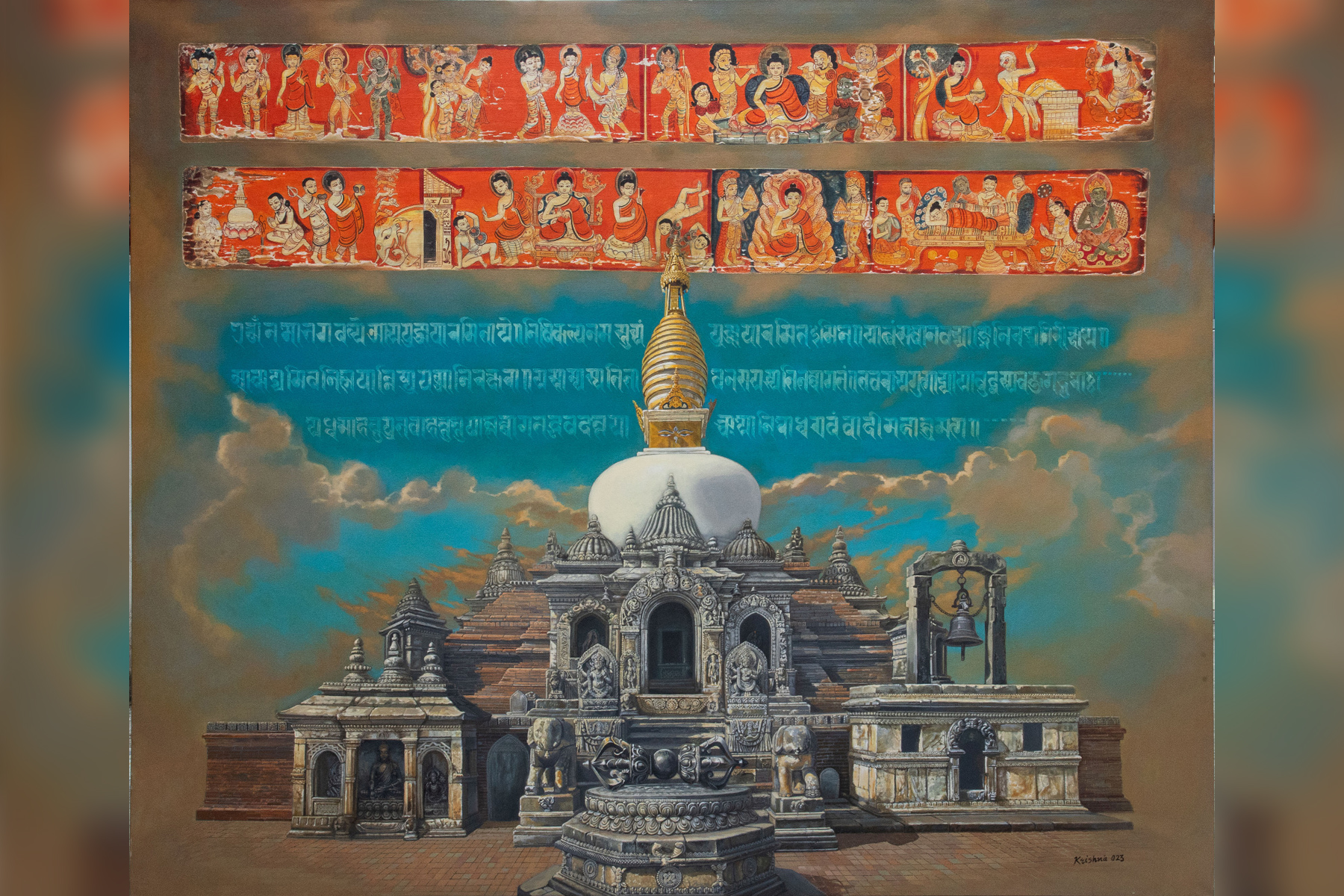
Chilancho Bihar of Kirtipur is yet another enchanting masterpiece that Krishna Gopal Shrestha has lovingly woven into this exhibition-a work that resonates with the sacred whispers of history, devotion, and artistic grandeur. It is a luminous confluence of Nepalese religious heritage, architectural magnificence, and Buddhist narrative art, where every stroke appears to breathe with the spirit of centuries past.
At the heart of the composition stands the revered Chilancho Stupa, one of Nepal’s most venerated Buddhist monuments. Rising majestically from the canvas, the stupa exudes an aura of serenity and timelessness, its white dome and golden pinnacle glowing as if touched by celestial light. Beneath it unfolds an exquisitely rendered temple-like structure, depicted with remarkable architectural precision. Every cornice, every carved window, and every layered roof-line speaks of the artist’s deep reverence for the sacred monument and the cultural landscape that surrounds it. The painting thus becomes not merely an image of a place but a visual hymn dedicated to Kirtipur’s spiritual soul.
Hovering above the monument are two horizontal narrative panels that shimmer like pages torn from an ancient illuminated manuscript. Executed in vibrant hues of crimson, gold, and saffron, these panels recount the sacred journey of the Buddha-from his miraculous birth and profound enlightenment to his compassionate teachings and ultimate Mahaparinirvana, the great passing into eternal peace. The figures, rendered in the traditional style of Buddhist manuscript painting, possess a rhythmic grace that transforms each scene into a living tale. They are not static images but sacred stories unfolding before the viewer’s eyes, inviting contemplation and wonder.
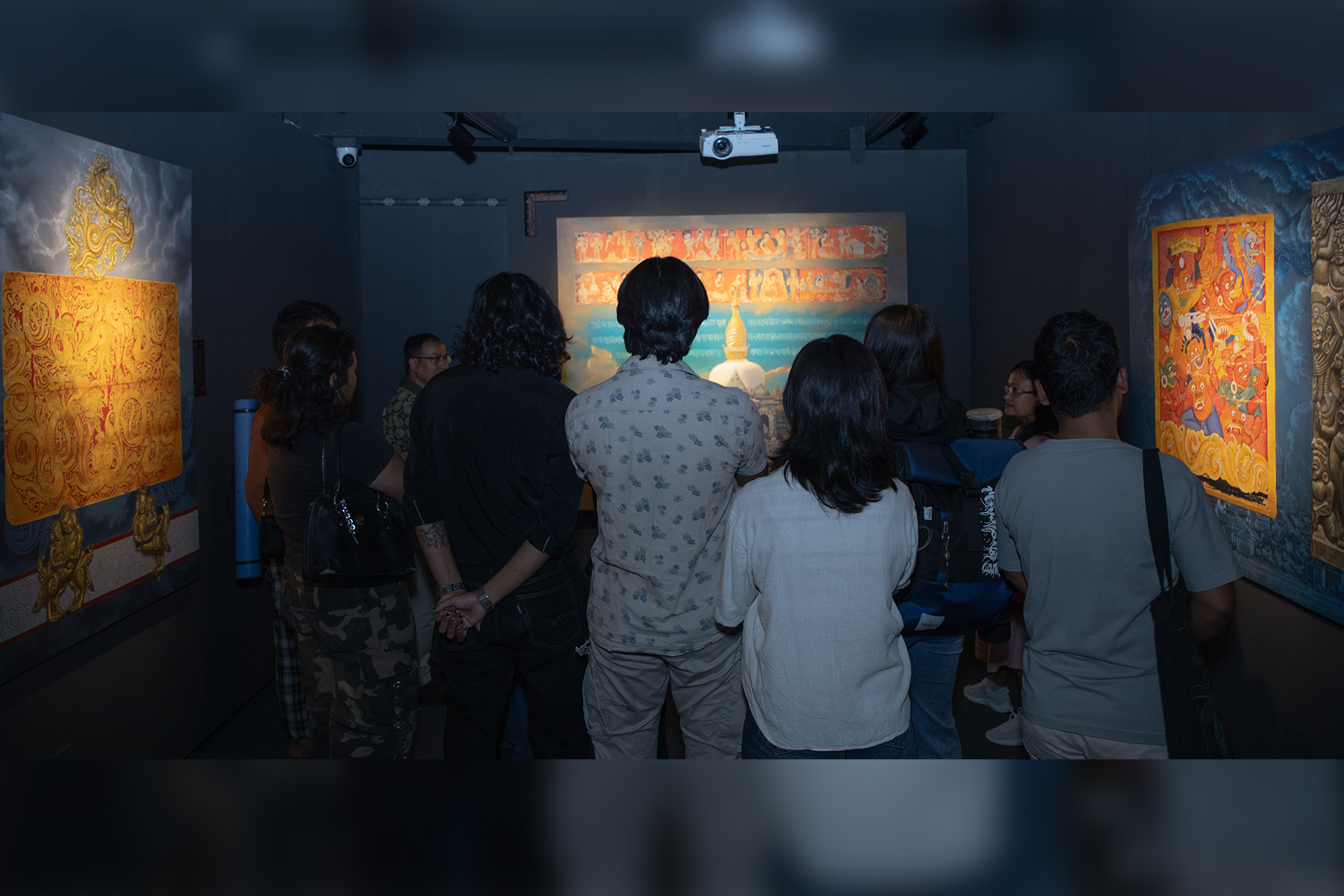
The upper reaches of the canvas dissolve into a realm of luminous skies and swirling clouds, amidst which sacred scripts drift like prayers carried by the wind. These floating syllables become symbols of divine wisdom, embodying the eternal transmission of Buddhist teachings from one generation to another. The contrast between this ethereal expanse and the earthly monument below creates a profound dialogue between the spiritual and the material worlds. Heaven and earth, memory and presence, transcendence and devotion-everything converges into a single, breathtaking vision.
Among the many admirers gathered at the gallery, visitor Ramesh Rai expressed his heartfelt appreciation for the artist’s work. “The paintings in this gallery embody the richness of our culture,” he remarked. “The way the artist has brought together ancient manuscripts, sacred sculptures, and contemporary artistic sensibilities onto his canvases is truly inspiring. Each painting feels like an invitation to rediscover who we are and where we come from.”
Equally captivating is Jalamanas, a painting that unfolds like a jewel box of Nepalese artistic imagination. Rich in symbolism and ornamentation, the work is a sophisticated fusion of traditional decorative art, sculpture, mythology, and cultural memory.
At the center of the composition, Shrestha undertakes an extraordinary artistic endeavor: he imaginatively reconstructs and completes the unfinished drawing of Jalamanas attributed to the fifteenth-century Nepalese master artist Jivaram. Through this creative act, the artist bridges a gap of centuries, allowing an incomplete fragment of history to blossom into a fully realized visual experience. The figure of Jalamanas emerges with regal grace, embodying both historical authenticity and artistic invention.
Above this central image, against a velvety black background that seems to stretch into infinity, rises the enigmatic figure of the Nagaraj-the Serpent King. Majestic and mysterious, the serpent deity watches over the composition with an air of sacred guardianship. Around him unfurl an abundance of mythical creatures, curling floral scrolls, and intricate decorative motifs that dance across the canvas like fragments of an ancient dream. Every detail is imbued with the elegance of Nepalese craftsmanship, echoing the refined sensibilities and spiritual values deeply embedded within the nation’s artistic traditions.
Jalamanas is more than a painting; it is an ode to the artisans of the past, a celebration of their ingenuity, and a reminder that true artistry transcends the boundaries of time.
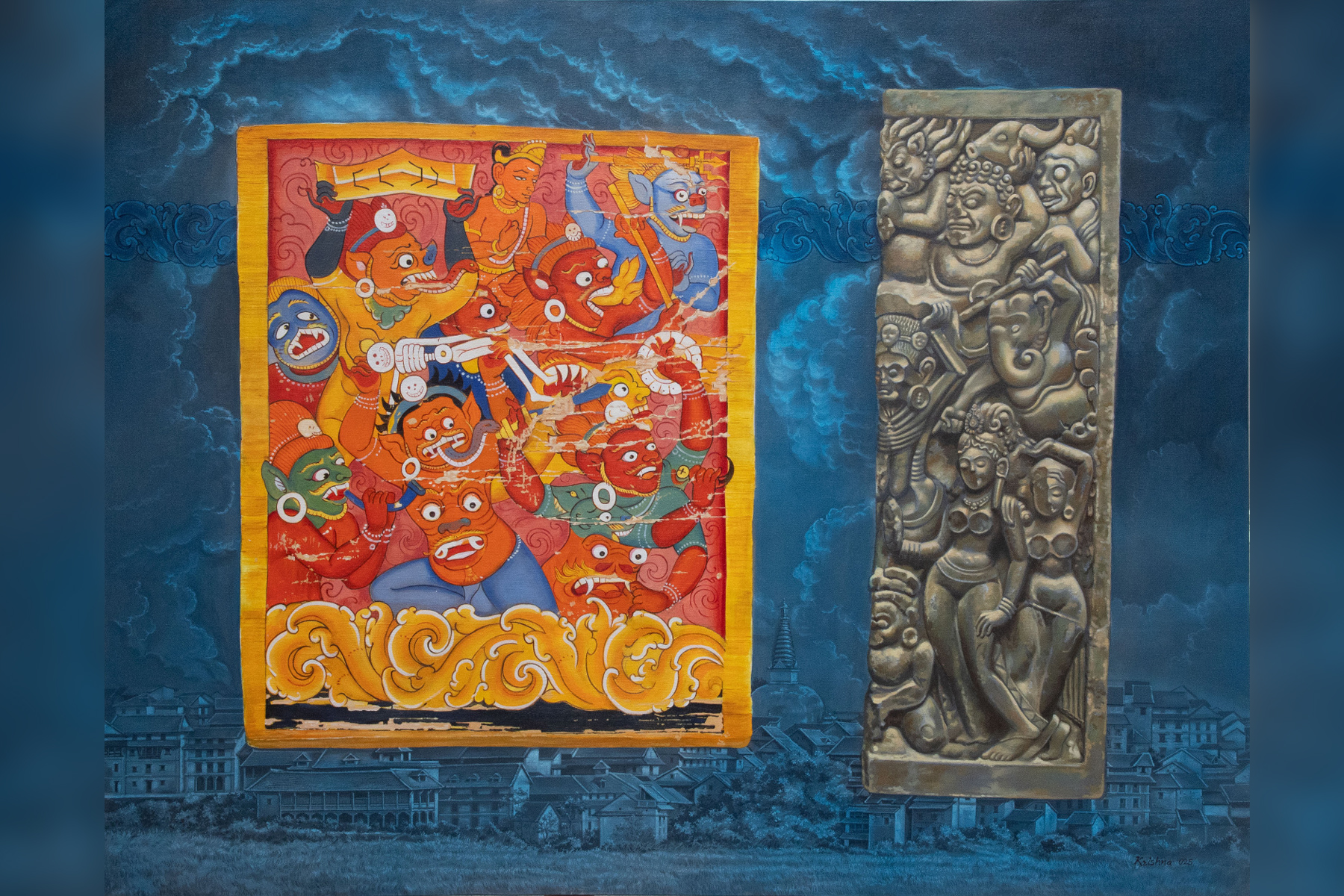
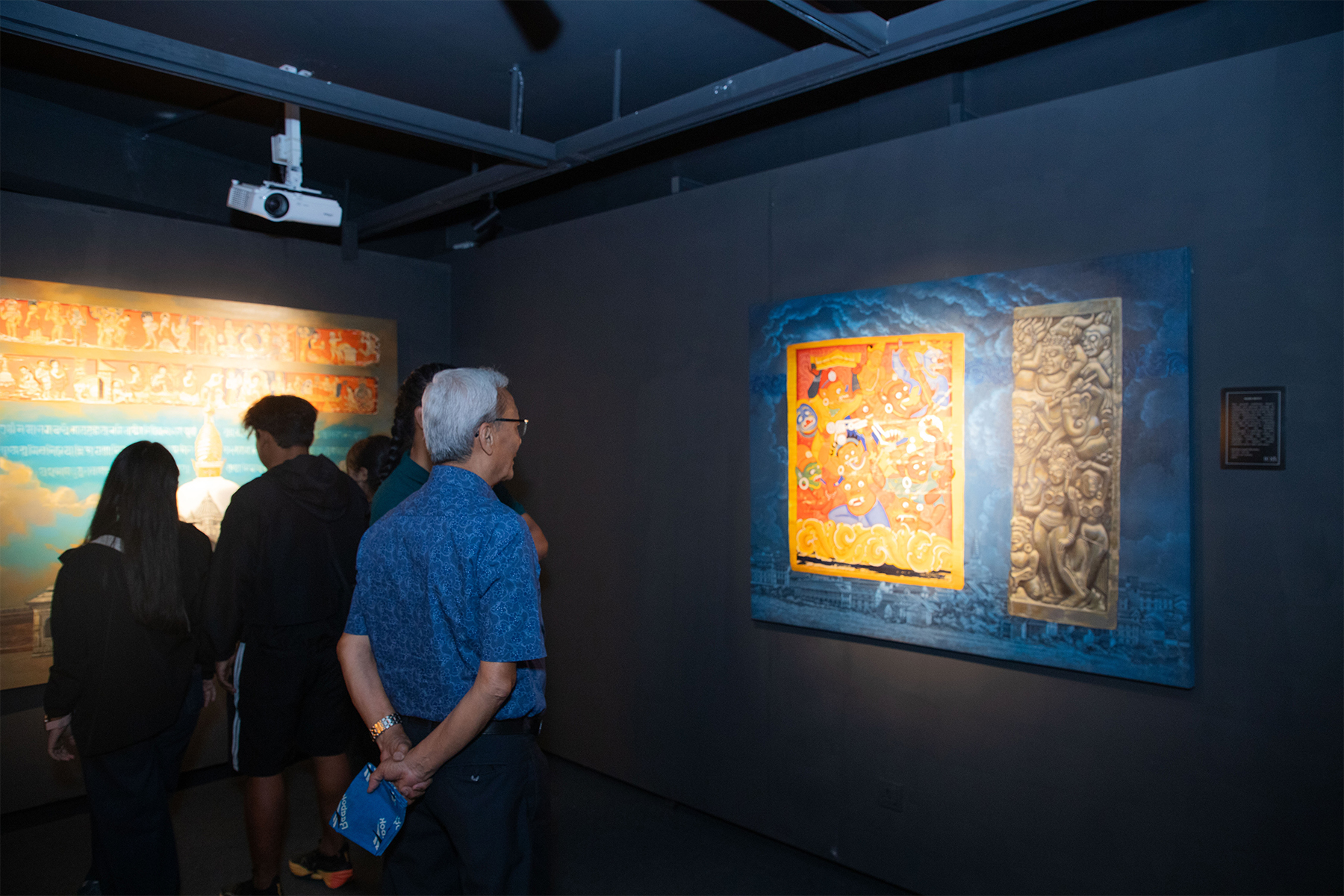
Another monumental work in the exhibition is Maara Bijaya, a painting of remarkable depth and spiritual intensity. Here, Shrestha orchestrates a compelling dialogue between manuscript painting and stone sculpture, uniting two of Nepal’s most cherished artistic traditions within a single visual field.
The left side of the composition bursts forth in radiant color, presenting a manuscript-style tableau populated by wrathful and protective deities. Their expressive faces blaze with fierce determination, their dynamic postures radiate energy, and their vibrant garments shimmer in hues of red, blue, gold, and emerald. They are embodiments of divine power—guardians who shield the faithful and symbolize the eternal triumph of wisdom over ignorance, light over darkness, and compassion over fear.
In striking contrast, the right side reveals an intricately carved stone relief inspired by Nepal’s medieval temple sculpture tradition. Rendered in subdued monochromatic tones, the relief possesses an almost tactile quality, allowing viewers to sense the weight and permanence of stone. The delicate carvings and iconographic details bear witness to the extraordinary craftsmanship of Nepalese artisans, whose devotion transformed inert matter into sacred forms imbued with spiritual vitality.
Enveloping these contrasting worlds is a dramatic backdrop of deep indigo skies, swirling clouds, and the faint silhouette of an ancient cityscape. The atmosphere is mystical and dreamlike, as though the sacred figures exist within a nominal realm where time dissolves and the spiritual and physical worlds coexist in perfect harmony.
By placing painting beside sculpture, color beside monochrome, and movement beside stillness, Shrestha creates a profound visual conversation that celebrates the continuity of Nepalese traditions across centuries. The contrasts are striking, yet beneath them lies an undeniable unity-a shared devotion to beauty, spirituality, and cultural memory.
Ultimately, *Maara Bijaya* stands as a powerful testament to the enduring vitality of sacred art. It reminds us that artistic traditions are not relics confined to museums or manuscripts; they are living guardians of faith, history, and identity. Through this masterful work, Krishna Gopal Shrestha reaffirms that Nepal’s artistic heritage continues to illuminate the present with the wisdom and splendor of the past.

Leave A Comment