

In the turbulent landscape of Nepal during the 1990s, artist Binod Shrestha bore witness to scenes of political unrest and violence—images that did not simply fade with time, but settled into the deeper architecture of memory like a sediment of history. These fragments of lived experience gradually transformed into a visual language of reflection, resistance, and emotional inquiry, where trauma and memory coexist in quiet tension.
Yet the political landscape that shaped his vision was neither singular nor confined to one moment in history. Beyond the democratic upheavals of the 1990s, Nepal continued to move through shifting cycles of conflict, transformation, and fragile peace. The Maoist insurgency introduced another profound layer of political violence and social disruption, reshaping everyday life, identity, and collective consciousness across the country. Even in the years that followed, the nation has continued to oscillate between moments of aspiration and rupture-through movements, protests, and the evolving voice of younger generations, including the rising energy of Gen-Z political expression.
Within this continuum of change, Shrestha’s work emerges not as a distant commentary but as an embodied witnessing. His visual language carries the weight of decades-of witnessing, remembering, and translating lived histories into form. It is this long arc of political and emotional memory that gives his current exhibition a heightened urgency.
At present, the relevance of his practice feels particularly resonant. In a contemporary Nepali art landscape where few artists have deeply engaged with prolonged narratives of political violence, memory, and historical continuity, Shrestha’s work stands as a rare and necessary intervention. It opens a space where art becomes both archive and inquiry-where the past is not concluded, but continuously re-entered through form, gesture, and silence.
Rather than offering resolution, his works ask the viewer to dwell within complexity: to recognize that history is not a closed chapter, but an unfolding presence that continues to shape how we see, remember, and imagine the present.
For Shrestha, art becomes not an escape, but a return-to memory, to history, and to the silent residues of witnessing. Over the years, his practice has unfolded as a continuous attempt to articulate what cannot be easily spoken: the lingering presence of violence, both personal and collective, across geographies and generations. Even after more than a decade away from Nepal, the distance has not diminished these impressions; instead, it has transformed them into layered artistic expressions shaped by time, displacement, and observation.
“When I look at Nepal today, the changes feel immense,” he reflects during a conversation with the Khojpatra team. “People have begun to celebrate their cultures more deeply than before.” This observation, subtle yet profound, echoes within his evolving artistic language-one that listens closely to transformation while holding space for memory.
For Shrestha, the act of making art is inseparable from the act of remembering. And perhaps, more importantly, from the act of processing. In this ongoing dialogue between past and present, silence becomes form, and memory becomes material.
Silent Bone: A Multi-Sited Encounter
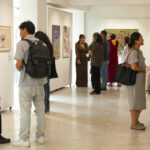
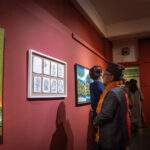
This month in Kathmandu, visual artist and educator Binod Shrestha presents Silent Bone, an expansive multi-site art project unfolding across several cultural spaces in the city. Rather than existing within the boundaries of a single gallery, the project disperses itself-like memory itself-across multiple venues, each carrying a distinct yet interconnected fragment of the larger narrative.
Bringing together sculpture, drawing, installation, performance, video, and site-responsive works, Silent Bone resists linear storytelling. Instead, it constructs an open field of experience-where meaning is not declared, but encountered.
Rooted in an exploration of memory, language, the body, and the quiet aftermath of violence, the project does not offer closure. It does not resolve. Instead, it lingers in uncertainty, inviting viewers to inhabit spaces of ambiguity and reflection.
Some works appear as material objects-tangible, grounded, present. Others emerge as gestures, fleeting and performative. Still others exist as absence itself: pauses, silences, and spatial voids that speak as powerfully as form. Visitors are encouraged to move between locations, assembling their own pathways through the work, or to engage with each site independently as a complete experience in itself.
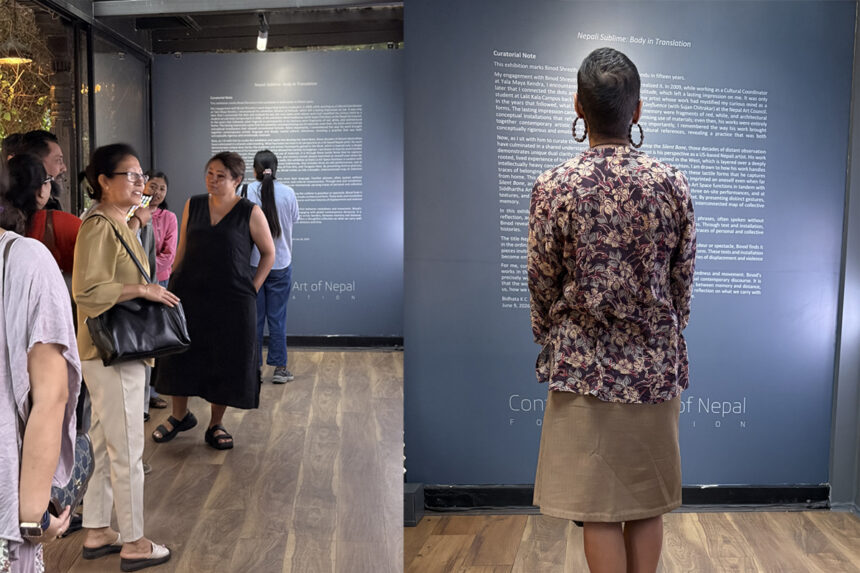
“My engagement with Binod’s practice began more than two decades ago when, as an art student, I encountered his conceptual installations that left a lasting impression on me. Curating Nepali Sublime: Body in Translation after his fifteen-year return, I am continually fascinated by his ability to merge Western academic perspectives with his deeply rooted experiences of Nepal. In dialogue with Silent Bone at Dalai La Art Space, his works transform ordinary Nepali forms and materials into powerful symbols of resilience and endurance. Through these tactile and evocative works, I see how the trauma of displacement, violence, and collective memory remains profoundly embedded within our bodies,” states the curator Bidhata KC regarding her impression and the artworks of Binod Shrestha.
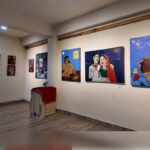
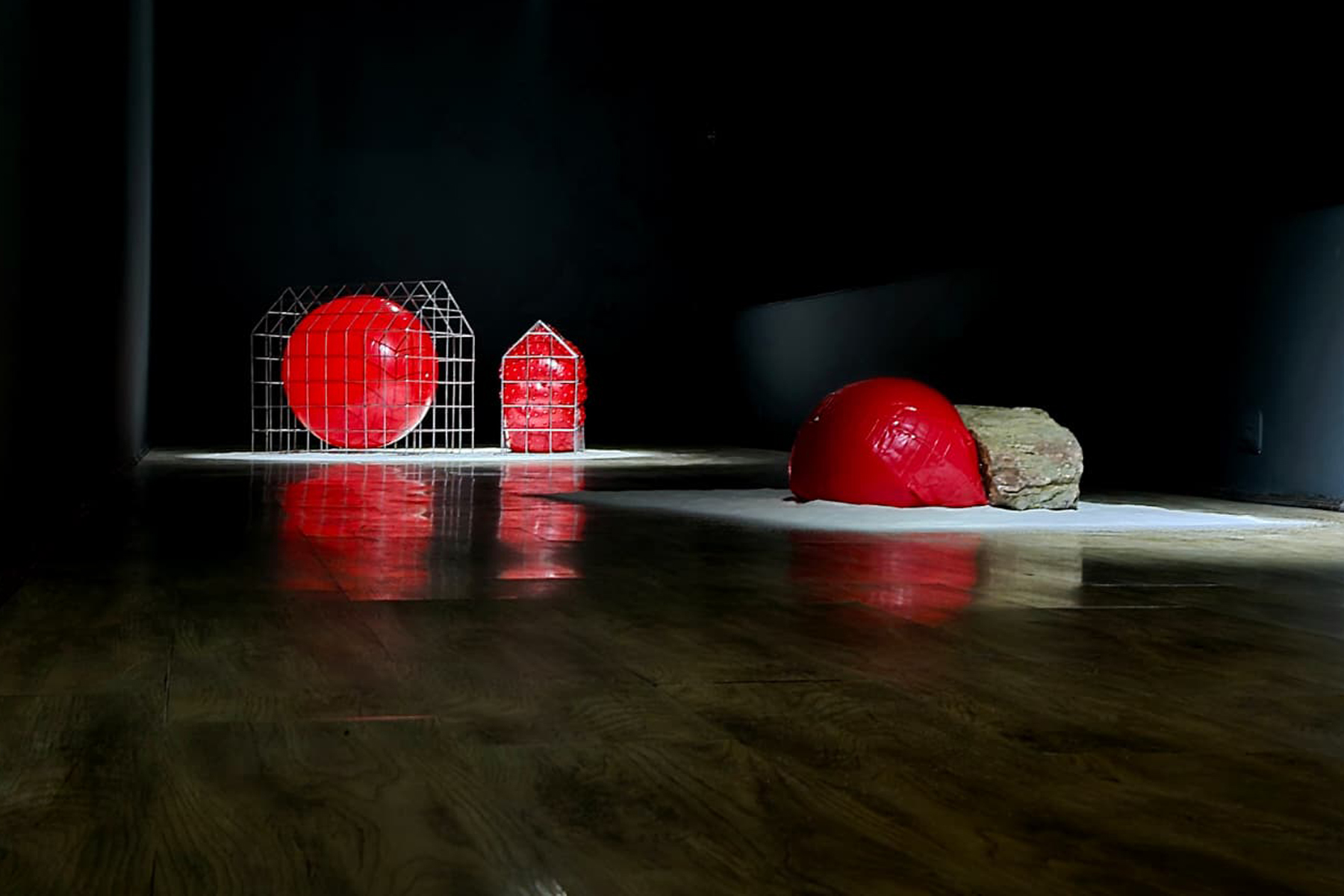
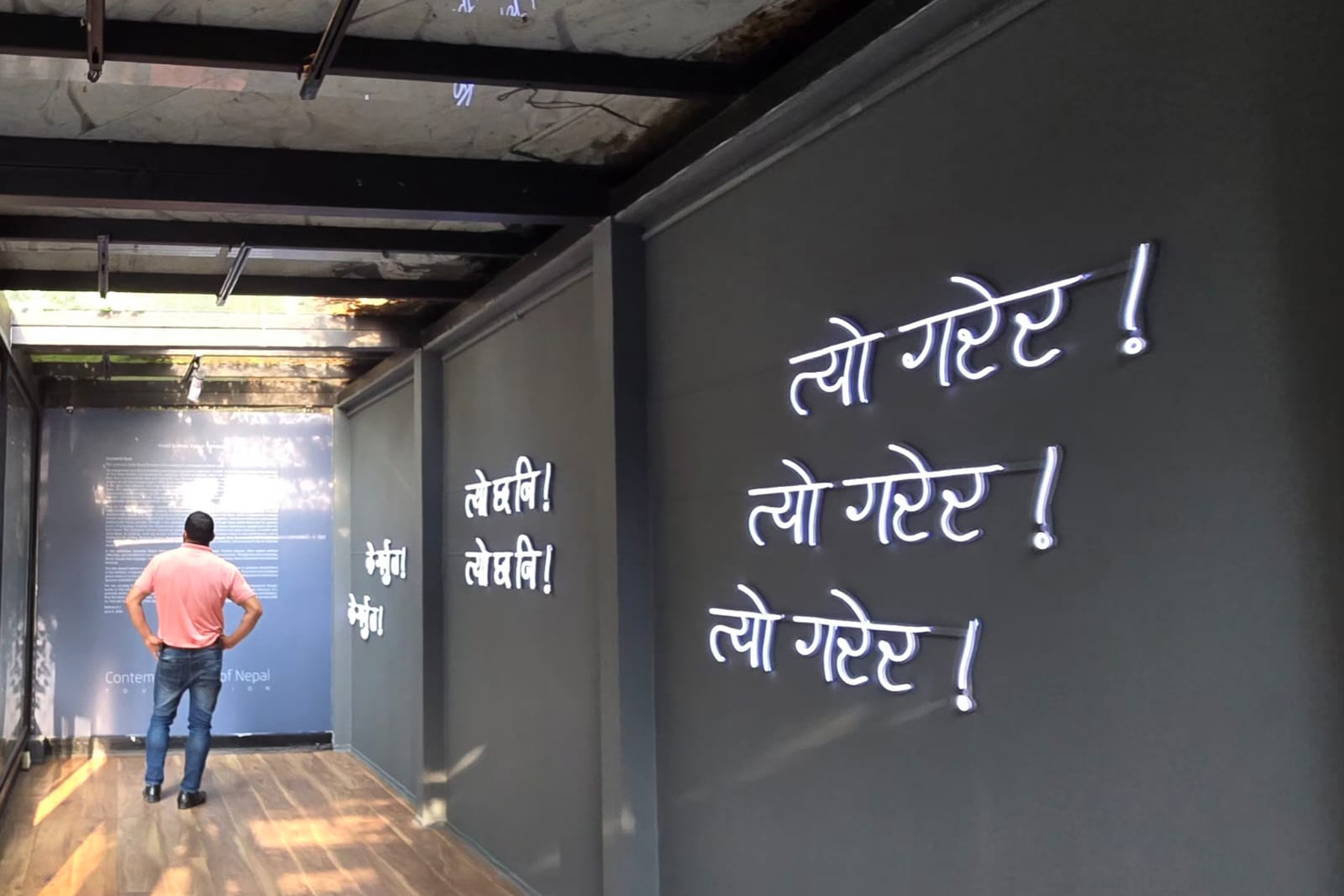
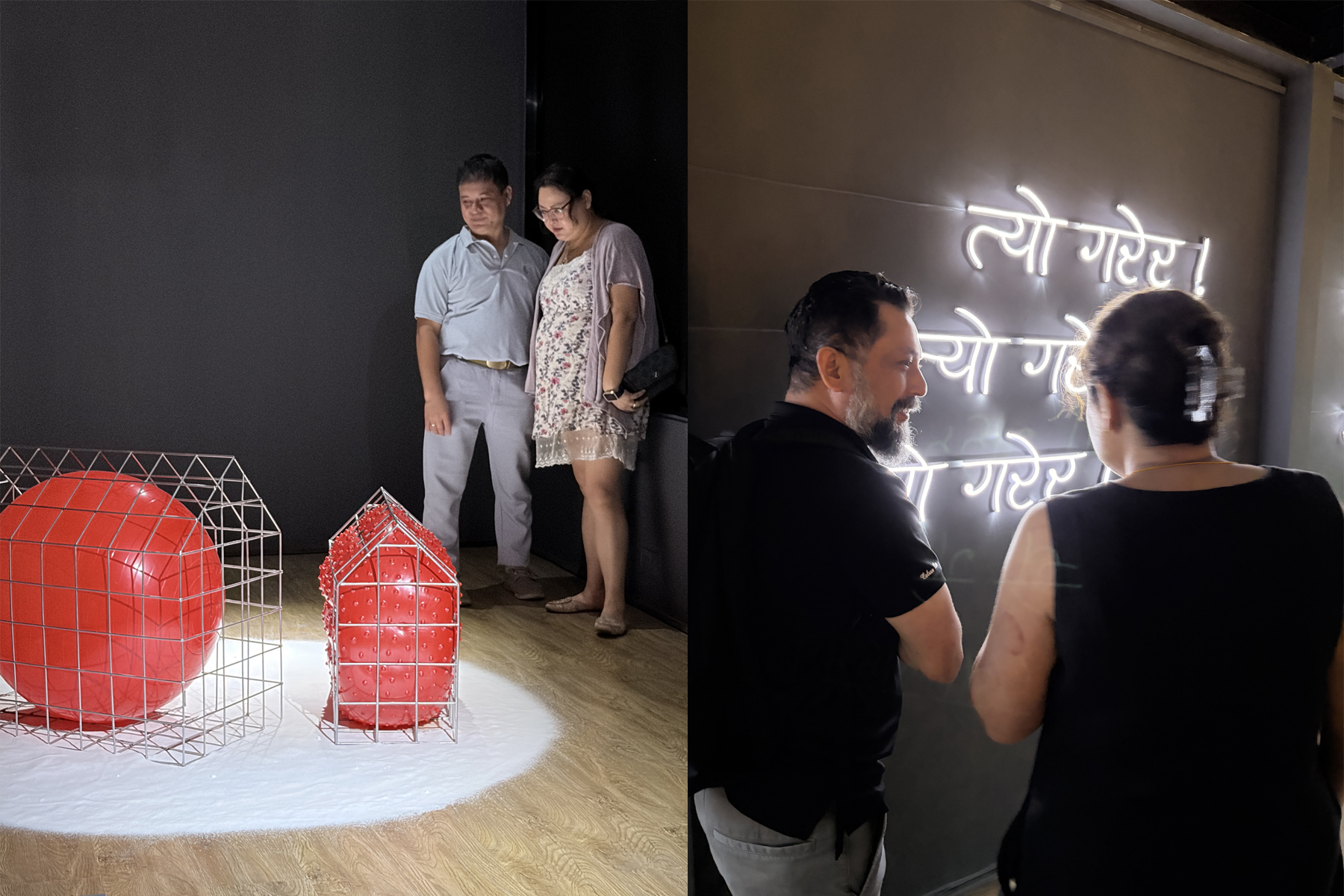
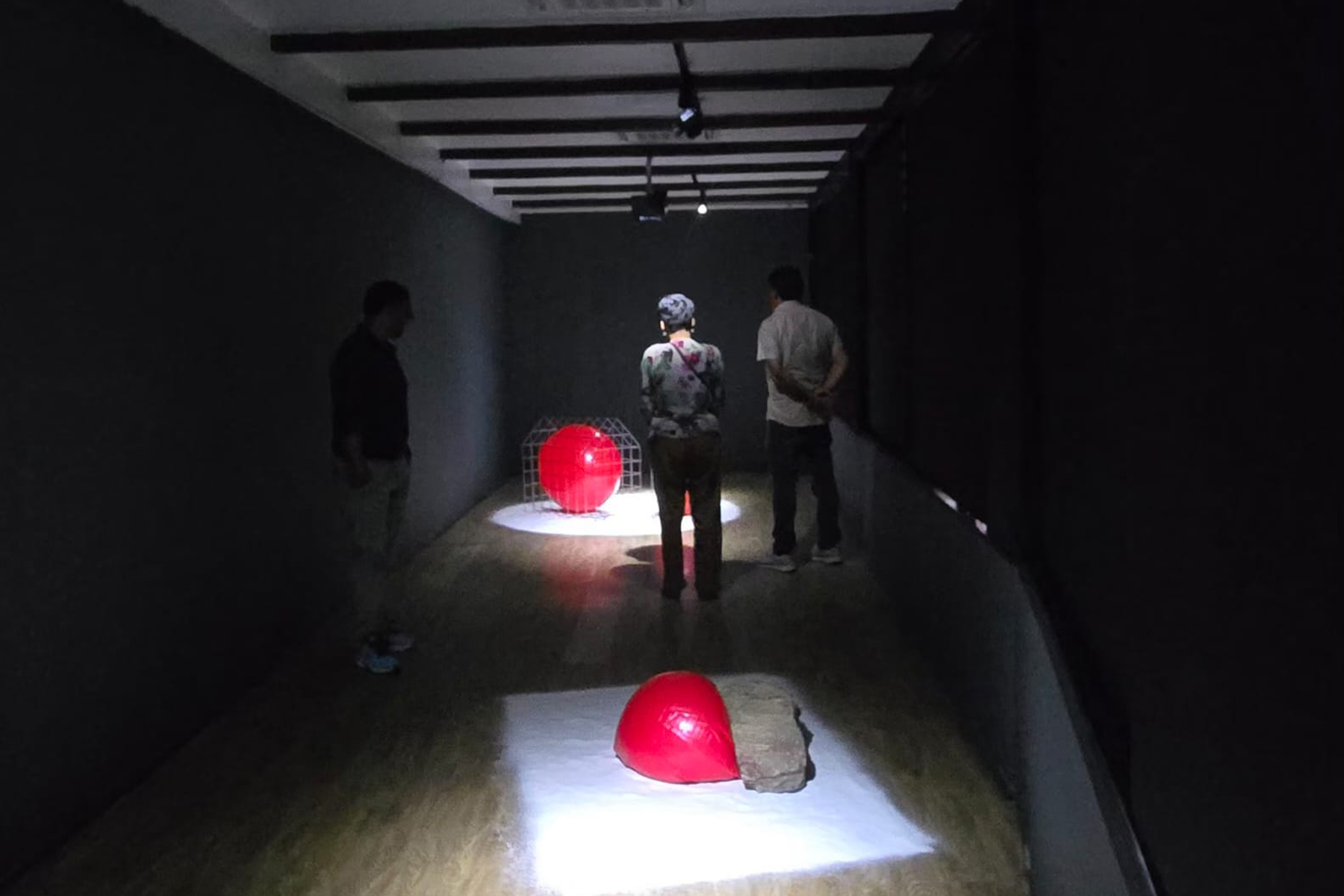
The artworks being displayed at the Dalai-La art space showcased two of his most piognant work where Nepali people keep on talking are displayed in the wall to show how we generalize things in our day to day language use. In another part of the gallery, the red balloons are kept inside and around the iron house like structure.
Upon asking about the materials used in installation and its after the show, the artist replies,’ all the materials I’ve used for the show are obtained from the re-cycle shop and after the show, it will be dismantled and will return back to the place that it came from.’
A City as Exhibition Space
The first segment, Nepali Sublime: Body in Translation, curated by Bidhata KC in collaboration with Dalai La Art Space, Thamel, opened on June 9 and continues until July 10. This section initiates the project’s exploration of embodiment and transformation through sculptural and spatial interventions.
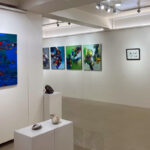
Another chapter, Of Place, Memory and Residue, presented in collaboration with Siddhartha Art Gallery and Baber Mahal Revisited, will run from June 12 to June 26. This segment brings together video installations, drawings, and installation-based works that trace the fragile intersections of memory and place.
On June 23, Silent Bone extends into performance at Mandala Theatre, Lakhechaur Marga-a closed, invite-only presentation featuring a sequence of five intimate performance acts.
The project continues with The Shape of Stillness, in collaboration with the Nepal Academy of Fine Arts, from June 26 to July 5. This segment unfolds through installation-based works that dwell in the aesthetics of pause, restraint, and spatial silence.
Finally, Reliquaries for Remembrance, presented in partnership with Taragaon Next, runs from June 28 to July 5. This concluding section brings together video installation and projections that weave together documentation and memory, reflecting traces of the entire project.
The Artist
Based in Texas, Binod Shrestha is a visual artist and educator whose academic journey spans an MFA from Bangalore University, India, and the Pennsylvania Academy of the Fine Arts, Philadelphia. His multidisciplinary practice includes drawing, sculpture, photography, installation, performance, and video.
Shrestha’s work consistently engages with themes of the body, memory, home, cultural hybridity, and the complexities of violence. His artistic inquiry does not seek definitive answers but instead opens spaces for contemplation—where personal and political histories intersect and dissolve into one another.
He has exhibited widely, including at institutions such as the Minneapolis Institute of Art and the Beijing Biennale, along with numerous international exhibitions across the United States, India, Nepal, and China. Through these varied contexts, his practice continues to evolve as a meditation on displacement, remembrance, and the fragile architectures of human experience.

Leave A Comment