
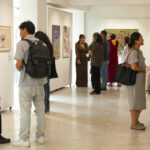
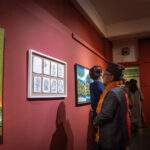
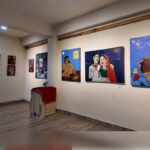
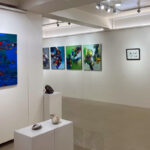
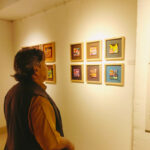

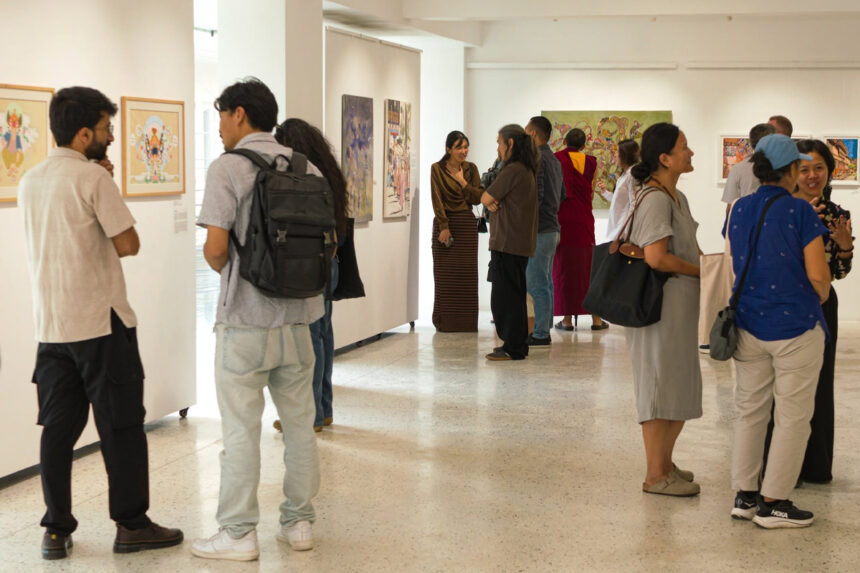
At Takpa Gallery in Lazimpat, the Himalayas arrive not as a distant landscape of snow peaks and silent valleys, but as a collection of intimate memories-etched into wood, woven into fabric, layered upon canvas, whispered through symbols and carried within the minds of artists who have grown up among its changing landscapes.
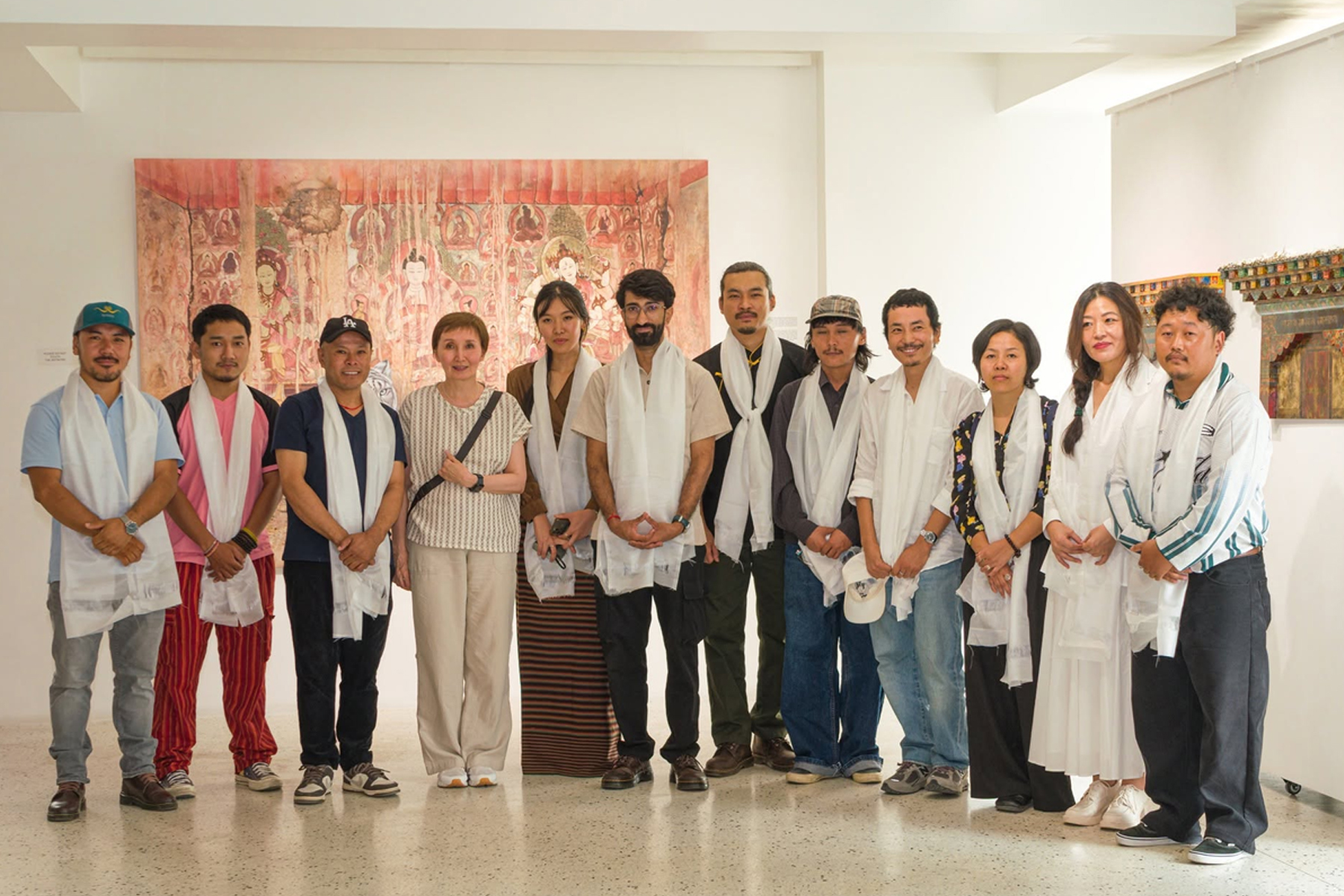
Titled ‘Voices of the Himalayas’, the group exhibition brings together eleven artists whose practices emerge from different corners of the Himalayan region. Their works are as varied as their journeys. Some speak through wood and mineral pigments; others through thangka traditions, embroidery, discarded tarpaulin, carpets and mixed media. Beneath this diversity, however, runs a shared concern: the fragile relationship between memory and change.
The exhibition, which opened on 22 August and continues until 19 September, does not attempt to present the Himalayas as a frozen cultural landscape. Instead, it reveals a region in transition-a place where traditions are remembered even as they disappear, where migration alters villages, where old symbols find new meanings, and where childhood memories continue to survive within contemporary artistic practices.
Perhaps this is what makes the exhibition particularly compelling. The Himalayas represented here are not merely geographical. They are psychological, cultural and deeply personal.
Wood, Memory and the Architecture of the Monastery
For Pasang Lama Hyolmo, wood becomes a vessel of memory.
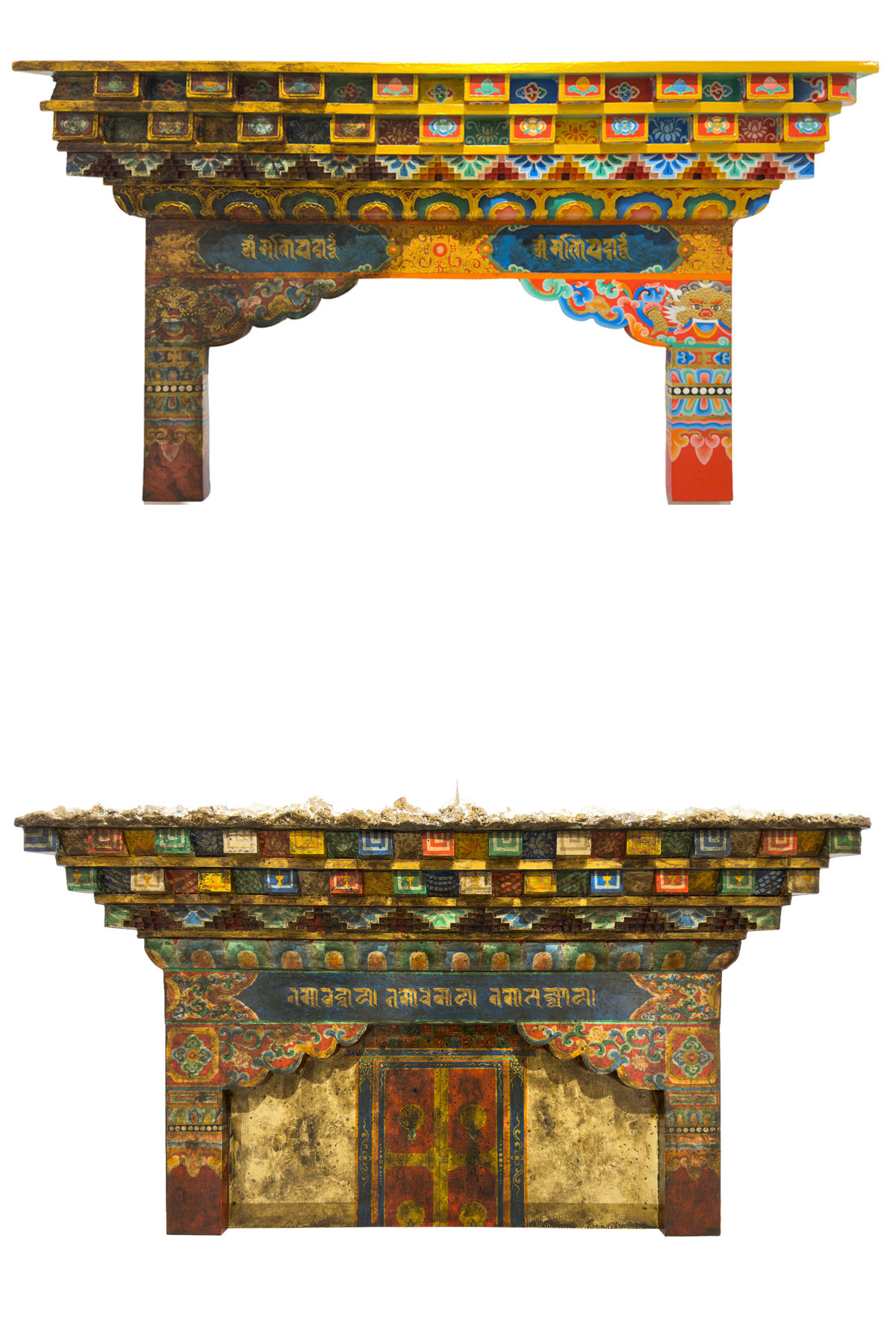
Having worked in monasteries, where he encountered the intricate visual traditions embedded within Himalayan religious architecture, Lama turns to wooden structures inspired by the symbolic forms found in monasteries. The four corners of these structures carry particular significance, with symbols emerging from the architectural vocabulary of sacred spaces.
Yet there is an intriguing contradiction at the heart of his work. The wood may be new, but the artist deliberately makes it appear old.
“Though the wood being used is new, I have turned it into an old one. The old things are more precious, which I have tried to make in the art,”
he explains.
Age, therefore, is not simply a quality of material. It becomes an artistic process-a way of recovering something that might otherwise disappear.
On the upper surfaces of his wooden forms rests a layer of white wooden dust. It resembles snow settling upon mountain ridges, transforming the sculpture into a miniature Himalayan landscape. The material becomes metaphor: wood carries the memory of monasteries, while white dust evokes the enduring presence of the mountains.
When a Landscape Begins to Forget
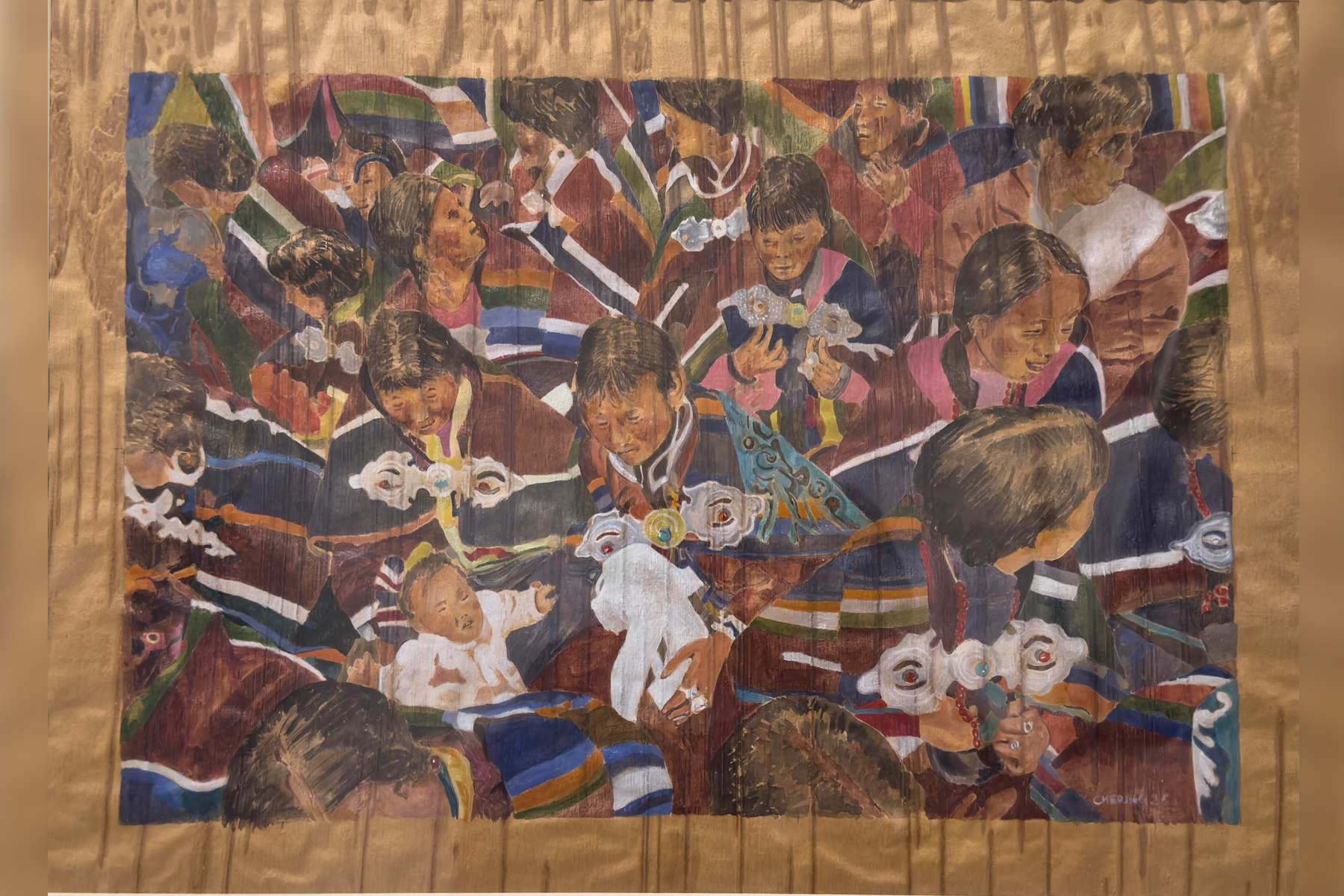
The question of cultural disappearance becomes more pronounced in the work of Chering Gyalpo from Dolpo.
Gyalpo works predominantly with wooden bark, a material closely connected to the older traditions of his region. In his practice, the bark becomes both surface and archive. It carries traces of a way of life that is gradually being transformed by the arrival of tourism and the changing economic realities of Dolpo.
During his father’s generation, wooden bark was used for writing and creating images. Gyalpo’s continued use of the material becomes an act of preservation, but not one that is nostalgic in a simplistic sense. His works remind us that traditions do not always disappear dramatically. Sometimes they simply become less necessary, less visible, and eventually less remembered.
His work quietly asks what happens to a culture when the world around it changes faster than its traditions can adapt.
This distinctiveness is also what visitors notice.
Saurav Khatiwada, one of the visitors to the exhibition, observes that the works are strikingly different from what one usually encounters in Kathmandu’s galleries. The variety of color palettes, materials and ideas, he suggests, gives the exhibition a character of its own.
The Sound of a Missing String
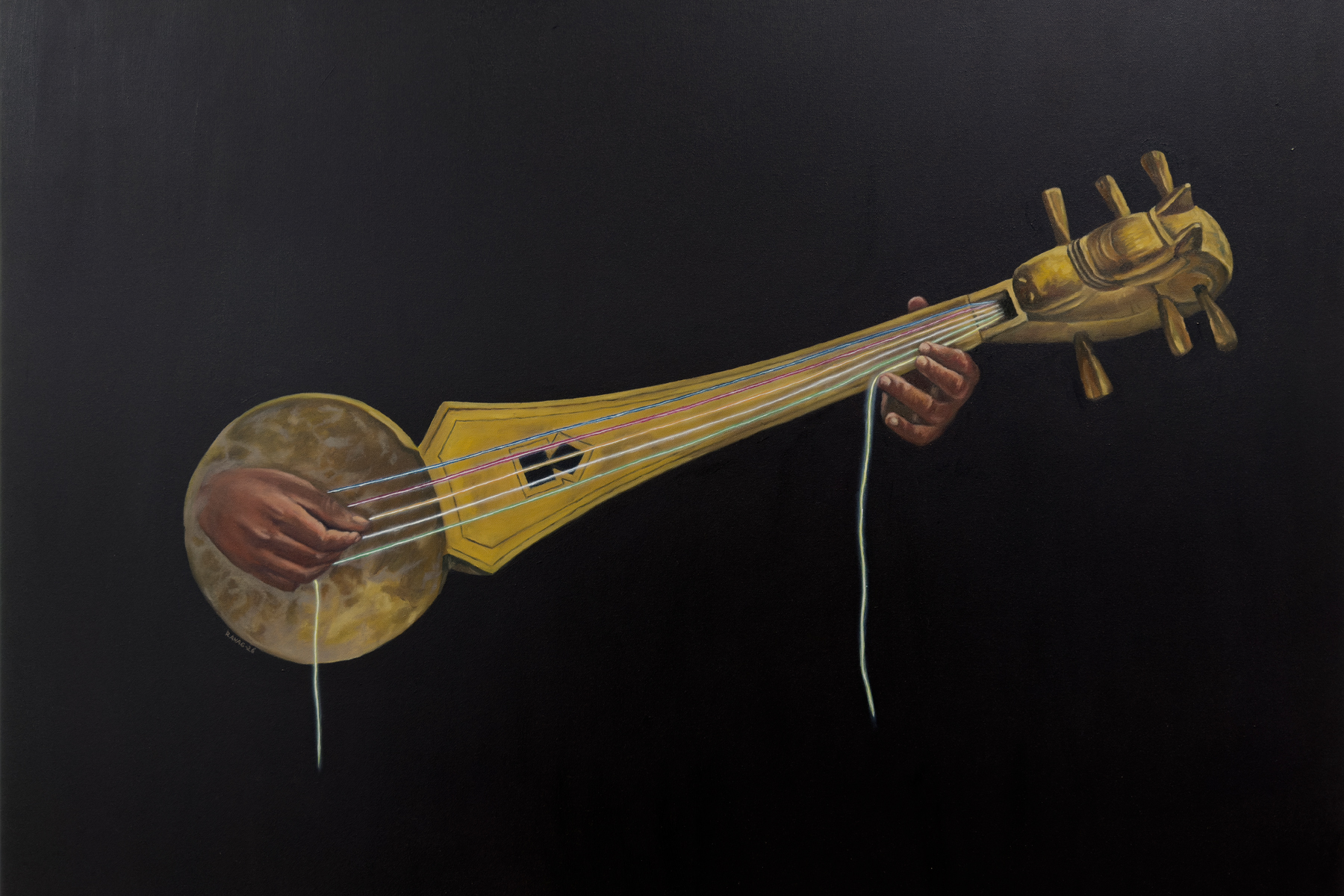
In the paintings of Karma Tashi Gurung, Dolpo returns through memory, music and the gradual erosion of tradition.
One of his works depicts the Tungna, a traditional string instrument. Once, its strings were made from animal skin; today, synthetic materials and fishing wire have increasingly replaced them. In the artist’s painting, one string is deliberately missing.
That absence becomes louder than the instrument itself.
The missing string functions as a visual metaphor for cultural discontinuity-the quiet disappearance of practices that were once woven naturally into everyday life. What appears at first to be a simple depiction of an instrument consequently becomes a meditation on what is lost when traditions are altered by time.
In another work, Gurung presents a monk wearing an animal mask. The image is both peculiar and majestic, carrying an almost ritualistic presence. The mask obscures identity even as it reveals another layer of cultural memory.
The Colours of Waiting
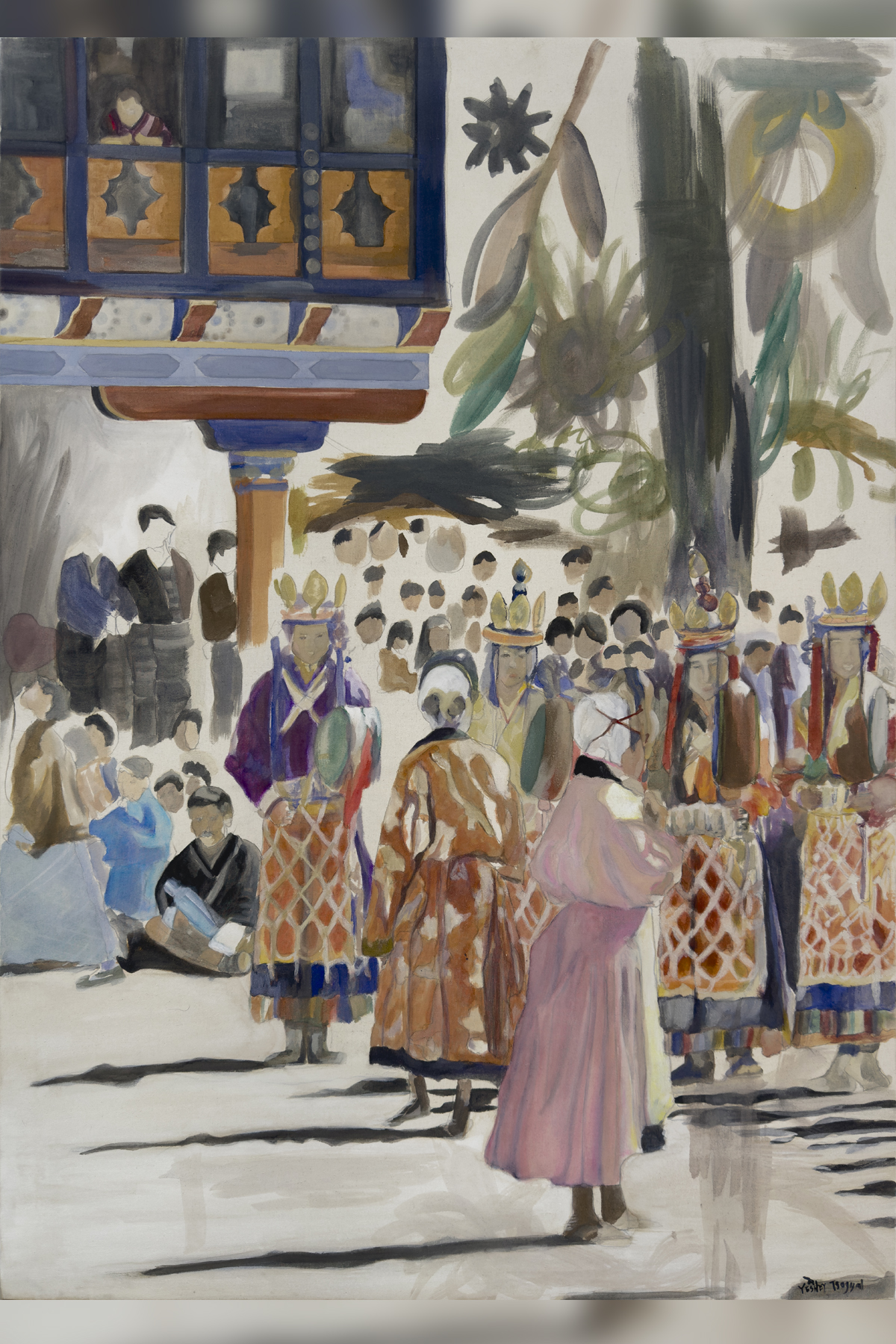
From the Himalayas of Nepal, the exhibition travels across the region to Bhutan, where Yeshey Tsogyal explores another form of cultural experience: the tension between movement and stillness.
Her paintings examine the rhythms of busy urban life and the peculiar sensation of waiting. At first glance, the works may appear to possess the softness of watercolor. Yet the luminous surfaces are created using mineral pigments, giving the paintings an earthy and distinctive character.
The colors seem to hold two states simultaneously-life in motion and life temporarily suspended.
There is something deeply Himalayan about this duality: movement and stillness, migration and belonging, departure and waiting.
Inside the Room of the Self
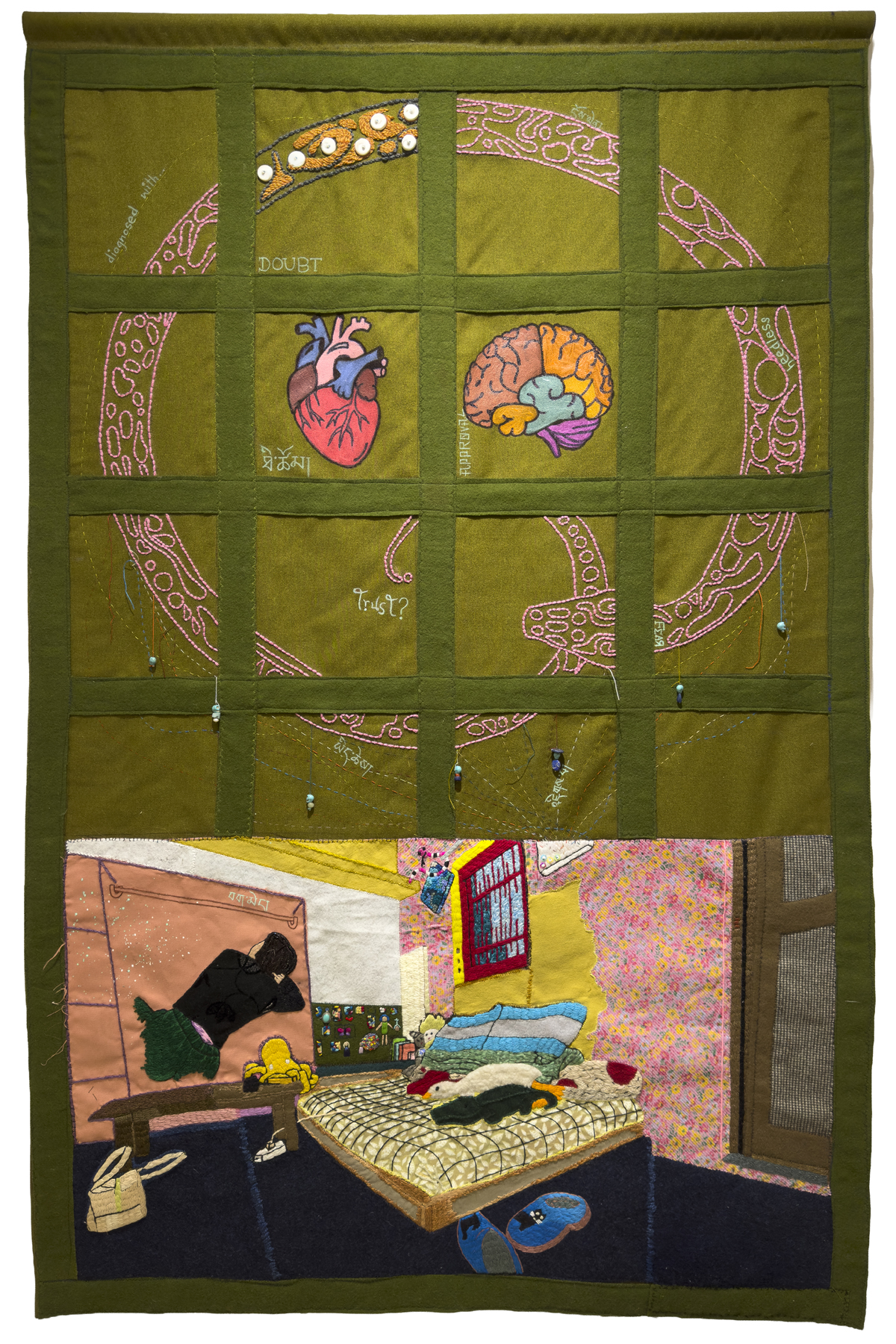
For Choenyi Dolma of Dharamsala, the journey begins much closer to home.
Her works emerge from the interior spaces of her house and, more significantly, from the interior landscape of her own mind. The room becomes a psychological space where thoughts, emotions and memories meet.
Human emotion, she suggests through her imagery, often occupies the uncertain territory between heart and mind.
Among the striking symbols in her work is the ouroboros, the serpent consuming its own tail-a timeless image of cyclical existence, continuity and renewal. Her works are neither simply paintings nor conventional textile pieces. Embroidery, fabric, beads and patchwork come together in a mixed-media vocabulary that gives the works a tactile intimacy.
The surface itself becomes part of the story.
The Restless Mind and the Contemporary Thangka
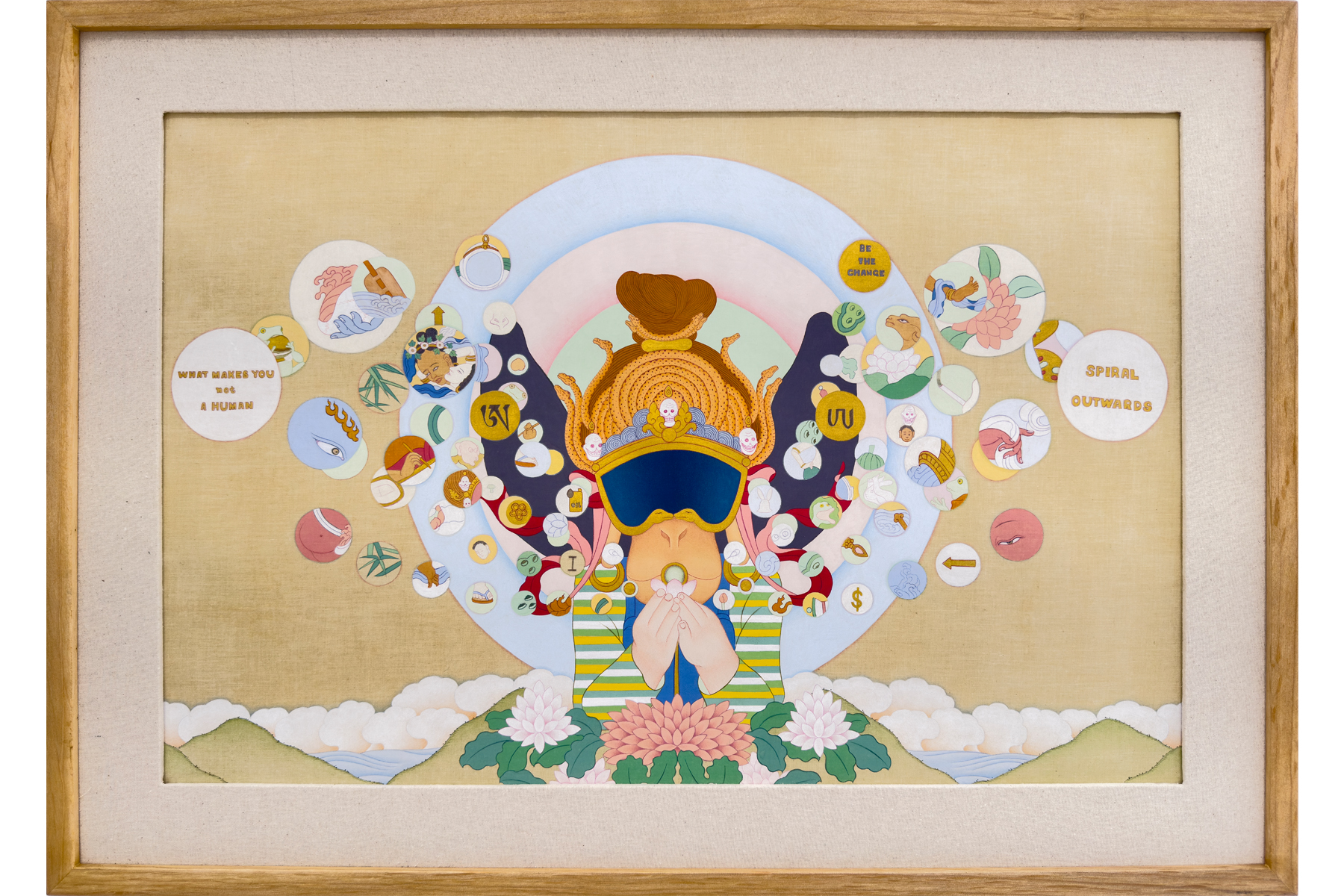
Sahil Bhopal continues his exploration of the ‘Monkey Mind’ series, where the human figure merges with the restless image of the monkey.
In his paintings, the monkey produces bubbles-visual manifestations of thoughts emerging from the mind. The image is playful at first, but beneath its humor lies a familiar psychological experience: the incessant movement of thought.
Traditional thangka elements appear within this contemporary visual language, creating a bridge between inherited Himalayan Buddhist imagery and contemporary artistic expression.
The old language has not disappeared. It has simply begun speaking differently.
A Childhood Map of Fear
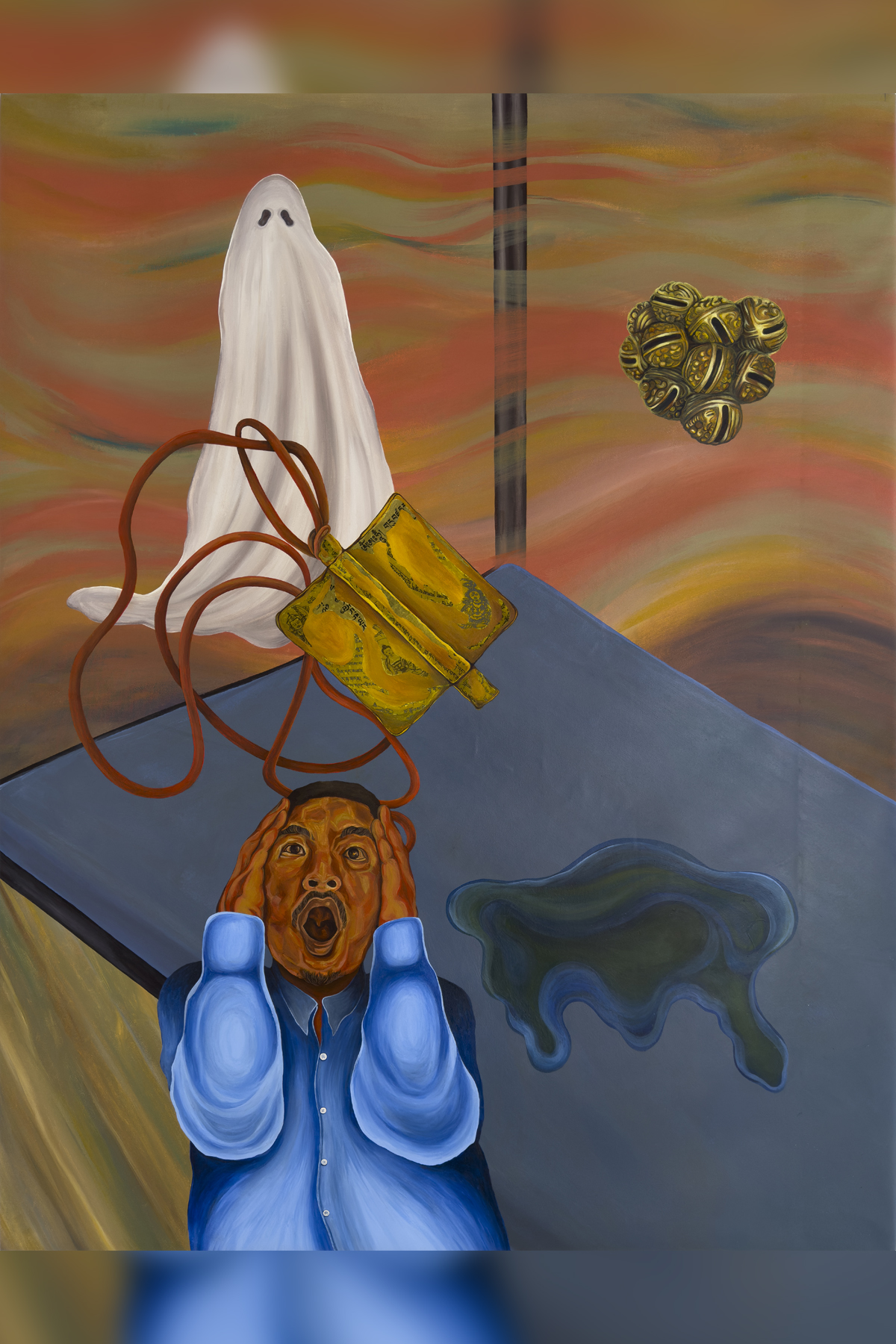
Perhaps one of the most personal works in the exhibition is Tenzin Melak’s ‘The World Map of Home No. 3’.
The title itself carries a childhood memory. The artist recalls being in Home No. 3 during his school years, and that place becomes the emotional geography from which the painting emerges.
The work brings together childhood fears, Buddhist beliefs, superstition, protective amulets and stories of ghosts that circulated while he was growing up.
Among the most fascinating details is an instrument associated with his grandmother. Its sound was believed to ward off ghosts. Another childhood memory becomes even more intimate: the experience of waking at night and having to walk to the toilet, where even the act of urination becomes transformed into an imaginary world map.
The personal and the fantastical overlap.
The painting carries an influence from the psychological intensity of Edvard Munch, but Melak transforms that influence through his own memories and cultural vocabulary. Fear is therefore not presented as an abstract emotion. It becomes geography-a map of childhood, belief and imagination.
Two Homes, Two Worlds
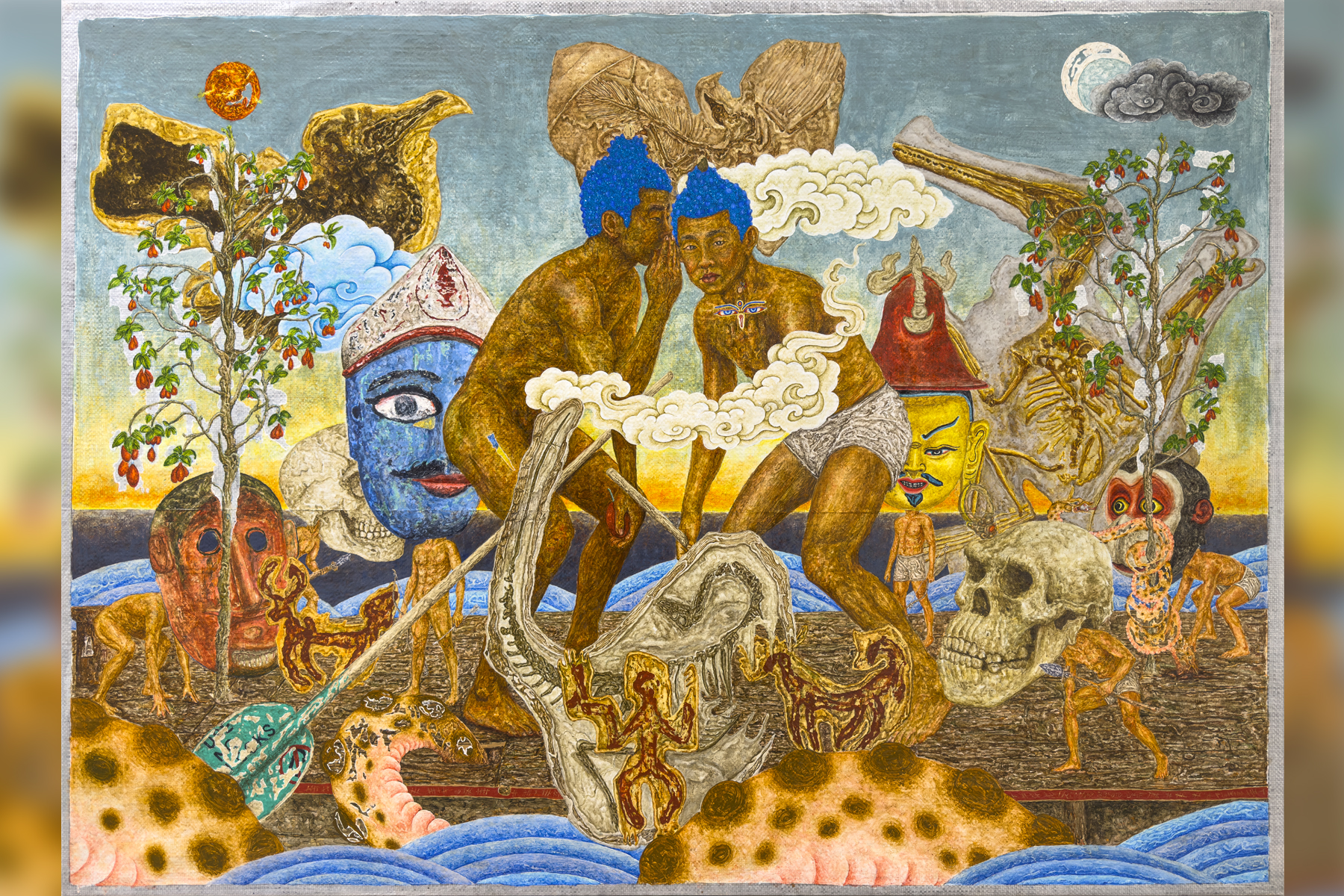
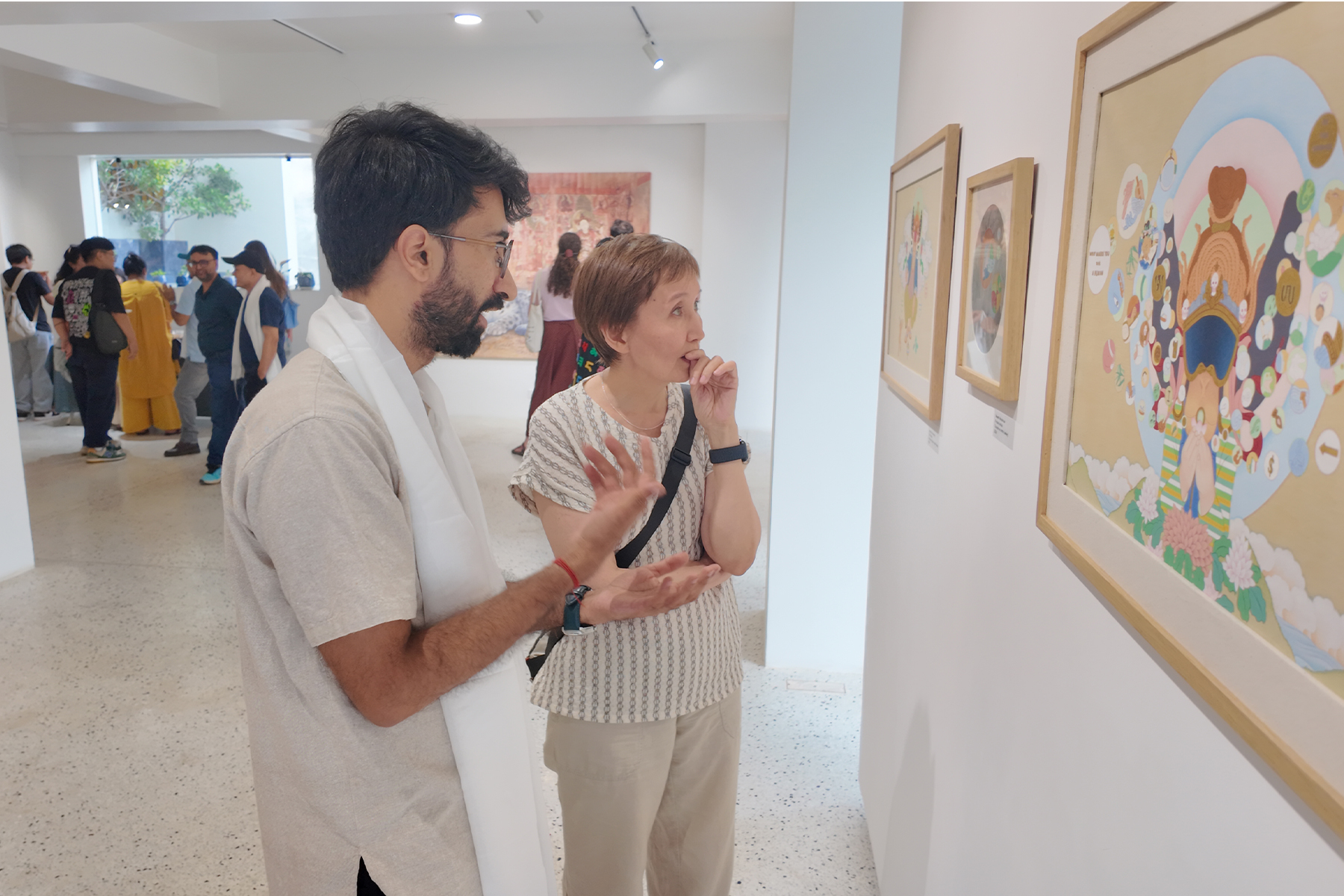
Tenzin Gyurmey Dorjee turns to friendship and childhood in a work painted on tarpaulin.
As a child, he remembers frequently visiting his friend’s home. The painting divides the composition into two worlds: on one side, his own home and cultural symbols; on the other, the world of his friend.
Images associated with the worship of Ram appear alongside Buddhist imagery and representations of Buddhas. The two cultural worlds do not confront each other. They coexist within the same pictorial space, connected by the memory of friendship.
The material itself carries another chapter of the artist’s story.
As a young artist without sufficient money to purchase traditional canvases, Dorjee began painting on tarpaulin. What began as a practical necessity gradually became part of his artistic language. Durable, inexpensive and readily available, the material offered him a surface upon which his memories could unfold.
The canvas, in his case, was not purchased. It was discovered.
Culture in Transformation
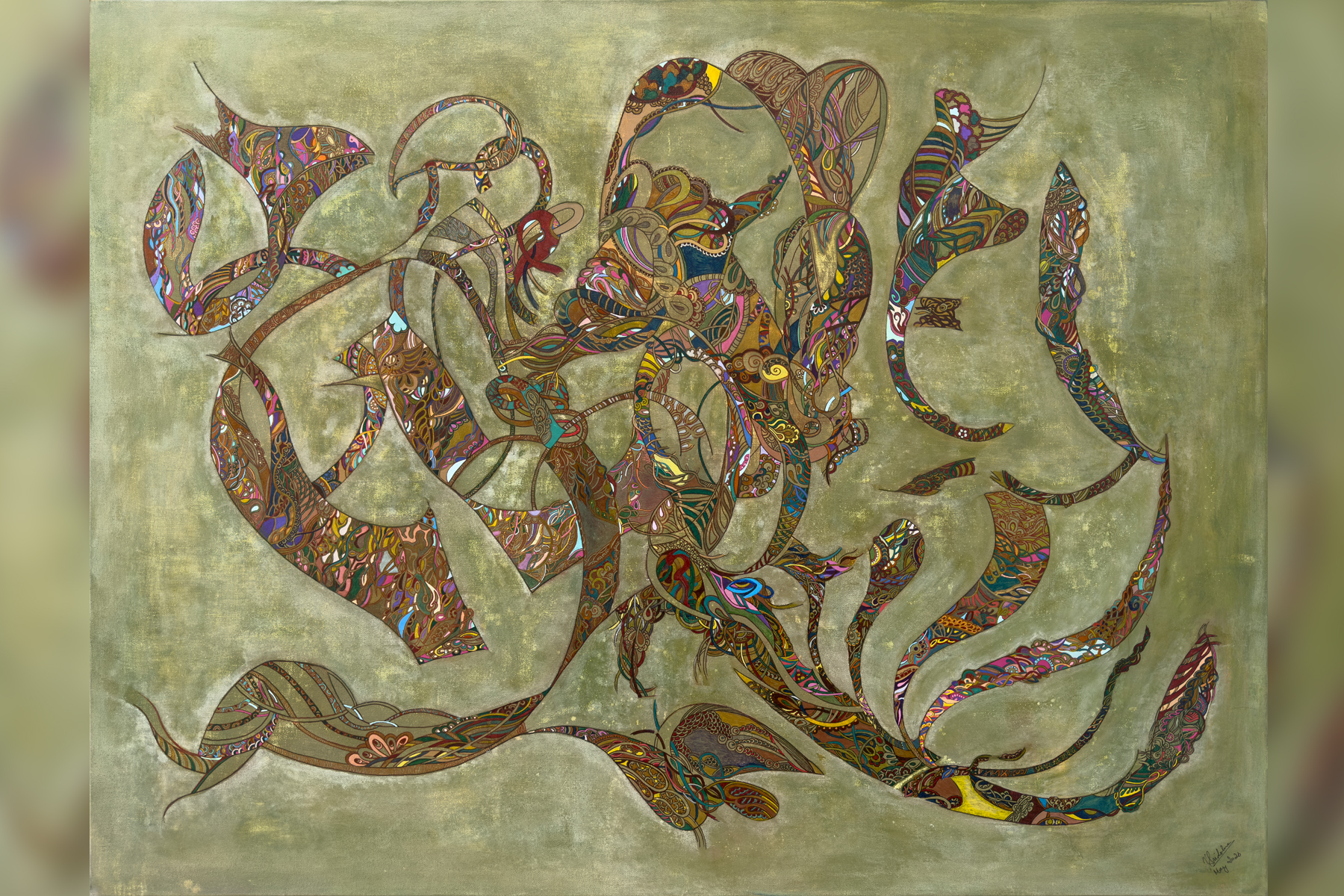
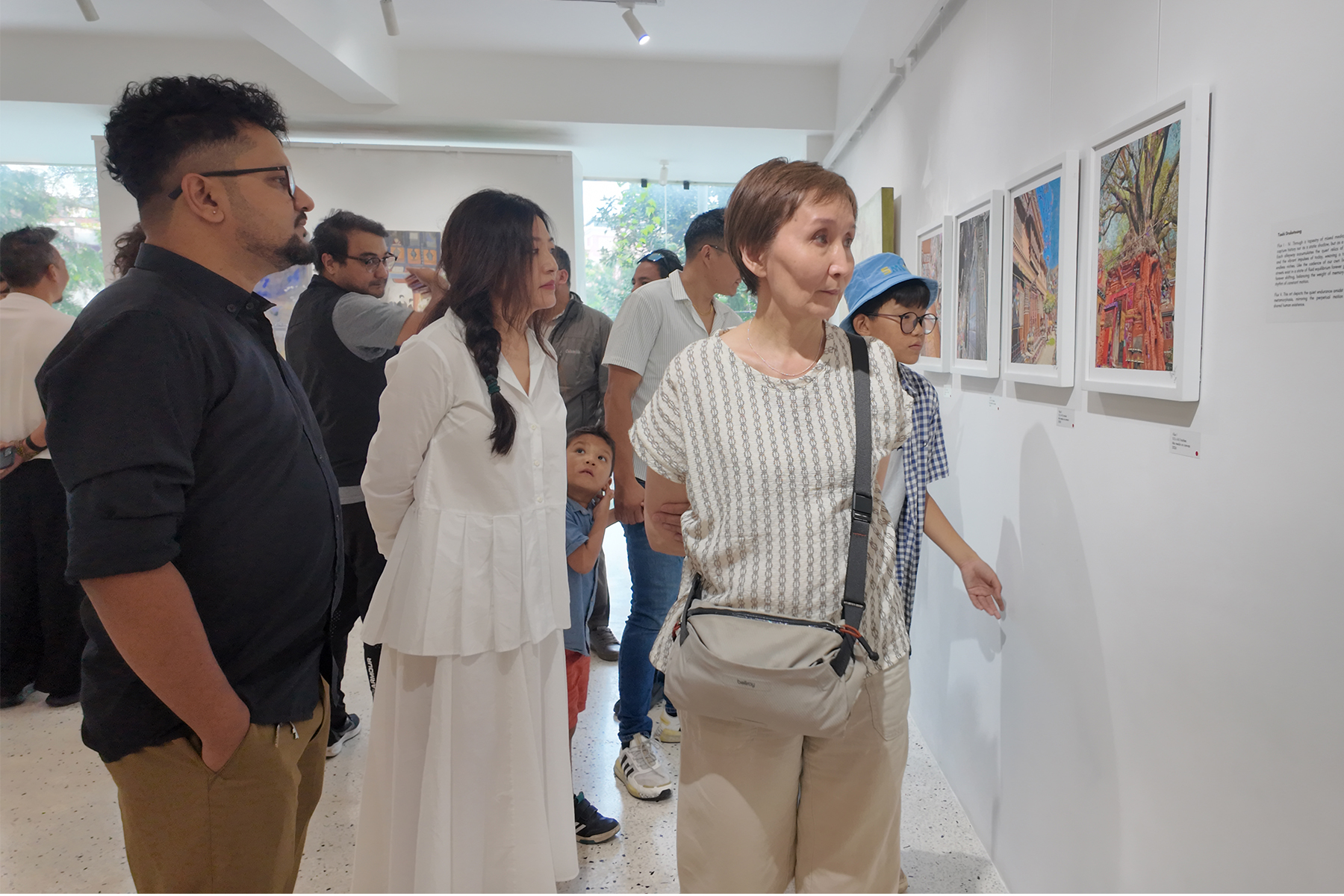
The work of Tashi Druketsang looks closely at the continuing transformation of culture.
Her paintings bring together acrylic and photographs, allowing different visual qualities to coexist on the same surface. There is a sense of dialogue between old and new, between inherited forms and contemporary interventions.
Her work suggests that culture is never entirely static. It is continually rewritten, painted over, remembered and reinterpreted.
Magic, Nature and Another Life
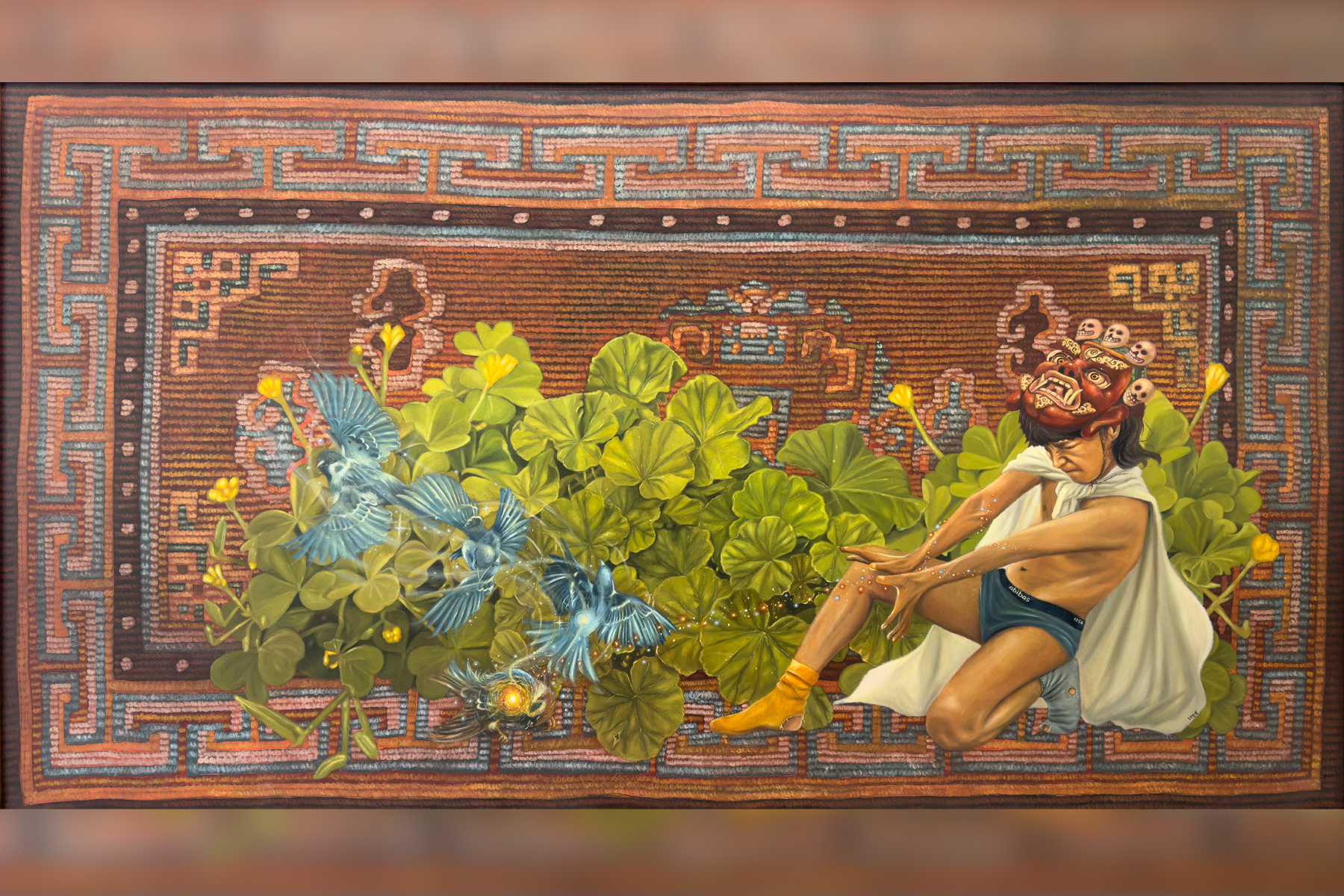
Sherab, another artist from Dolpo who studied in India, approaches cultural memory through a world where spirituality, magic and nature remain deeply intertwined.
His imagery carries the atmosphere of a Himalayan myth. A masked boy appears protected from negative energy. A bird rises from leaves, suggesting movement towards another life. A dead bird is symbolically brought back through magic, invoking the idea of rebirth.
The artist creates a touch of carpet in his canvas, connecting the work to cultural practices and the ceremonial spaces associated with important Rinpoches. Here, nature and culture occupy the same visual universe.
The bird’s transformation from death to another existence is not merely fantastical. It echoes a worldview in which life is understood as a continuum rather than a single, closed passage.
The Sacred Refuge
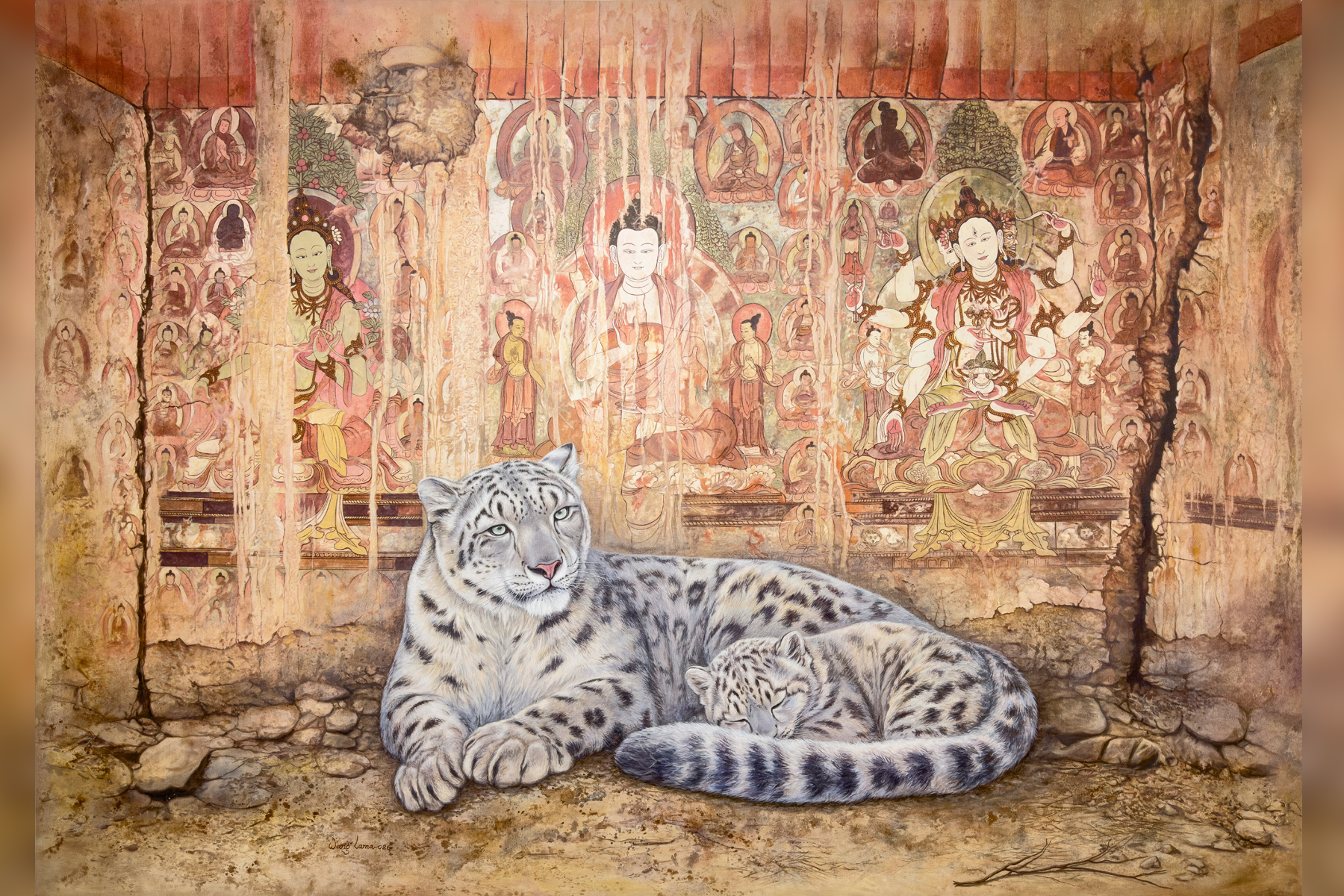
The final voice belongs to Wang Lama from Humla, whose work brings together sacred spaces, migration and ecological change.
His paintings are inspired by caves and monasteries-places that were once destinations for meditation and introspection. These spaces, historically associated with spiritual retreat, now exist within a changing social landscape.
Education and economic opportunity have encouraged migration towards cities. Villages have shifted, populations have moved, and with them, cultural practices and artworks associated with those places have gradually diminished.
Yet as human beings leave, other inhabitants arrive.
Wild animals increasingly take refuge in these remote spaces.
The snow leopard, elusive and deeply symbolic of the Himalayan ecosystem, becomes particularly important in Lama’s work. The artist connects the animal’s presence with the changing balance of the ecosystem and with stories of reproduction and survival.
His painting consequently holds two narratives at once: the story of human migration and the story of nature reclaiming abandoned spaces.
The sacred refuge is no longer inhabited only by those seeking spiritual solitude. It has become a refuge for the wild.
Listening to the Himalayas
Taken together, the works in ‘Voices of the Himalayas’ reveal a region that is constantly negotiating between memory and modernity.
The exhibition does not romanticize the Himalayas as an untouched realm of monasteries, snow peaks and ancient traditions. Instead, it presents a more complex reality. Tourism changes Dolpo. Migration empties villages. Materials disappear or are replaced. Religious imagery enters contemporary painting. Childhood fears become maps. Tarpaulin becomes canvas. Wood becomes an archive. A missing string becomes a metaphor for cultural loss.
And yet, across all these changes, the artists continue to remember.
Their memories do not remain confined to the past. They are transformed into new materials, new symbols and new visual languages.
This is perhaps the most powerful quality of the exhibition: the Himalayas speak here not through a single voice, but through eleven distinct voices-sometimes loud, sometimes meditative, sometimes playful, sometimes melancholic.
They speak through wood dust resembling snow, through the absent string of an old instrument, through a serpent consuming its own tail, through the restless bubbles of a monkey mind, through childhood ghosts and grandmother’s instruments, through two neighboring homes, through carpets, mineral pigments, tarpaulin and the elusive snow leopard.
The mountains, in these works, are not merely something to be seen.
They are something remembered.
Something carried.
Something slowly changing.
And something that, through art, continues to speak.
‘Voices of the Himalayas’ is on view at Takpa Gallery, Lazimpat, Kathmandu, from 22 August to 19 September.

Leave A Comment