



There are places where history does not merely survive in books- it lives in stone, wood, pigment, ritual and memory. Nepal is one such place. Its gods and goddesses have long inhabited the everyday imagination of its people, appearing not only in temples and shrines, but also in festivals, courtyards, sculptures, paintings and the countless rituals through which generations have inherited a sense of belonging.
From childhood, the people of Nepal grow up surrounded by these sacred presences. The ringing of temple bells, the procession of chariots, the intricate carvings on traditional architecture and the quiet rituals performed before familiar deities all become part of an intimate cultural vocabulary. Over centuries, this vocabulary has found an equally compelling expression in art.
It is within this rich cultural landscape that the Nepal Art Council has presented Deities of Nepal III: Lores and Legends, an exhibition that brings together an extraordinary range of artistic interpretations of Nepal’s deities, myths and cultural memories. Following two earlier editions under the Deities of Nepal title, the third edition continues the conversation between divinity, tradition and contemporary artistic expression.
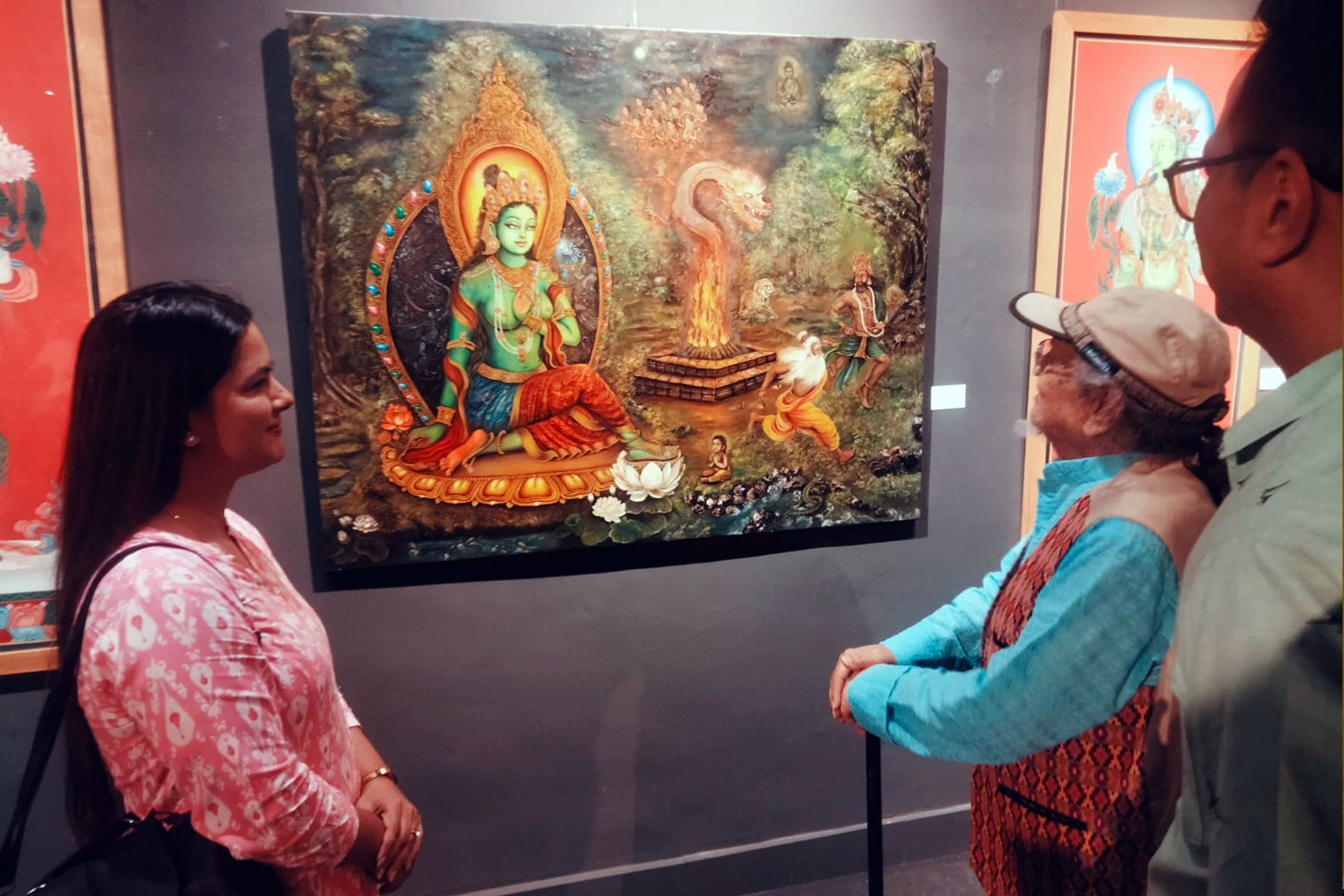
Held from 17 September to 10 October, the exhibition opens its doors every day from 10:30 am to 5:30 pm. With more than 157 participating artists, the exhibition unfolds as an expansive visual gathering in which generations, mediums and artistic approaches meet beneath the same roof.
Walking through the galleries, one encounters not a single understanding of the sacred, but many. Here, the deity is sometimes recognizable, sometimes fragmented, sometimes abstracted, and sometimes transformed almost beyond recognition. Yet beneath these different approaches lies a shared impulse: the desire to preserve, reinterpret and continue a cultural memory.
Many of the participating artists are celebrated practitioners who have spent decades developing their individual visual languages. Their presence gives the exhibition a sense of artistic depth, while the participation of younger and emerging artists introduces a different energy. Traditional artists stand alongside contemporary practitioners, allowing the exhibition to become a meeting point between inherited forms and newer ways of seeing.
For the viewer, the experience is therefore not unlike entering an enormous visual archive-one in which gods, legends, architectural memories and cultural symbols have been translated into paint, sculpture, mixed media and experimental forms.
Gods Re-imagined Through Material and Form
On the ground floor, to the right of the main gallery hall, the works of several master artists immediately command attention. Among them is the work of Sarada Man Shrestha, whose unusual representation of Ganesh becomes particularly striking through his use of sacks and other materials. Rather than presenting the familiar deity through conventional iconography alone, the artist allows material itself to become part of the narrative. Ganesh emerges as both a sacred figure and an object of artistic experimentation.
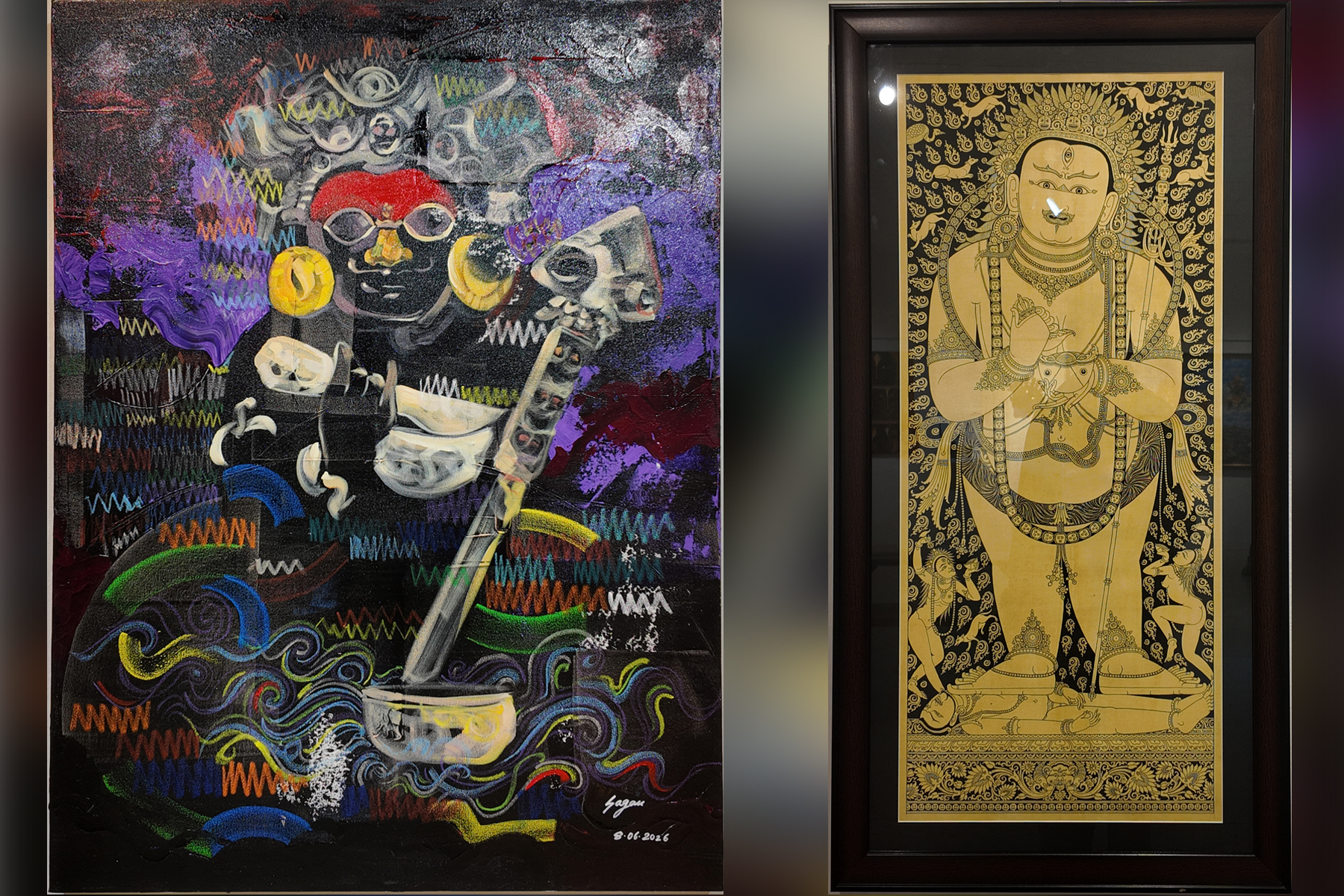
Nearby, the abstract language of Sagar Manandhar takes another direction. Known for his continuous experimentation with abstraction, Manandhar has approached Bhairav through a visual vocabulary that moves away from literal representation. The deity becomes something to be sensed as much as seen-an encounter between form, color and suggestion.
The works of Mukesh Shrestha further contribute to the diversity of the gallery, while the presence of younger artist Suchin Shrestha introduces a fresh artistic voice. His depiction of Layaku stands apart through its expressive quality, demonstrating how architectural and cultural memory can become a source of contemporary visual interpretation.
Another significant presence is that of veteran artist Mukti Singh Thapa, whose depiction of Mahakal is executed in ink on cotton canvas. There is a certain directness in the work, where the medium and the subject appear to meet naturally, allowing the image to retain its spiritual intensity without becoming excessively ornamental.
What makes the exhibition particularly compelling is that these established names do not exist in isolation. Alongside them are emerging artists, many of whom are still finding their place within Nepal’s artistic landscape. Their inclusion gives the exhibition a democratic character: the room becomes a shared space where experience and experimentation coexist.
Between Tradition and Contemporary Vision
The first floor extends this dialogue between tradition and contemporary practice. A mural dedicated to Machhindranath—the deity associated with rain and abundance—occupies an important place within the exhibition. The figure carries with it centuries of cultural memory, particularly within the Newar traditions of the Kathmandu Valley.
Elsewhere, Asha Dangol’s work inspired by an ancient tap introduces another dimension of Nepal’s architectural and cultural heritage. Rabindra Shrestha, whose experimental approach has long been recognized, contributes a work built around line and the visual vocabulary of Nepal’s cultural heritage.
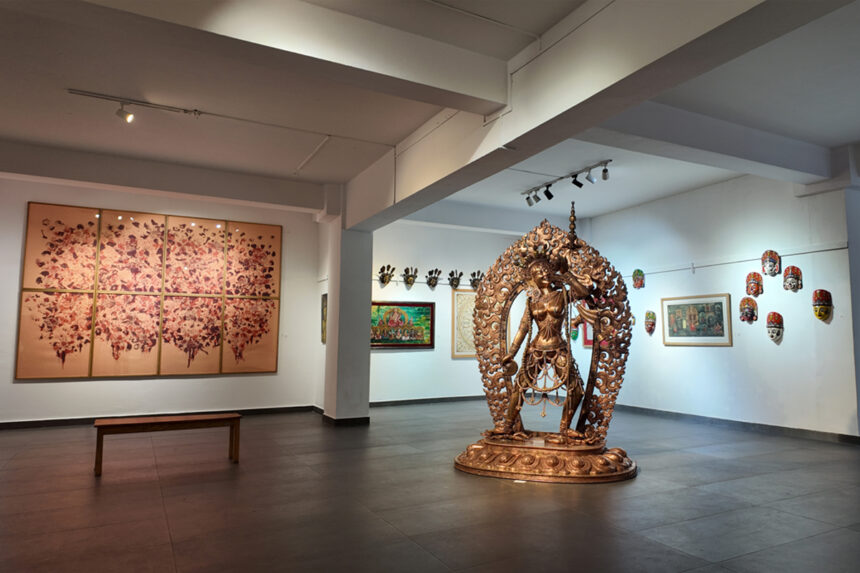
The exhibition also extends beyond painting. Sculptural representations of deities occupy their own place within the galleries, reminding visitors that Nepal’s sacred imagery has historically been expressed through many forms and materials.
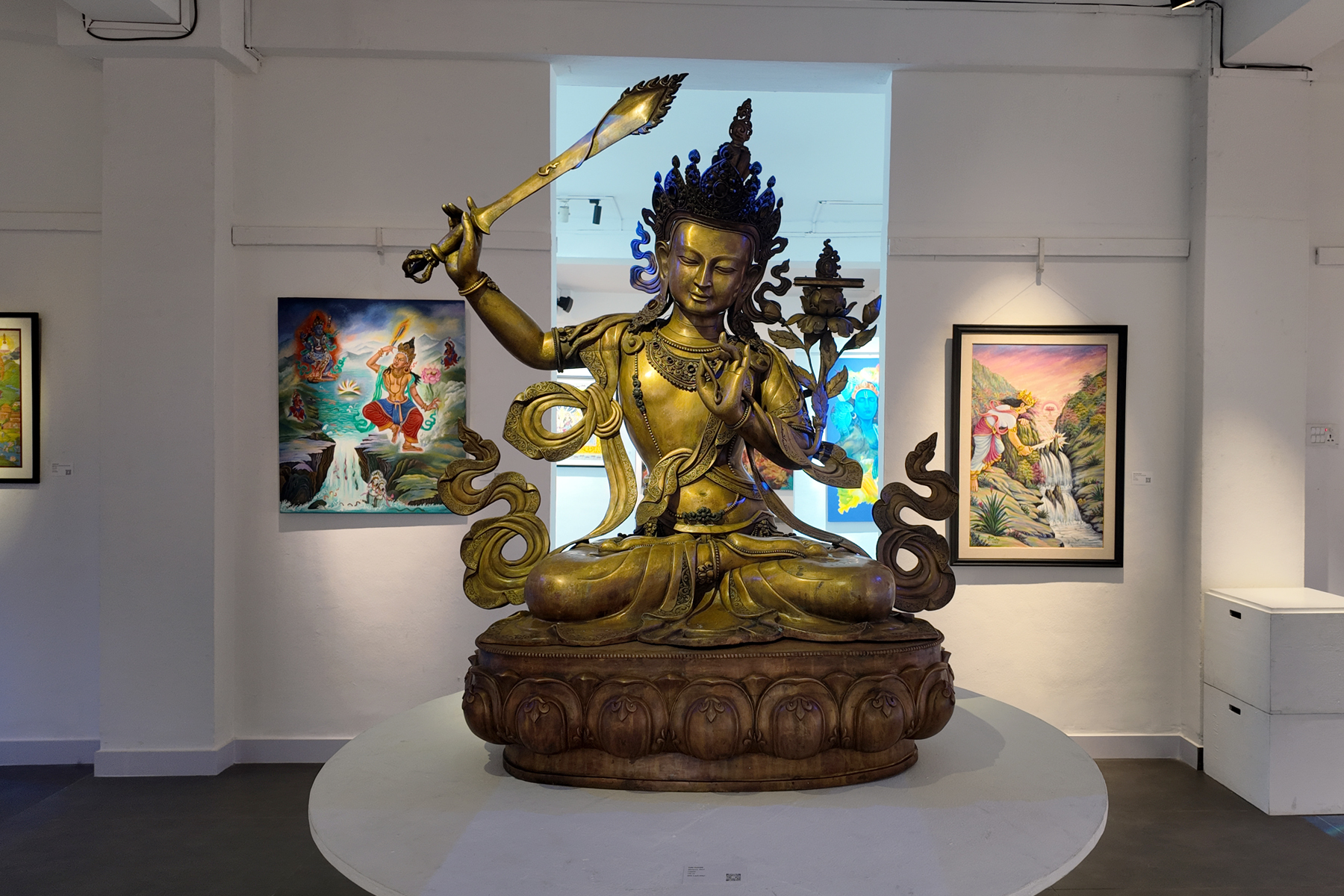
Among these works are sculptures by the late Kalu Kumale, whose works remain on display even as the artist passed away during the exhibition. His presence in the exhibition consequently carries a poignant significance. The work continues to speak, even when its maker is no longer present to speak about it.
Moving into another gallery hall, the visual language changes once again. The distinctive strokes of S.C. Suman bring the influence of Mithila art into the exhibition, while Jeevan Rajopadhyay approaches the sacred through abstraction. His work demonstrates how a deity can be transformed through an artist’s personal visual language without losing the cultural associations embedded within the image.
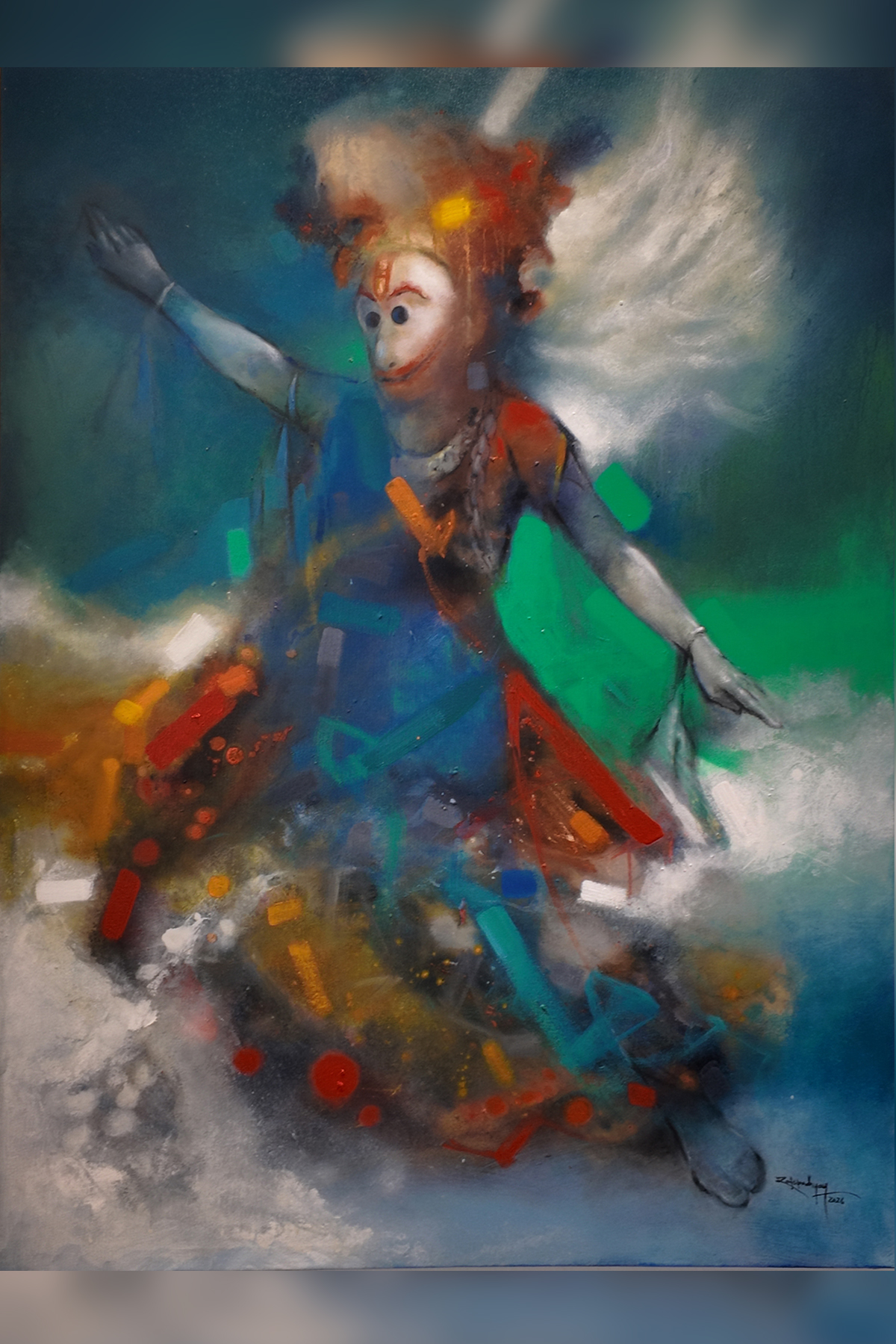
Roshan Bhandari, known for his continuing experimentation, presents Hanuman against an aura created through his distinctive artistic vocabulary. The work does not merely portray the deity; the surrounding space becomes part of the representation, creating an atmosphere around the figure.
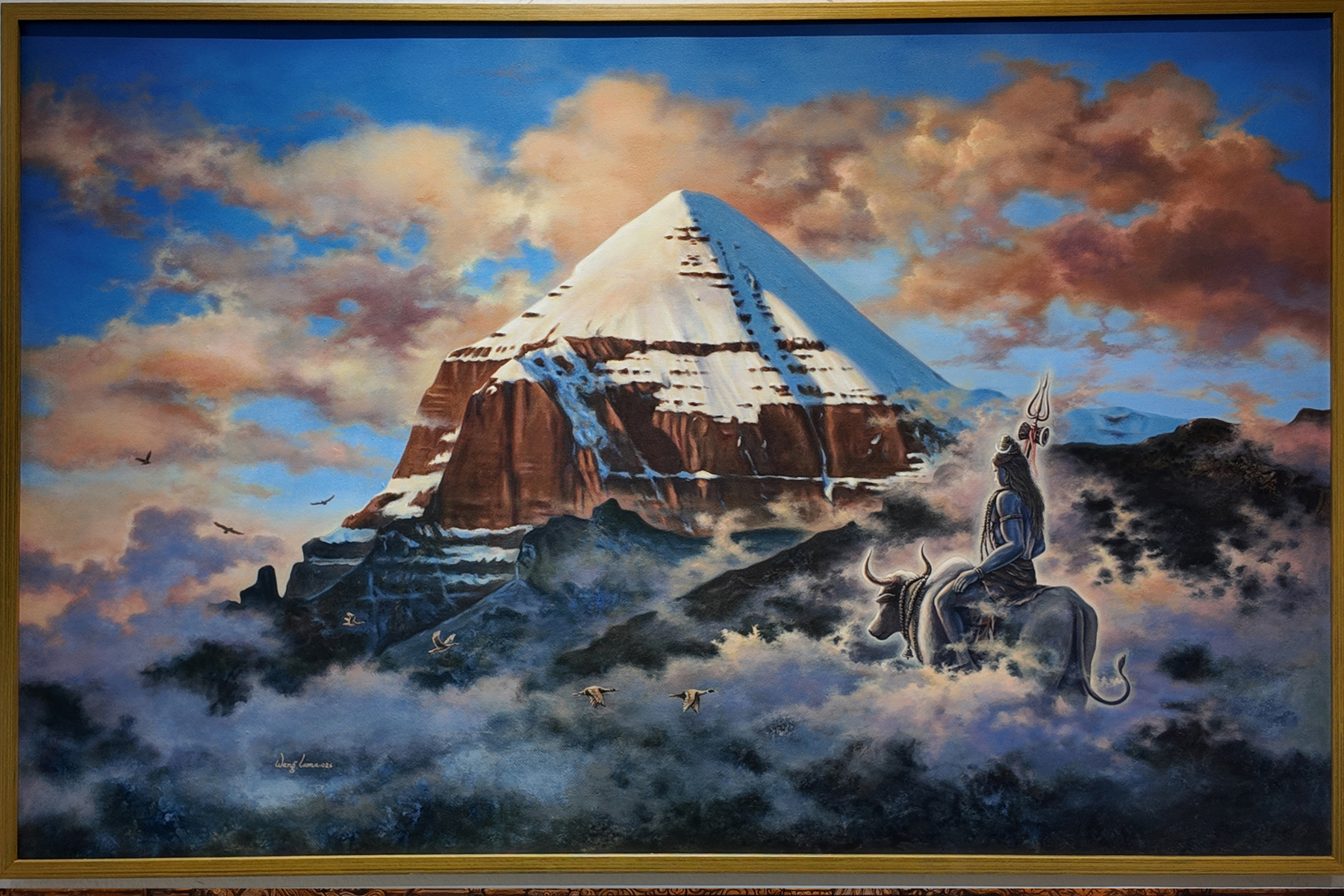
Wang Lama’s depiction of Mount Kailash offers yet another interpretation. Beneath the majestic mountain appears the imagery of Lord Shiva, bringing together landscape, mythology and spirituality. The mountain is not simply geographical—it becomes a sacred landscape, a threshold between the earthly and the divine.
An Exhibition as Cultural Memory
The significance of Deities of Nepal III extends beyond the sheer number of artworks on display. Its deeper value lies in its ability to bring cultural knowledge into a space where different generations can encounter it together.
In an age when cultural memories can easily become distant from everyday life, exhibitions such as this provide a visual means of transmission. A young visitor who may know a deity through a festival or family ritual can encounter another interpretation of that same figure through contemporary art. An art student can observe how an inherited iconography can be transformed through abstraction, mixed media or sculpture. In this sense, the exhibition becomes both an art exhibition and a living archive.
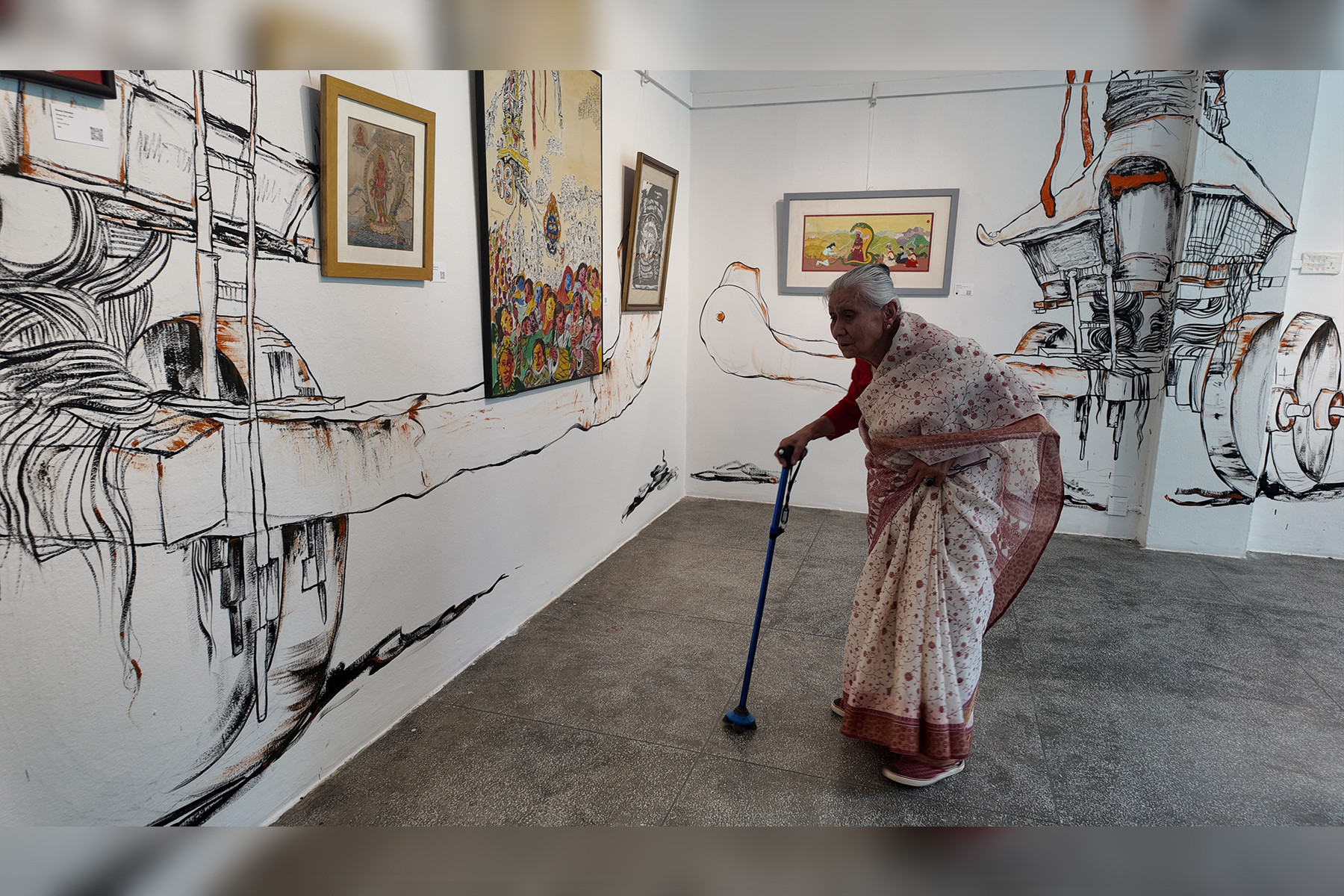
Swosti Rajbhandari Kayastha, the curator of the exhibition, explains the continuity behind the series, “These kinds of exhibition are getting really popular among the artists and art-lovers alike. Thus the artists had asked us to continue this kind of exhibition once in a year, that’s why it’s just a continuum of our second series.”
Her observation also points to something important about the exhibition’s existence. Deities of Nepal III is not simply a repetition of an established format. Rather, each edition creates another opportunity for artists to reconsider the relationship between inherited cultural imagery and the present moment.
An art collector, who preferred to remain anonymous, shared the following observation about the exhibition, “The paintings and sculptures on display are distinctive and visually compelling. However, the prices of several works were higher than I had anticipated. For collectors and visitors, the basis for determining these values was not always clear. The pricing appeared to lack a consistent or transparent system, making it difficult to understand how the final prices were established by the gallery or the artists.”
Many Gods, Many Ways of Seeing
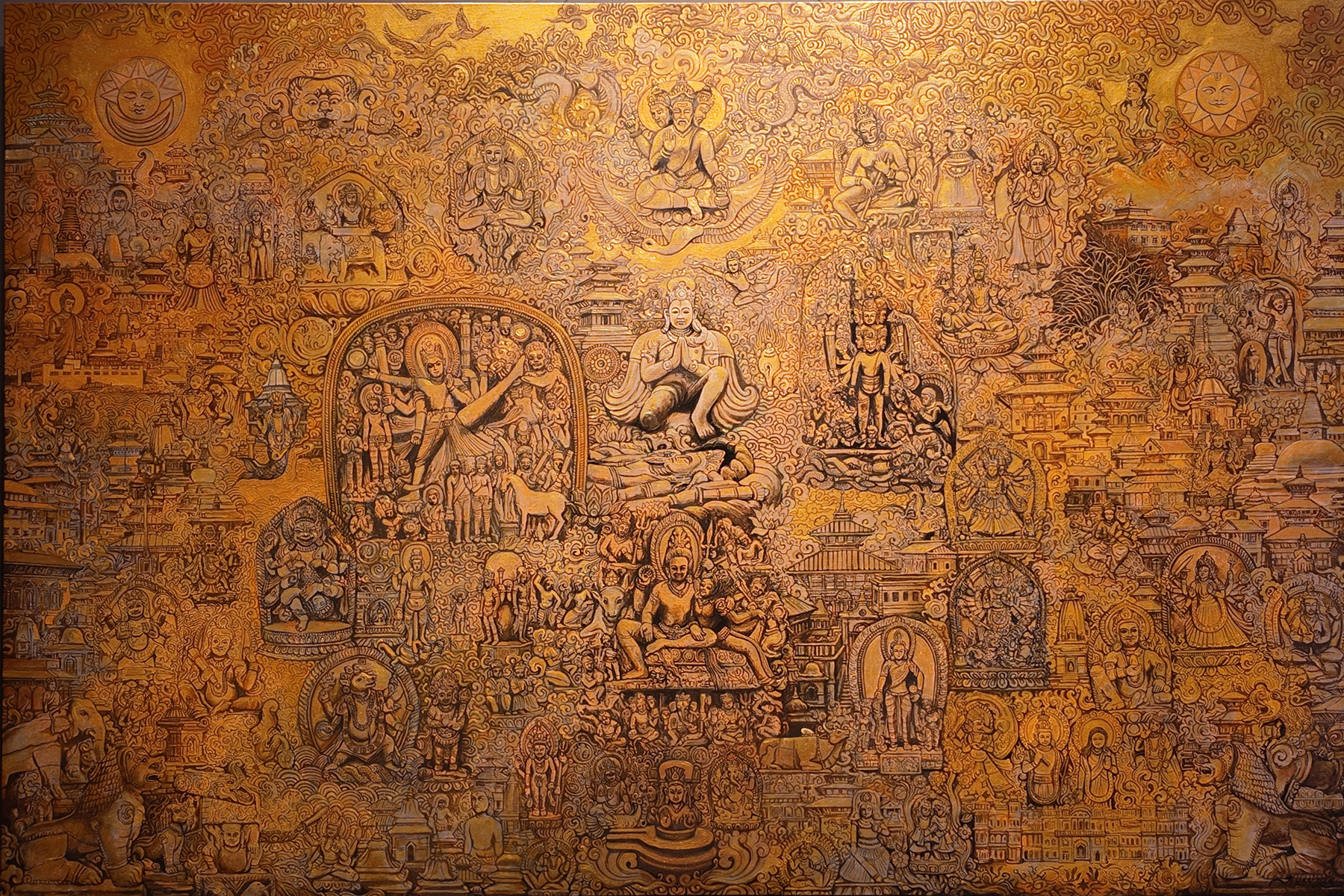
On the third floor, the exhibition continues to reveal yet another collection of interpretations. Ishan Pariyar, known for his detailed works, has brought together parts of different deities within a single canvas. Against a yellow background, the fragments create a visual rhythm that attracts the viewer from a distance and rewards closer observation.
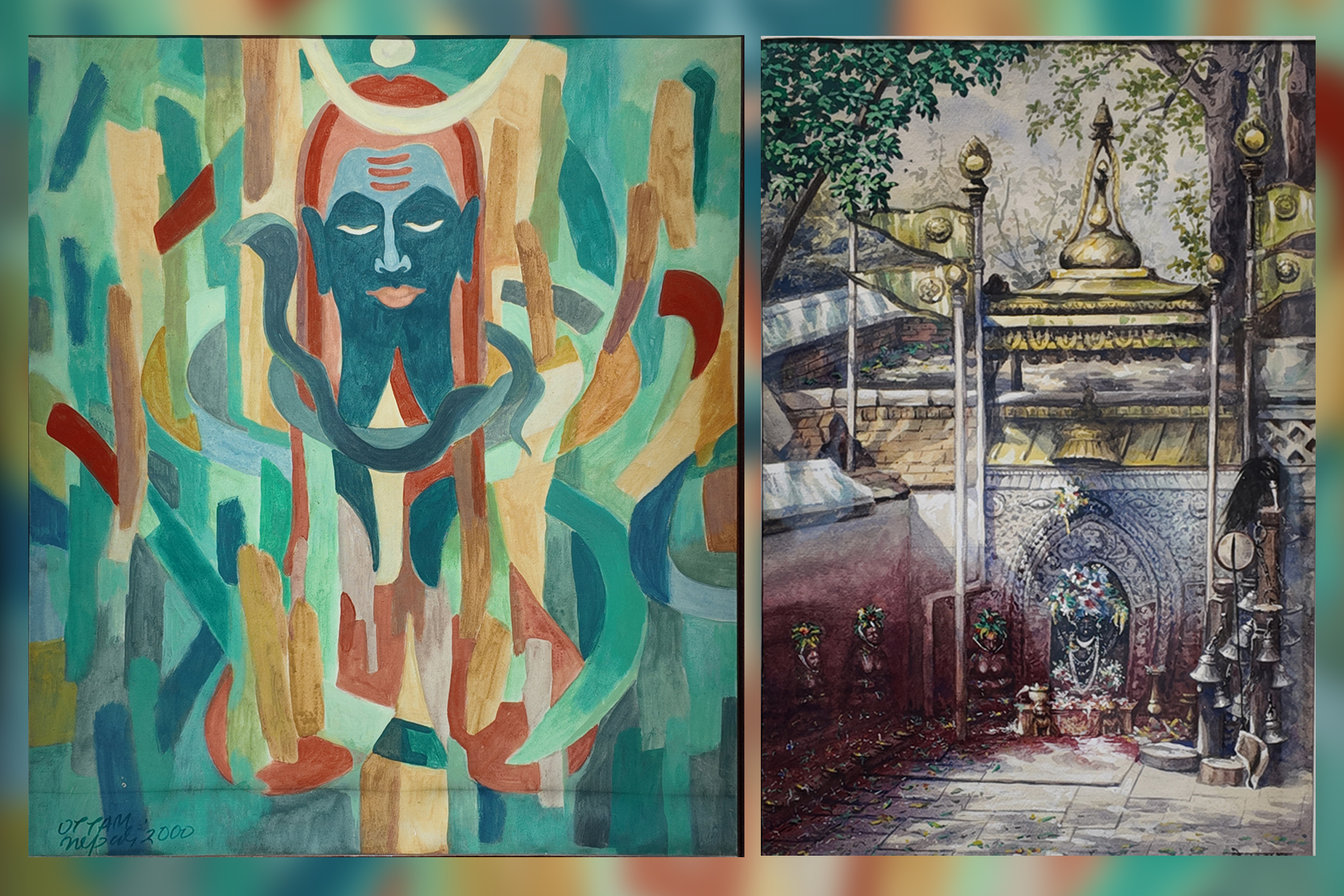
The exhibition also pays tribute to artists whose contributions remain part of Nepal’s artistic history. The works of the late Uttam Nepali and late Tej Bahadur Chitrakar are displayed for the public, allowing their artistic voices to remain part of this contemporary gathering.
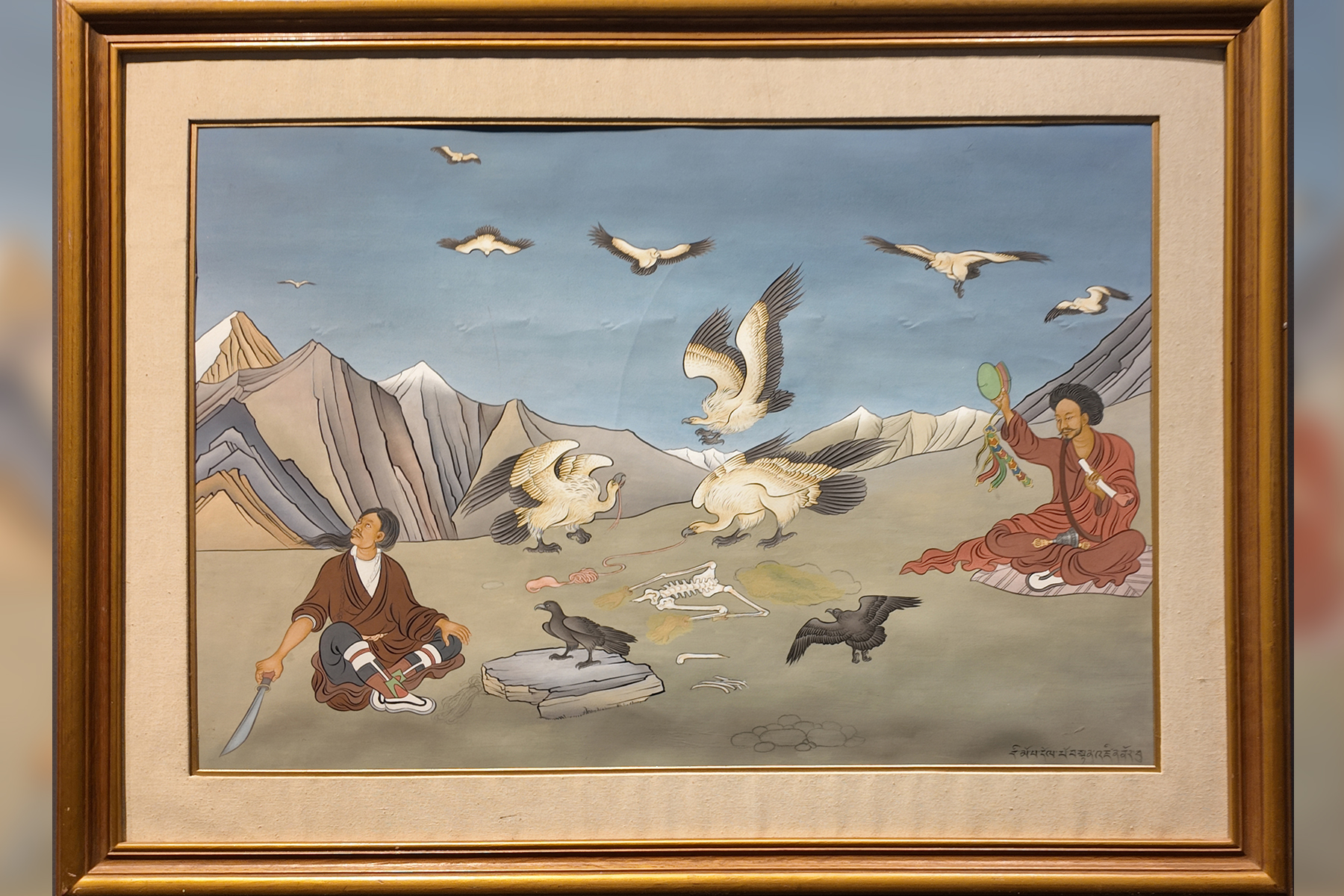
One of the more distinctive spaces belongs to Tenzin Norbu, a senior artist from Dolpo. His works, created using mineral pigments alongside sketches, possess a visual character deeply connected to the landscape and cultural atmosphere of Dolpo. There is something almost transportive in these works; looking at them, the viewer seems to move beyond the gallery walls and towards the remote Himalayan world from which their visual sensibility emerges.
At the top floor, another veteran artist, Jimmy Thapa, offers a markedly different understanding of the relationship between art and spirituality. His paintings incorporate writing into the visual composition, creating works that seem to operate simultaneously as images and meditations.
For Thapa, painting is not merely an exercise in aesthetic pleasure. His approach suggests that art can also become a vehicle for contemplation and heightened consciousness. During the exhibition, he has also been conducting meditation and healing sessions through art, extending the experience of the exhibition beyond the conventional relationship between artwork and viewer.
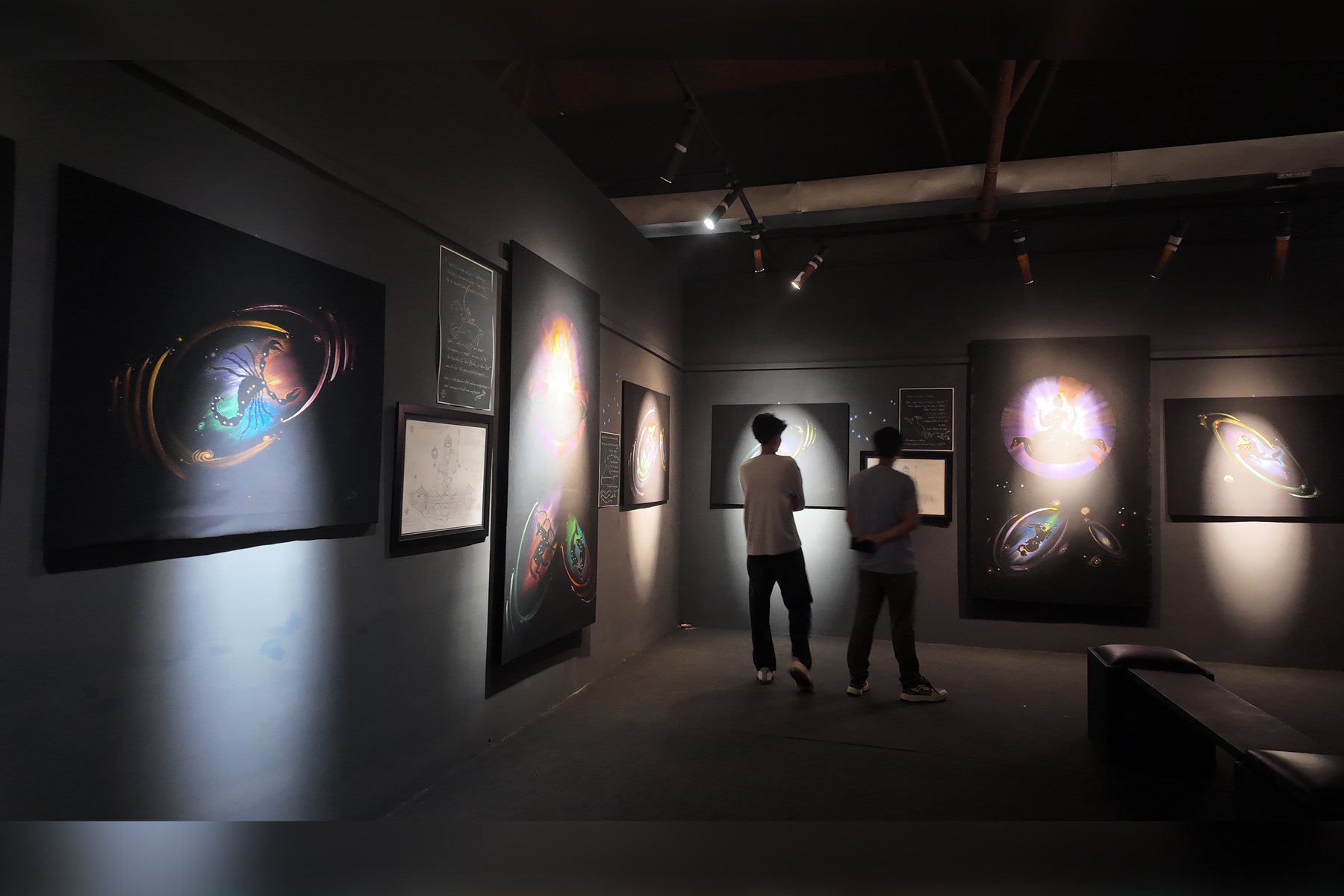
Where the Sacred Meets the Contemporary
Perhaps the greatest strength of Deities of Nepal III: Lores and Legends is that it refuses to place tradition and contemporary art in separate rooms.
Instead, the exhibition allows them to speak to one another.
A deity rendered through an experimental abstract vocabulary stands beside a traditional sculpture. An ancient architectural motif appears through contemporary line work. A sacred mountain becomes a landscape painting. A familiar god is reconstructed through unconventional materials. Mythological imagery enters the language of abstraction, while contemporary artists return to stories that have traveled through generations.
The result is an exhibition that feels less like a static collection and more like a conversation across time.
The gods of Nepal have never belonged exclusively to the past. They continue to live in festivals, rituals, architecture, memory and imagination. Through Deities of Nepal III, they enter once again into the contemporary gallery-not as distant relics, but as subjects capable of generating new questions, new forms and new artistic possibilities.
For visitors to Nepal Art Council, the exhibition offers an opportunity to encounter more than 157 artists within a single cultural and artistic landscape. It invites viewers to slow down before the works, to recognize familiar symbols from unfamiliar perspectives, and perhaps to rediscover the stories that have surrounded Nepali life for generations.
And perhaps that is where the true significance of Lores and Legends lies. The exhibition does not merely preserve the past. It allows the past to continue speaking-to artists, to students, to art lovers and to a new generation of viewers who will carry these stories forward.
For those in and around Babarmahal, Nepal Art Council becomes, for the duration of the exhibition, a particularly meaningful destination. One may enter simply to look at the artworks, but leave carrying something less tangible: a renewed awareness of the visual heritage that has shaped Nepal’s collective imagination. And for collectors and art enthusiasts, the exhibition also offers an opportunity to encounter works by artists across generations-works whose cultural and artistic significance may continue to unfold long after the exhibition itself has closed.

Leave A Comment