




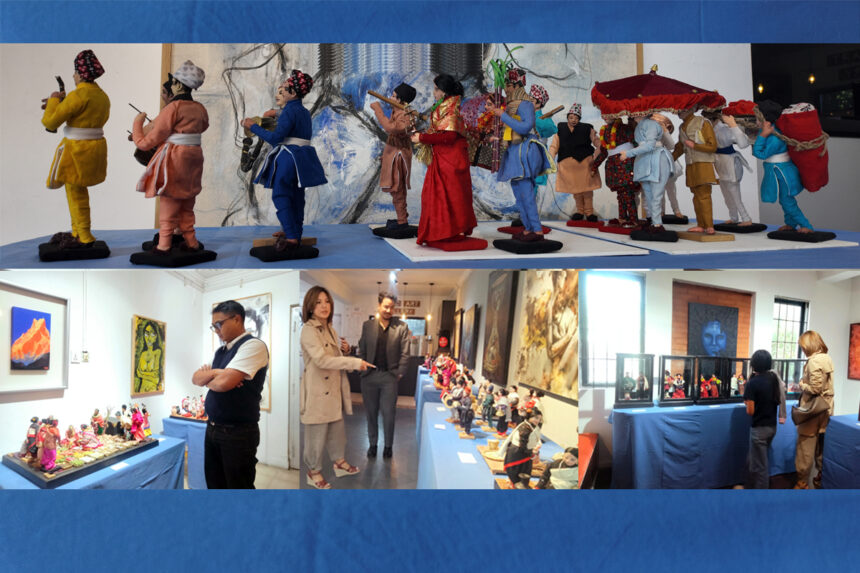
At Music Art Gallery, Sanepa, Padmashree Shrestha transforms the familiar rhythms of Newari life into an intimate world of dolls, preserving the gestures, rituals, and communal memories of a culture through the delicate language of sculpture.
Have you ever wondered what it would feel like to step into the everyday life of a traditional Newari community, where women gather around a communal well, families prepare food using age-old techniques, musicians fill the air with melodies, and wedding rituals bring entire communities together? At Music Art Gallery, Sanepa, artist Padmashree Shrestha offers visitors a glimpse into this world through an unusual and deeply personal exhibition of dolls. Beginning on October 28 and running until November 6, the exhibition transforms the gallery into a miniature cultural landscape in which the traditions of the Newar community unfold through carefully crafted figures and meticulously reconstructed scenes of everyday life.
At first glance, these dolls may appear to be small sculptural objects. Yet, the longer one spends with them, the more they seem to transcend their physical dimensions. Each figure appears caught in the middle of an activity, as though a moment from the past has been gently preserved in time. Their gestures suggest movement, their expressions invite curiosity, and their elaborate clothing and ornaments evoke a world rich in cultural meaning. There is an unusual vitality to these miniature figures: one almost feels that they might resume their activities or begin speaking if only one lingered a little longer.
Such liveliness is the result of Shrestha’s painstaking attention to detail. From the structure of the figures to the folds of their garments, from traditional ornaments to the utensils associated with particular rituals, every element contributes to the authenticity of the scenes. The artist does not merely create dolls; she reconstructs fragments of a cultural landscape, allowing the material details of everyday life to become vessels of collective memory.
Speaking enthusiastically about her creations, Shrestha explains, “These dolls are not only commercial pieces; they represent my ethnicity and origin.”
This statement offers an important key to understanding the exhibition. Her works are not simply decorative objects intended to please the eye or attract a buyer. They emerge from a personal relationship with the traditions they represent, expressing a desire to preserve and share the cultural inheritance of the Newar community. As visitors move from one composition to another, they encounter not merely representations of customary practices but also the intimacy of a lived culture-its rhythms, its social relationships, and its enduring sense of belonging.
One of the first scenes to greet visitors upon entering the gallery depicts women gathered around a traditional well to collect water. The composition recalls a time when communal wells were more than sources of water; they were also places of conversation, encounter, and shared responsibility. Women arrived carrying their pitchers, exchanged news, and participated in the quiet social rituals that shaped the rhythm of their neighbourhoods. As modern urban life gradually transforms such practices in Kathmandu, the scene acquires a particular poignancy. What might once have been an ordinary part of daily existence now carries the weight of nostalgia.
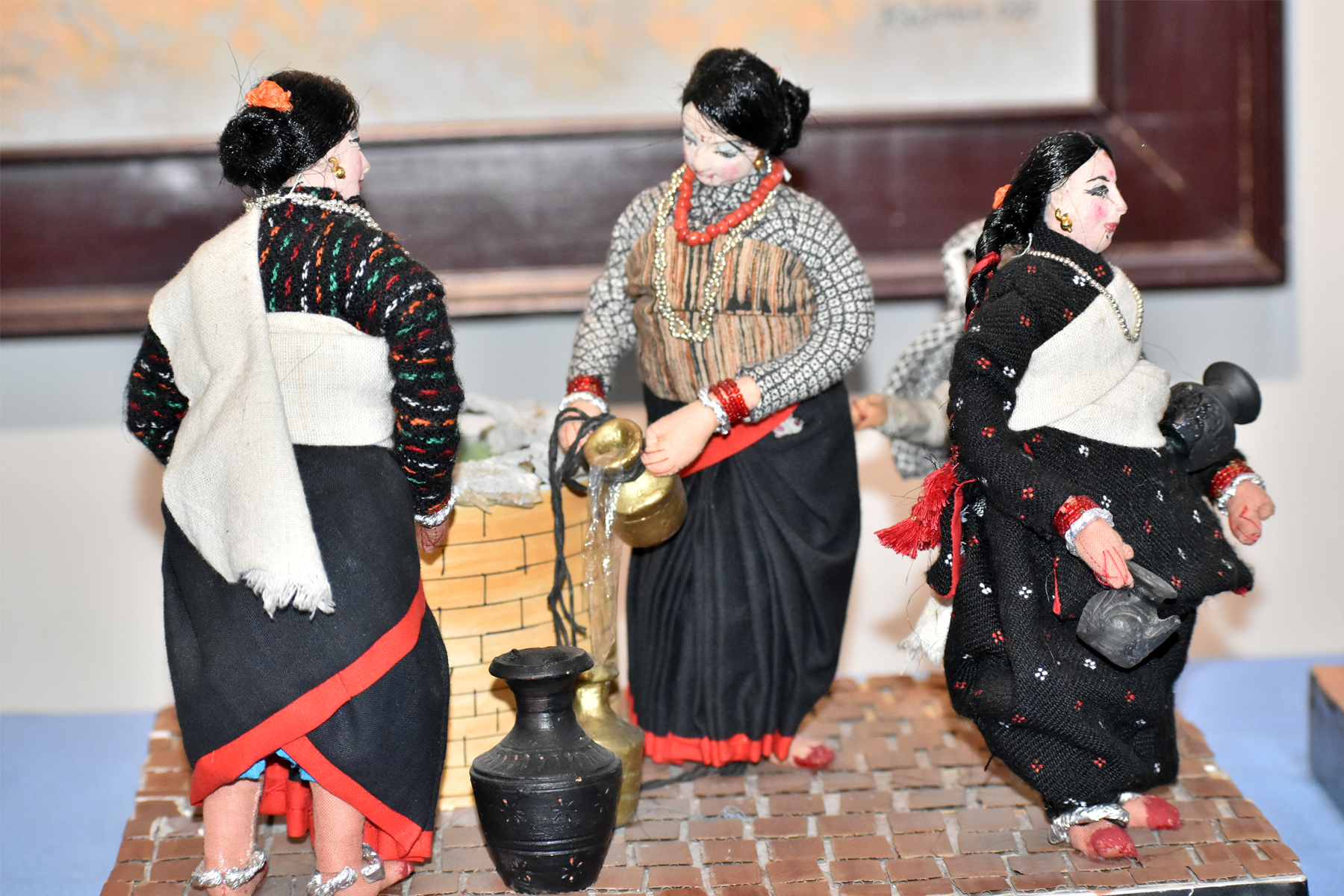
Shrestha carefully recreates the women’s traditional attire, ornaments, and pitchers, allowing the smallest details to contribute to the atmosphere of the scene. The figures appear absorbed in their familiar task, their presence recalling a form of communal life in which everyday labour was inseparable from social connection. Through this composition, the artist invites viewers to revisit a disappearing aspect of urban memory and to consider how seemingly ordinary activities become significant when viewed through the passage of time.
Another composition turns to the preparation of popcorn using a traditional haandi, a clay vessel associated with the process. Here, the familiar act of preparing food becomes a miniature cultural performance. The vessel occupies a central place in the scene, while the woman’s figure suggests the practical knowledge and inherited techniques through which such customs were maintained. The work draws attention to the relationship between people and the objects they use, reminding viewers that cultural traditions often survive through gestures repeated across generations. A vessel, a cooking technique, or the posture of a woman at work may appear commonplace, yet each can hold within it a history of domestic knowledge and cultural continuity.
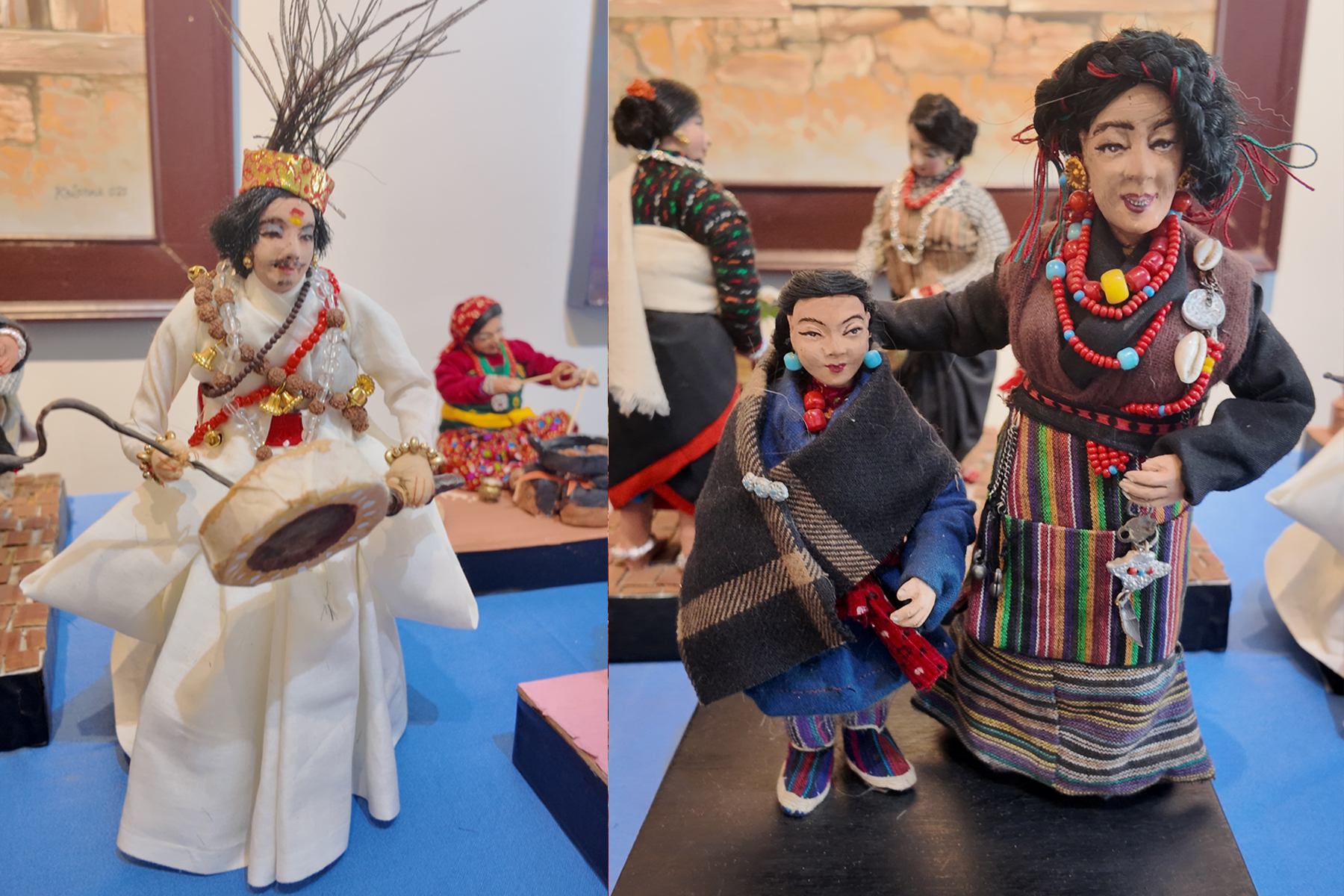
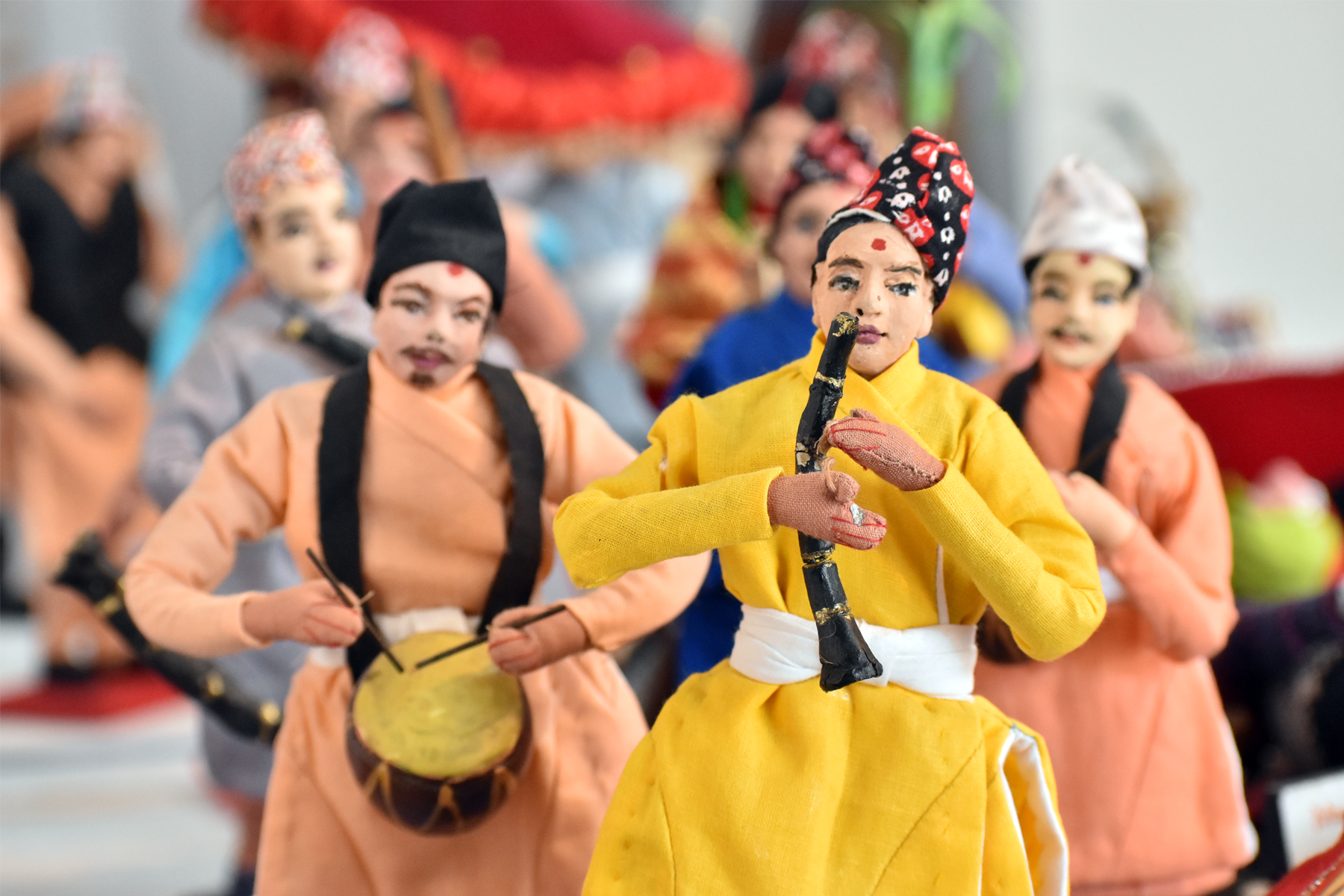
Music, another essential expression of Newari cultural life, finds its place in a separate group of dolls depicting men and women playing traditional musical instruments. Dressed in customary attire, the figures appear united by a shared rhythm. Their arrangement suggests more than a musical performance; it evokes the collective spirit through which music accompanies festivals, ceremonies, and community gatherings. In this composition, Shrestha brings together clothing, instruments, and human gestures to create a scene that seems to extend beyond the boundaries of its frame. Although the figures remain still, one can almost imagine the sounds that might fill the space around them.
The theme of togetherness becomes even more pronounced in a scene depicting women preparing beaten rice through traditional methods. Before the convenience of modern machinery and commercial food production became widespread, such activities often involved collective effort, with members of a community working alongside one another. Shrestha recreates this shared labour with considerable precision, paying attention to the characteristic tools, utensils, postures, and arrangements of the figures. The result is a composition that encourages viewers to look beyond the activity itself and recognise the social relationships embedded within it.
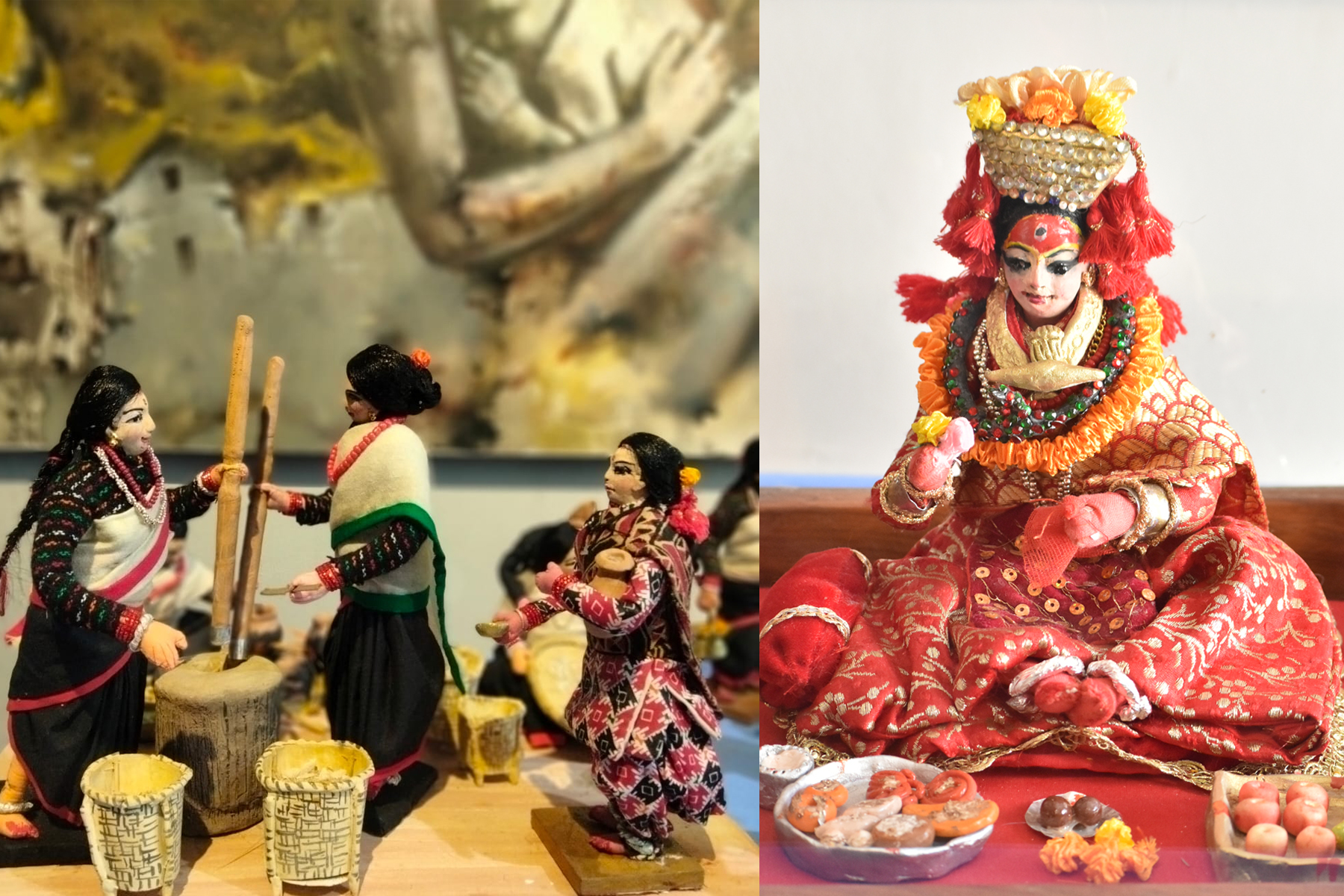
The scene is particularly evocative because it recalls a time when the preparation of food could become a communal occasion rather than an isolated domestic task. Work, conversation, and companionship existed together, binding people through repeated acts of cooperation. The more closely one examines these miniature arrangements, the more one begins to appreciate the richness of the world they contain. Their small scale does not diminish their cultural significance; instead, it encourages an intimate kind of looking, in which details gradually reveal the larger social landscape to which they belong.
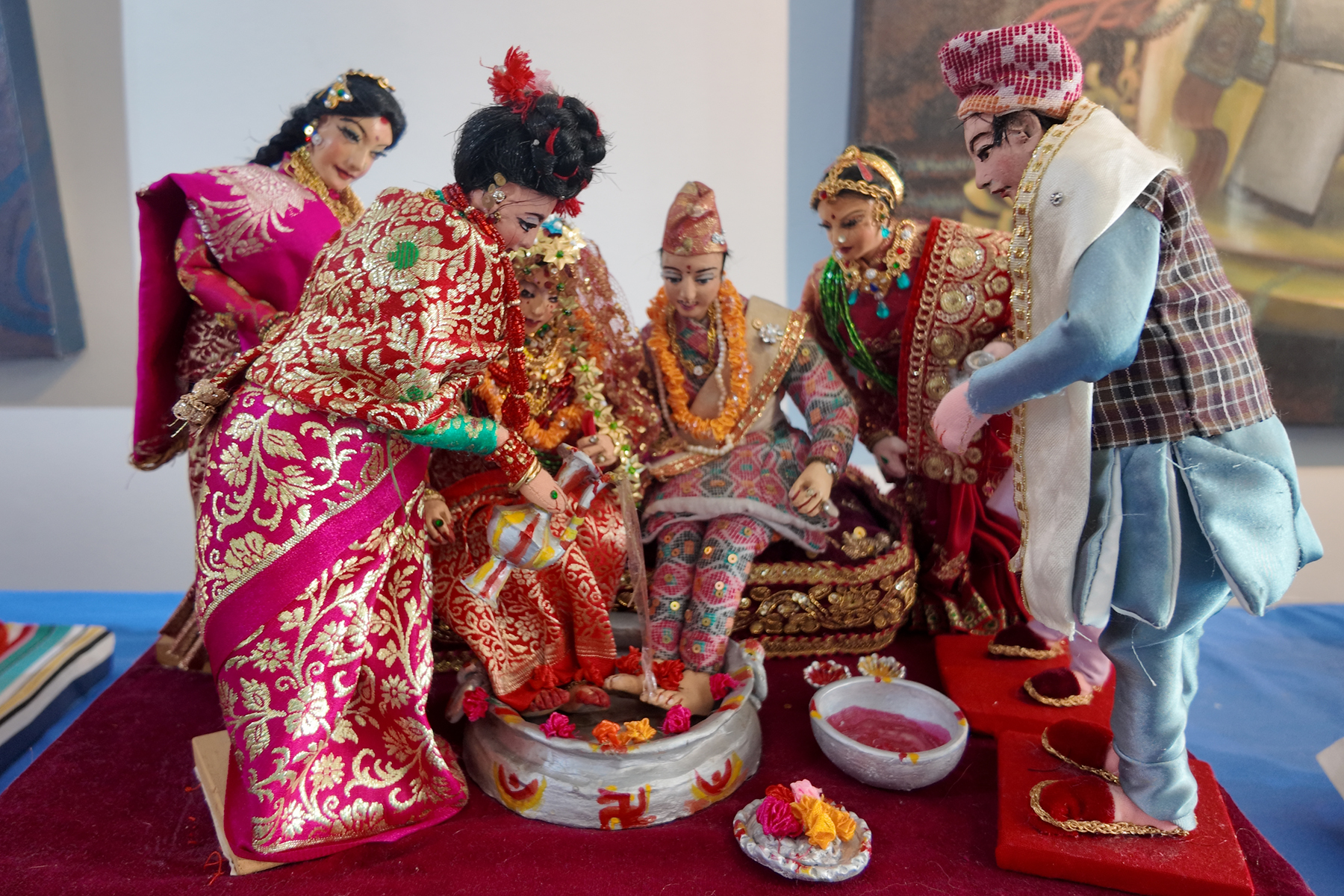
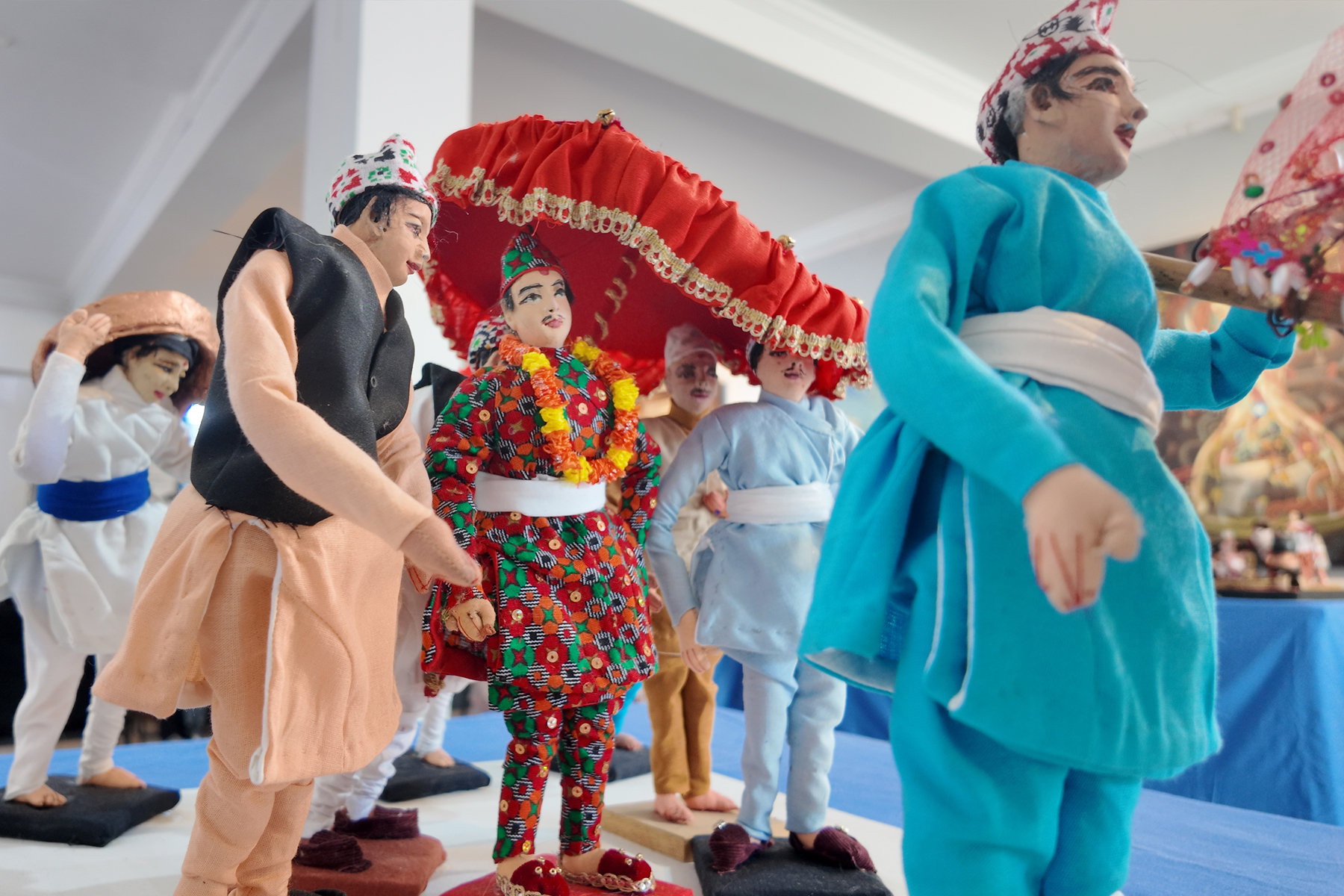
Among the cultural practices represented in the exhibition, the Newari marriage ceremony holds a special place. Marriage rituals are significant occasions in Newar communities, involving elaborate customs, exchanges, and the participation of extended families. Shrestha presents a particular ritual associated with the giving of gifts between families, drawing attention to the customary process through which such exchanges are acknowledged and reciprocated. As described in the exhibition, gifts presented by the groom’s side are recorded, and the practice of returning gifts forms part of the wider ceremonial exchange.
Through this scene, the artist captures an aspect of marriage that extends beyond the union of two individuals. The exchange of gifts becomes a visible expression of social relationships, mutual recognition, and customary obligations. The figures, their attire, and the carefully arranged objects collectively suggest the importance of ritual in maintaining connections between families. What might otherwise remain an intricate cultural practice becomes accessible through a small but expressive sculptural arrangement.
Taken together, these scenes reveal the breadth of Shrestha’s interests. Her subjects are drawn not only from ceremonies and festivals but also from the ordinary activities through which culture is lived and transmitted. Collecting water, preparing food, playing music, and participating in marriage rituals may belong to different spheres of daily life, yet they are connected by a common thread: each reflects a way of being together. In Shrestha’s miniature world, culture is not presented as an abstract idea or a distant historical inheritance. It is embodied in people, objects, gestures, and relationships.
The practice of doll-making itself has a history in Nepal, sustained by artists and craftspeople who have translated aspects of social and cultural life into miniature forms. Shrestha acknowledges this lineage, with the name of Kiran Maskey among those associated with the tradition. Works by earlier doll-makers preserved in institutions such as the National Museum offer an important point of reference for understanding how these figures can function as artistic creations as well as records of cultural life. Shrestha’s exhibition enters into this wider history while maintaining the intimacy of her own relationship with the subjects she portrays.
Her interest in doll-making began in childhood, when her grandmother would make dolls for her. What began as an experience of affection and fascination gradually developed into a lasting artistic interest. Later visits to museums, where she encountered dolls displayed as cultural objects, further strengthened her curiosity. These early experiences seem to have established the foundation for a practice that brings together personal memory, visual observation, and a desire to preserve tradition.
For inspiration, Shrestha consults photographs and books, studying the subjects and details that might inform her next creation. Her artistic education also played an important role in shaping her practice. She studied sculpture and painting under Govinda Lal Singh Dangol and Sunil Ranjit, whose guidance and encouragement helped nurture her artistic development. The influence of this training can be seen in the attention she gives to form, composition, and the visual organisation of her miniature scenes.
The present exhibition marks her seventh doll exhibition at Music Art Gallery, an indication of her continuing engagement with the medium. Over time, this sustained practice has allowed her to explore a variety of subjects while returning to the cultural world that inspires her. Her dolls occupy an interesting space between sculpture, storytelling, and cultural documentation. They are made to be seen as artworks, yet they also invite viewers to read them as narratives, discovering in each figure a fragment of a larger story.
For younger generations, these works may offer a particularly meaningful encounter with Newari heritage. Many customs that once formed an ordinary part of community life are becoming less familiar as urban spaces, technologies, and lifestyles change. A miniature scene can provide an accessible point of entry into these traditions, encouraging younger viewers to ask questions about the objects, rituals, and practices represented before them. In this sense, the exhibition is not simply an act of remembrance; it is also an invitation to curiosity and intergenerational dialogue.
There is something quietly compelling about the way these dolls hold time. Their scale invites close attention, while their detailed surroundings encourage viewers to imagine the lives extending beyond the edges of each composition. A woman standing beside a well, a figure preparing food, or a group of musicians may occupy only a small space within the gallery, yet each suggests a much larger world of relationships, memories, and inherited knowledge. The stillness of the figures becomes a means of recalling movement; their silence becomes a way of imagining sound and conversation.
Shrestha’s exhibition reminds us that cultural preservation does not always require monumental gestures. Sometimes, it begins with the careful recreation of a familiar object, the arrangement of a traditional garment, or the preservation of a gesture that might otherwise disappear from everyday life. Through her dolls, the artist gives these details a renewed presence, allowing visitors to encounter tradition not as something distant or frozen but as a living inheritance carried through memory and artistic imagination.
The exhibition also offers an opportunity to meet the artist herself. Shrestha is present at the gallery each day, giving visitors the chance to learn more about the stories and inspirations behind her creations. The dolls are available for purchase at accessible prices, making them potential souvenirs for the festive season-gifts that carry more than decorative appeal. For those seeking something meaningful to share with family and friends, they offer a small piece of Nepal’s cultural imagination, carefully shaped by hand.
At Music Art Gallery, Padmashree Shrestha’s miniature figures invite us to pause before the familiar and look again. In their carefully modelled forms and reconstructed scenes, everyday customs acquire the quiet dignity of art. They remind us that heritage resides not only in grand monuments, celebrated ceremonies, or the pages of history, but also in the ordinary gestures through which people live, work, celebrate, and remain connected to one another. Each doll holds a story; together, they form a tender portrait of a culture whose traditions continue to find new ways of being remembered.

Leave A Comment