



At Gallery Takpa, Lazimpat, four distinct artistic sensibilities come together in an exhibition aptly titled Crossroad. Bringing together the works of four artist-academicians associated with Kathmandu University, the exhibition offers a meeting point of individual experiences, visual languages and creative explorations. Featuring Sagar Manandhar, Pratima Thakali, Sujan Dangol and Anil Shahi, the exhibition unfolds as a conversation between artists whose approaches to art-making are markedly different, yet whose works find a common ground within the gallery space. The title Crossroad seems particularly appropriate: it suggests not merely a physical meeting of four artists, but an intersection of ideas, emotions, materials and personal journeys that have shaped their respective practices.
Although these artists share an academic association, their artistic expressions move along remarkably different trajectories. Each approaches the canvas and its possibilities through an individual vocabulary, drawing from personal experiences, observations and an enduring curiosity about the medium itself.
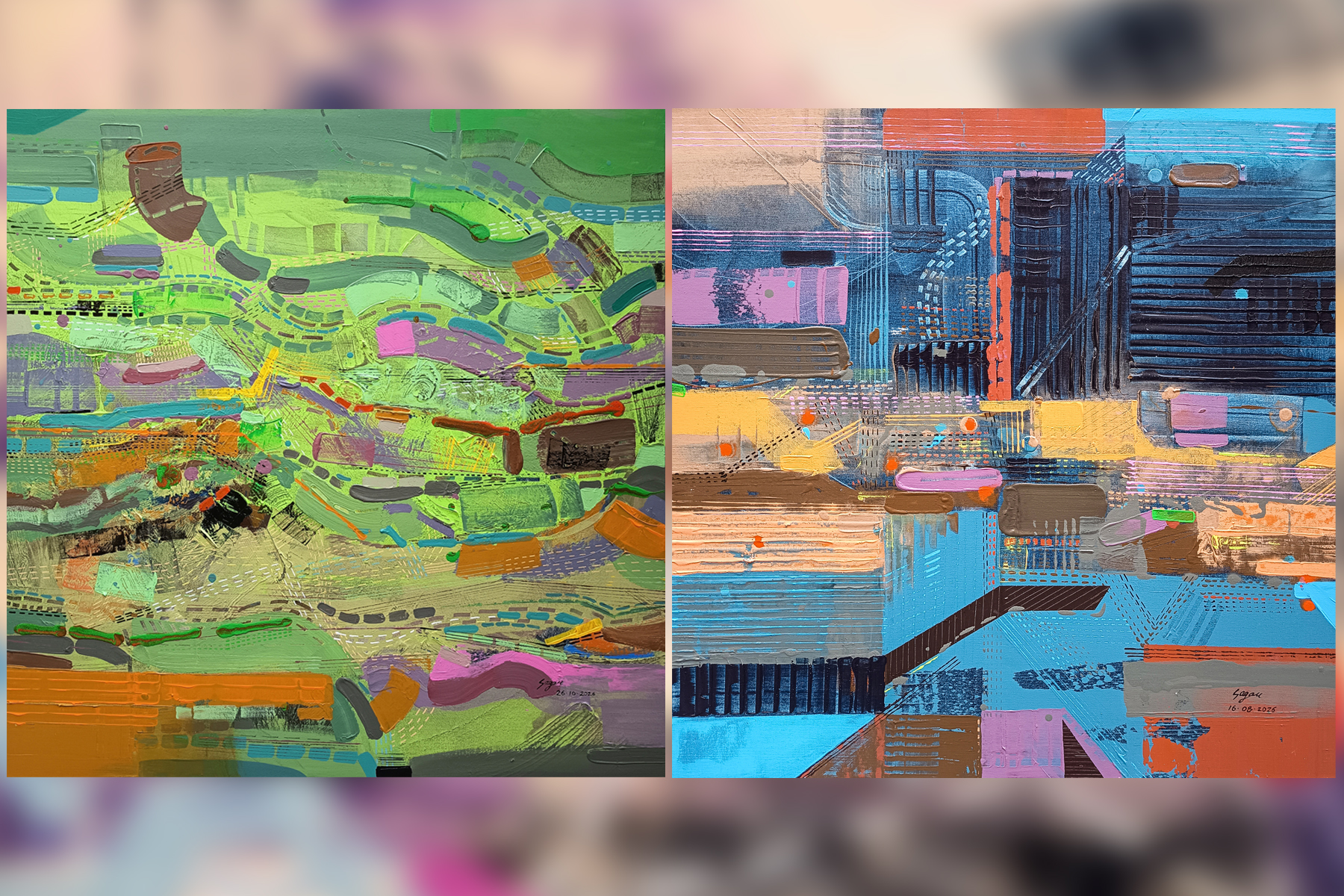
Sagar Manandhar, who has established himself through his sustained engagement with abstraction, brings another dimension to his exploration of color and form in this exhibition. Known for his willingness to experiment with visual structures and chromatic possibilities, Manandhar approaches abstraction not as a departure from reality, but as an alternative way of experiencing it. His present works reveal a refreshing interplay of colors, shapes and arrangements that seem to evoke fragments of the urban landscape. Rather than presenting recognizable city-scapes, he allows their impressions to emerge through abstract compositions, leaving room for individual interpretation.
In an earlier exhibition, Manandhar explored the relationship between visual expression and the sounds of musical instruments, translating an essentially auditory experience into a visual language. The distance between what is heard and what is seen became an intriguing territory for artistic investigation. His present works, however, seem to move towards a different sensory experience. The colors and forms possess a certain fluidity, almost as though they are quietly moving beyond the boundaries of the canvas and finding their way into the viewer’s imagination. There is no single narrative demanding attention; instead, the paintings invite viewers to pause, observe and allow their own associations to take shape. It is this openness of interpretation that lends his abstract compositions a distinctive appeal.

Pratima Thakali, meanwhile, approaches her artistic expression through a quieter and more contemplative visual language. Her works often rely on seemingly simple imagery, yet their emotional resonance extends well beyond what initially meets the eye. In this exhibition, she continues to engage with the subject of migration, a theme that appears to occupy a deeply personal space within her artistic practice. Through her paintings, migration emerges not simply as the physical movement of people from one place to another, but as an experience marked by separation, memory, longing and the search for belonging.
Blue occupies a significant place in her recent compositions. Its presence lends the paintings a certain visual tranquility, gently drawing the viewer into their contemplative atmosphere. Yet beneath this apparent calmness lies a lingering sense of melancholy. The figures and images seem to inhabit spaces of solitude, as though caught between the familiarity of a remembered home and the uncertainty of an unfamiliar destination. Thakali’s paintings do not attempt to explain the complexities of migration through elaborate narratives. Instead, they allow emotions to surface through restrained imagery and carefully considered compositions. There is something quietly evocative about this simplicity: the paintings leave behind an impression that continues to linger even after the viewer has moved away from them.

Anil Shahi, another artist whose practice is distinguished by experimentation, brings a deeply personal dimension to the exhibition through three paintings. His works appear to draw upon the challenges, struggles and experiences that have shaped his life, translating personal encounters into symbolic visual narratives. The recurring image of a diamond becomes particularly significant in understanding his compositions. Traditionally associated with luxury, brilliance and enduring strength, the diamond also possesses an extraordinary hardness. Shahi seems to draw upon these contrasting associations to explore the relationship between vulnerability and resilience.
In one of his paintings, arrows appear to penetrate the diamond, creating an unsettling visual encounter. The image suggests the possibility of even the hardest structures being affected by the pressures and difficulties of life. It is a metaphor that invites viewers to look beyond the apparent strength of an object and consider the vulnerabilities concealed within it. In another composition, a Stupa emerges from the diamond, introducing a spiritual dimension to the narrative. The third painting presents an altogether different atmosphere: flowers blossom around the diamond while butterflies gather, seemingly drawn towards their nectar. The imagery introduces a sense of renewal and transformation, suggesting that growth and beauty may emerge even in the midst of difficult experiences.
Taken together, these three works can be read as different stages of an ongoing personal journey, moving between adversity, spiritual reflection and the possibility of renewal. The predominantly monochromatic treatment further reinforces this introspective quality. By limiting the color palette, Shahi creates an atmosphere in which the symbolic elements assume greater prominence. His works remind us that hardship is not an experience confined to a particular individual; it is something that finds its way into everyone’s life in different forms. Translating such experiences into visual metaphors requires a certain degree of introspection, and Shahi’s paintings offer viewers an opportunity to encounter those emotions through their own interpretations.

Sujan Dangol, on the other hand, takes the exhibition into the realm of material experimentation through his engagement with cynotype-based experimental prints. Moving beyond the line-based visual language for which he is familiar to many viewers, Dangol explores the expressive possibilities of an alternative printing process. His present works revolve around the richness of soil, a subject that carries ecological, cultural and philosophical associations.
Soil, in Dangol’s exploration, is far more than the ground beneath our feet. It is a living foundation that sustains countless forms of life while holding traces of human history, cultural practices and the natural environment. It accommodates an extraordinary range of microorganisms, including bacteria and other microscopic life forms, most of which remain invisible to the human eye. By bringing attention to this largely overlooked world, Dangol invites viewers to reconsider their relationship with something that is often taken for granted.
His experimental prints offer a different visual experience, encouraging audiences to look closely at the textures, patterns and impressions produced through the process. The works also reflect his willingness to move beyond the comfort of a familiar medium. Although his line-based compositions have attracted considerable attention, Dangol does not appear inclined to remain confined to a single artistic vocabulary. Instead, he continues to explore new materials and processes, allowing each experiment to open up another possibility for expression. The works presented in Crossroad are a reflection of this continuing curiosity and his readiness to engage with art through different material languages.
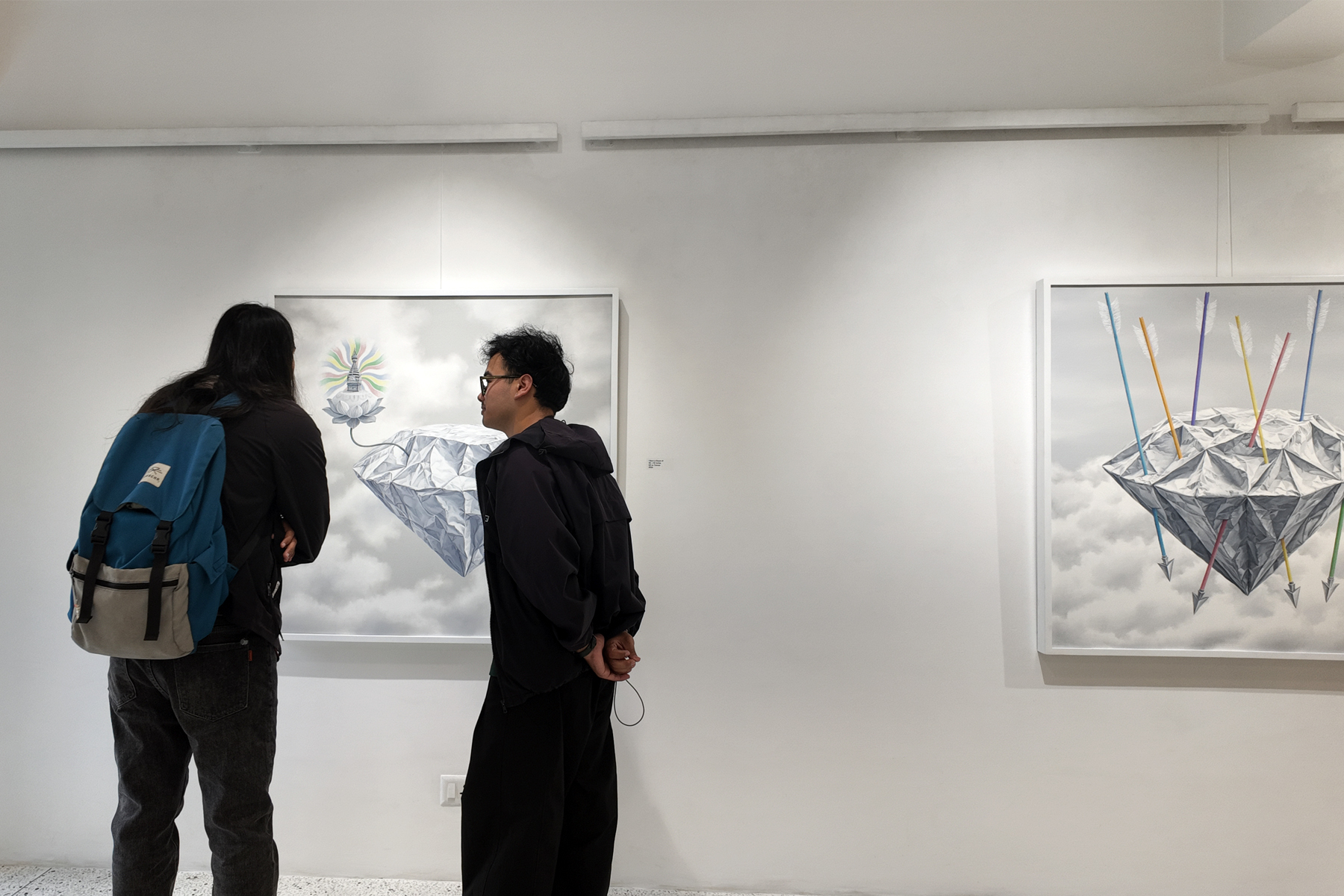
The exhibition also appears to have been carefully considered in terms of its spatial arrangement. The individual works maintain their distinct identities without overwhelming one another, allowing the gallery to develop a visual rhythm of its own. Roshan Bhandari, one of the visitors to the exhibition, shares a similar observation. Reflecting on the works, he remarks, “The artists showcasing their artworks have long been experimenting with the works they create. Since the spaces in the gallery hall have been carefully arranged, a sense of visual harmony can be experienced throughout the gallery. Their mediums of expression are also distinct, and the exhibition is certain to leave a lasting impression on the minds of its audiences.”
Perhaps what makes Crossroad particularly engaging is that it does not attempt to bring these four artists under a single artistic philosophy. Their differences remain visible, and it is precisely these differences that give the exhibition its character. Manandhar’s abstract explorations, Thakali’s contemplative reflections on migration, Shahi’s symbolic narratives of personal resilience and Dangol’s material experiments with soil each offer a different way of looking at the world. Yet, when encountered together, they create a larger conversation about the many possibilities of artistic expression.

In this sense, Crossroad becomes more than a collective presentation of artworks. It is a meeting point of individual journeys, where different experiences and artistic convictions briefly converge before continuing along their own paths. The exhibition offers an opportunity to witness how four artists, despite their distinct approaches, remain united by a shared curiosity about the world and the possibilities of translating their observations into art.
The exhibition opened on 14 November at Gallery Takpa, Lazimpat, and will remain on view until 12 December. For those interested in contemporary Nepali art and the evolving practices of its artists, Crossroad offers a worthwhile encounter. A visit may also provide an opportunity to engage in conversations with the artists themselves, whose thoughts and reflections could add another dimension to the experience of viewing their works.

Leave A Comment