
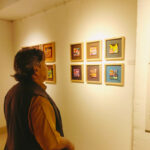
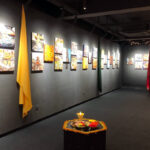


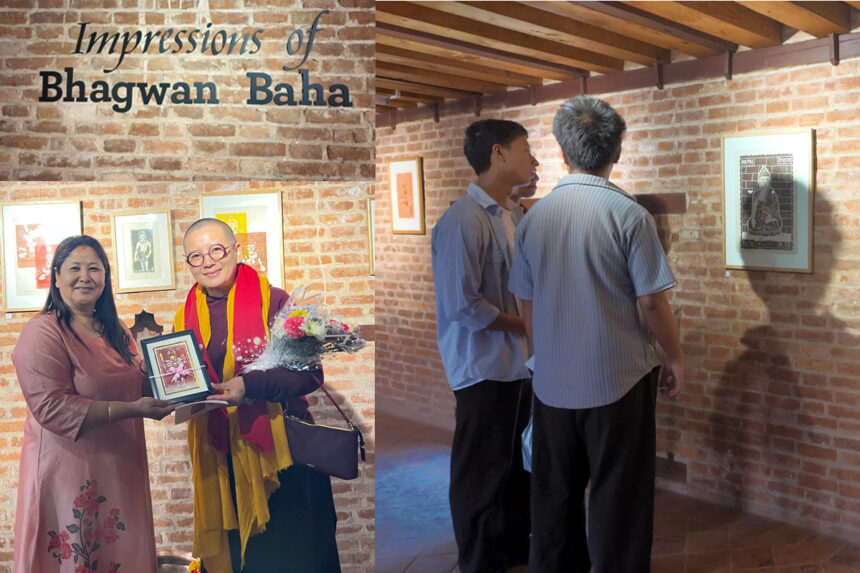
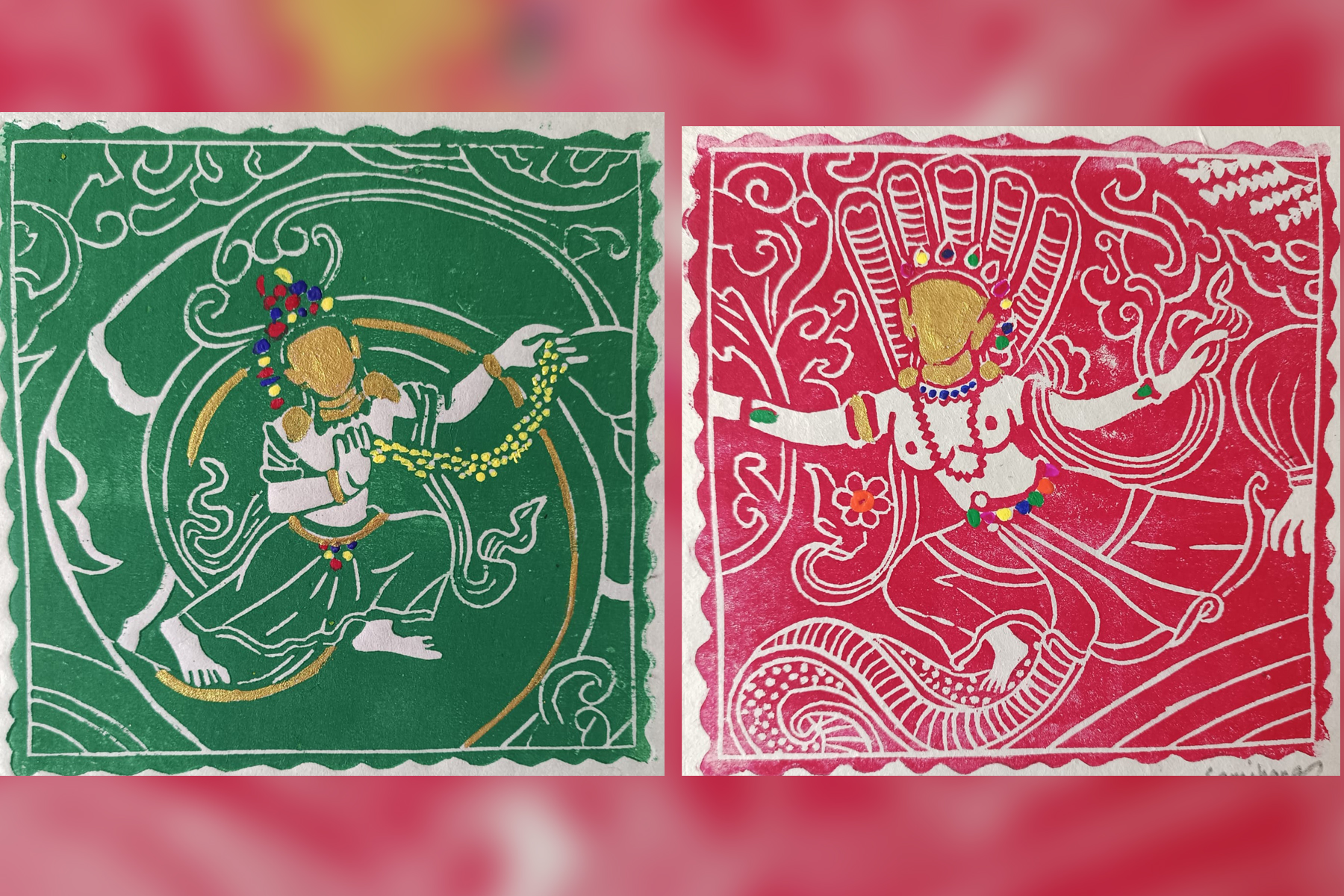
In the layered cultural memory of the Kathmandu Valley, myths are never entirely past. They survive through rituals, architecture, processions, oral narratives, and increasingly, through contemporary art. The recent works of artist Samjhana Rajbhandari revisit one such enduring narrative rooted in Bhagwan Bahal- also known as Vikramsheel Mahavihar- one of Kathmandu’s oldest and most historically resonant monastic courtyards. Through woodblock prints oscillating between mythology, memory, and contemporary interpretation, Rajbhandari opens an intriguing dialogue between ancient Newar cosmology and the evolving language of Nepali modern art. Her works reimagine the gods and goddesses associated with the Bahal, transforming inherited iconographies into layered contemporary reflections.
Bhagwan Bahal, situated within the dense urban rhythm of Thamel, exists today almost like a hidden temporal pocket. Tourists move around it, commerce surrounds it, modernity presses constantly against its walls, yet within the courtyard survives a different experience of time. The Bahal remains deeply connected to the legend of Singhasartha Bahu, the merchant whose story continues to echo through the cultural consciousness of the valley.
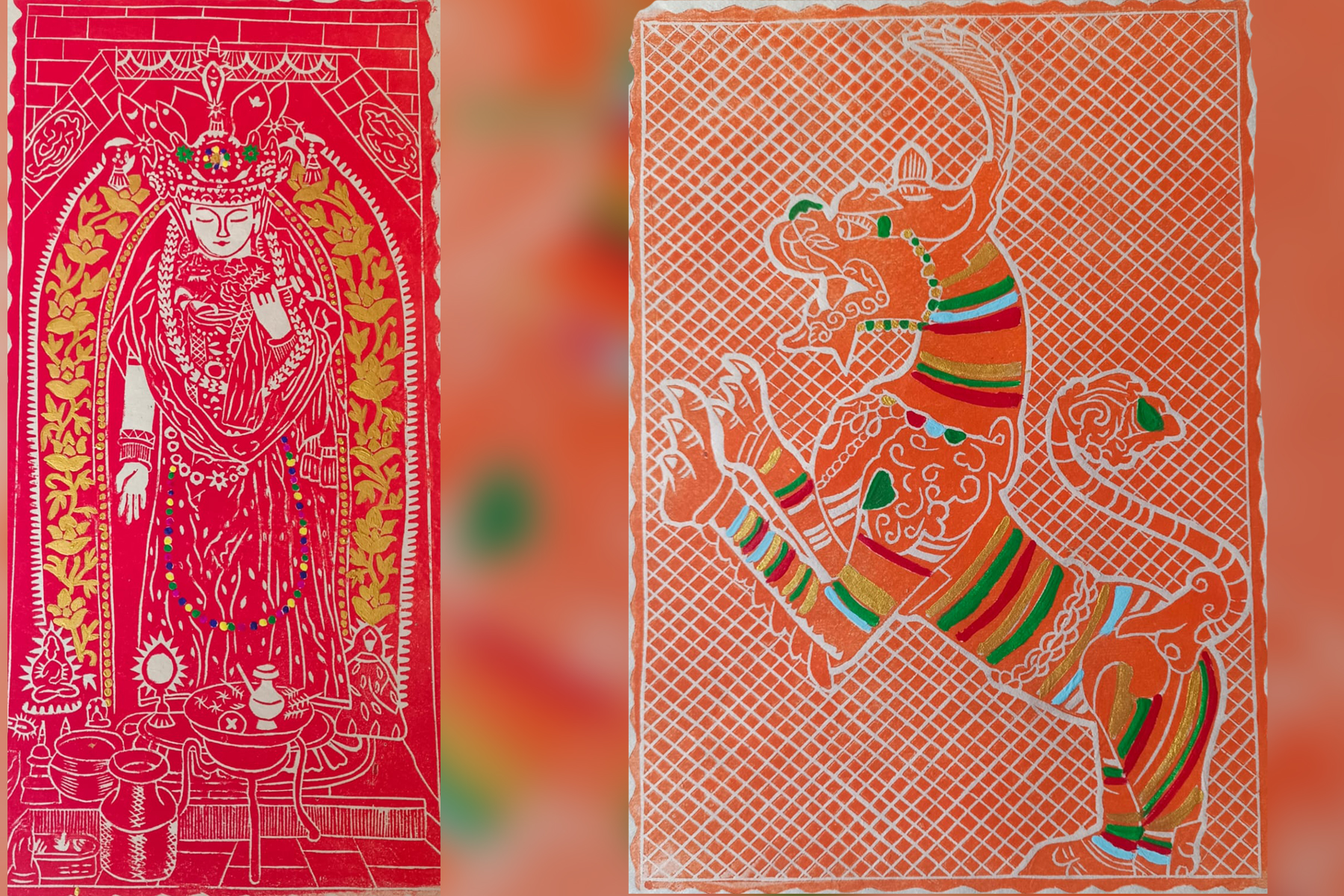
According to the myth, Singhasartha traveled to Tibet with fellow merchants on a trading expedition. There, they were enchanted and trapped by demonesses. Only through the intervention of Avalokeshwore was Singhasartha rescued, while many of his companions perished. Yet even after returning to Kathmandu, the demonic forces followed him and were ultimately restrained near Bhagwan Bahal itself.
The significance of this narrative extends far beyond folklore. Myths function as cultural mechanisms through which societies construct morality, fear, divinity, and collective identity. In the Kathmandu Valley, stories rarely remain mere stories; they evolve into ritual structures, architectural symbolism, jatras, and social memory. Much like Kumari Jatra, Ghode Jatra, or Rato Machhindranath Jatra- where divine intervention gradually transformed lived events into ritualized cultural spectacles- the Singhasartha narrative similarly transcended its origin and embedded itself into the spatial and spiritual identity of Bhagwan Bahal.
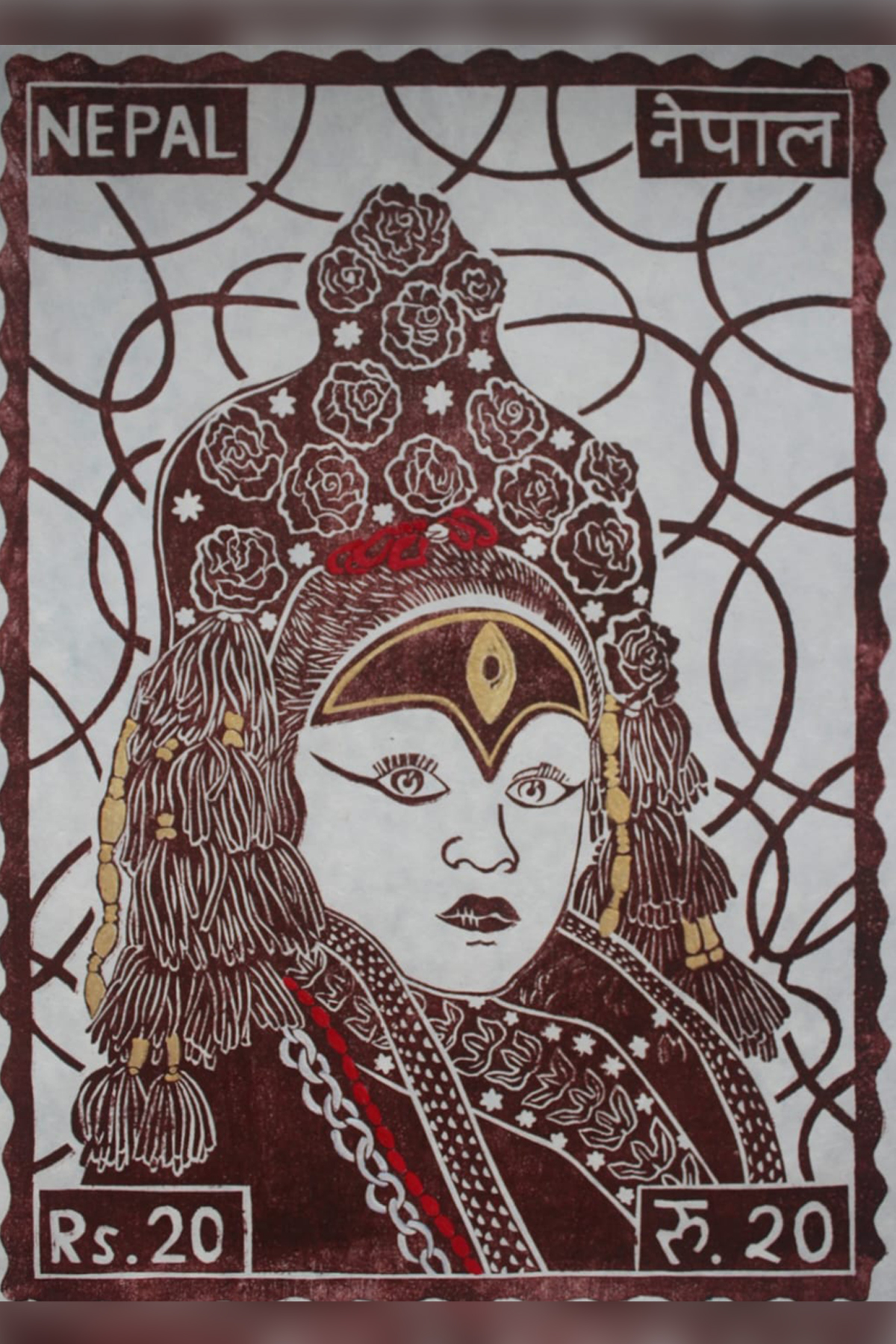
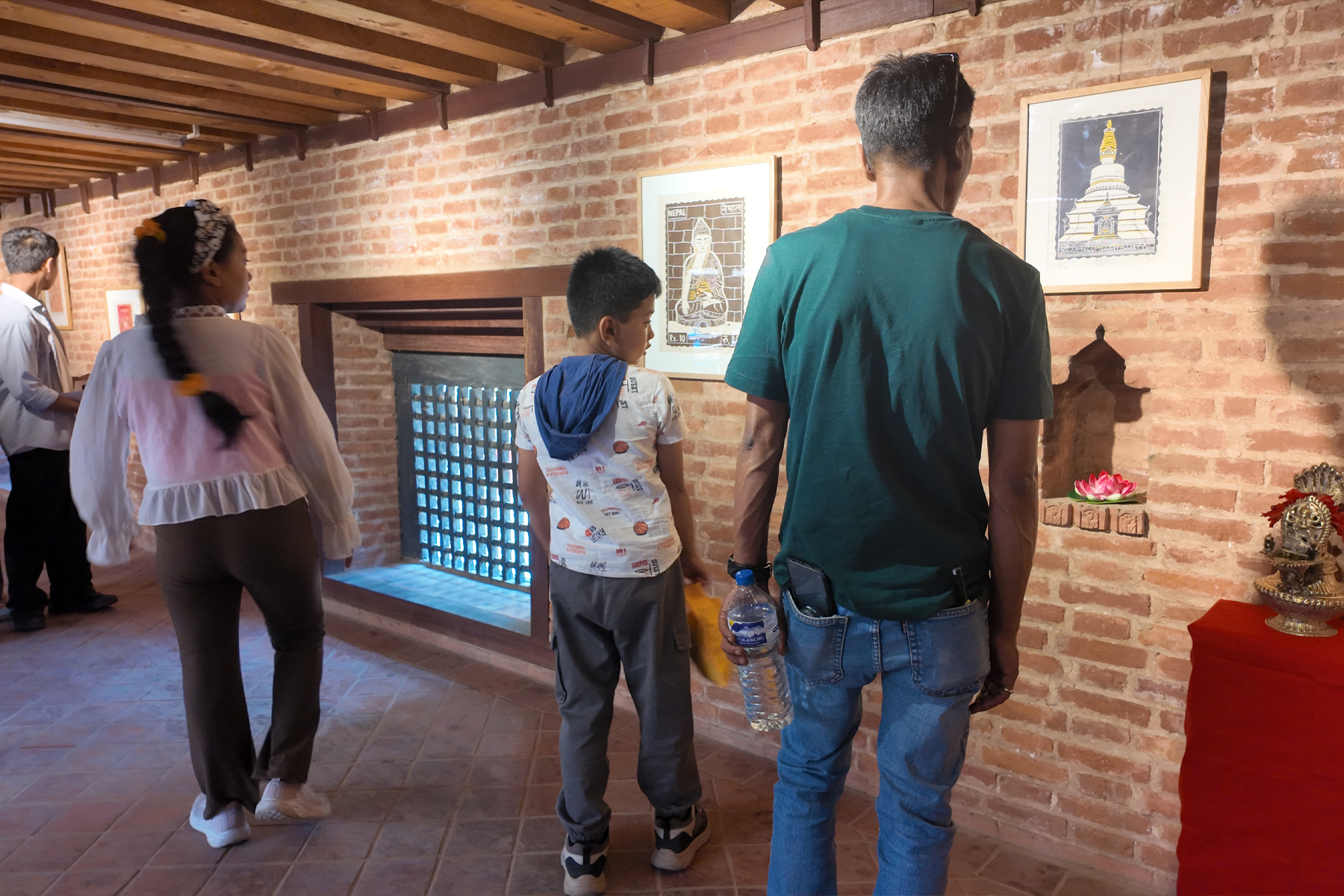
It is precisely this transformation that Rajbhandari’s exhibition investigates. Her works do not merely illustrate mythology; they interrogate how myths are constructed, expanded, and preserved across centuries. Through sharp contrasts, layered textures, and symbolic forms, her woodblock prints contemporize the ancient tale of gods, merchants, demons, and salvation. She approaches mythology not as a stagnant inheritance, but as a living psychological structure that continues to shape how societies perceive morality, protection, fear, and belonging.
Another compelling dimension of her practice lies in the medium itself. Woodblock printing, believed to have originated in ancient China around the fifth century, remains one of the oldest printmaking techniques in human history. Rajbhandari employs this ancient transnational medium to reinterpret one of Nepal’s oldest monastic myths. The result is a profound cultural layering: a Nepali Buddhist narrative emerging through a Chinese-origin printmaking tradition, viewed and interpreted within the fragmented realities of the twenty-first century.
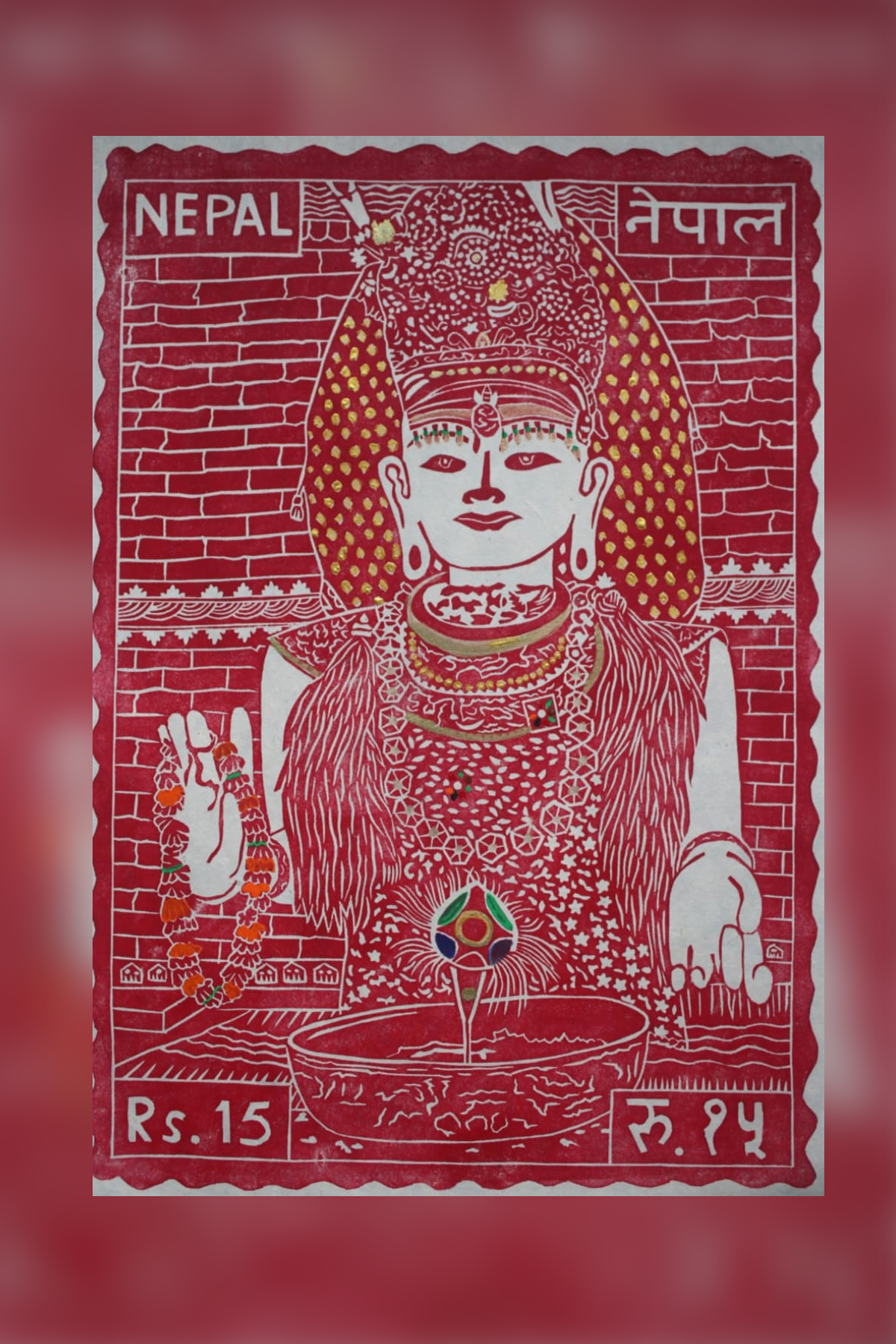
This simultaneity perhaps makes the exhibition particularly relevant within the contemporary Nepali art scene. Nepali modern art today increasingly moves beyond aesthetic representation into conceptual territories where history, identity, migration, ritual, memory, and philosophy intersect. Younger artists are no longer simply documenting tradition; they are dissecting it, recontextualizing it, and allowing it to converse with global artistic languages. In this sense, Rajbhandari’s work participates in a broader postmodern tendency within Nepali contemporary art, where timelines collapse, meanings become layered, and ancient symbols are reactivated through new media and conceptual frameworks.
Her exhibition ultimately poses an impossible yet fascinating question: can the future be constructed from the density of the past? If memory allows us to revisit what has already occurred, perhaps mythology allows civilizations to imagine futures through inherited symbols. Rajbhandari’s works operate precisely within this threshold. Bhagwan Bahal becomes not merely an archaeological or religious site, but a living psychic archive. The demons of the myth no longer exist solely as supernatural beings; they emerge as metaphors for fear, temptation, migration, loss, and the uncertainties that continue to haunt societies today.
What makes the exhibition especially compelling is that it does not romanticize heritage blindly. Instead, it reveals how cultures continuously reshape narratives in order to sustain themselves. Gods intervene because societies require moral structures. Rituals survive because communities seek continuity. Myths expand because memory alone is never sufficient.
And perhaps this is where the exhibition becomes unexpectedly futuristic.
To witness, within the same moment, an ancient Nepalese monastic myth, a centuries-old Chinese printmaking technique, contemporary conceptual art practices, and the living urban reality of Thamel coexist together is profoundly surreal. It is a collapse of eras- a layered simultaneity where the past does not disappear, but mutates into new forms.
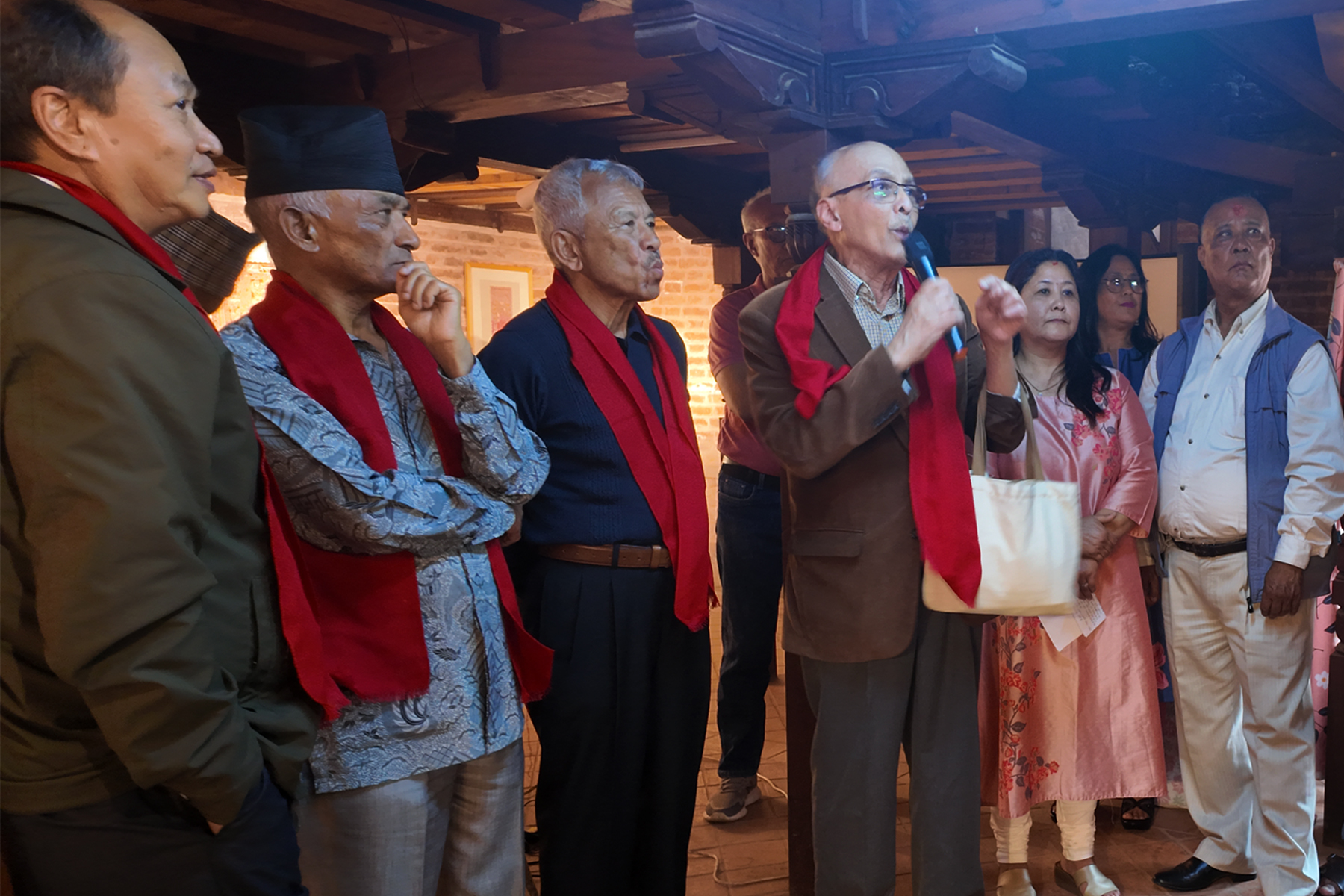
Samjhana Rajbhandari, associated with Sirjana College of Fine Arts and a Master’s graduate in Fine Arts from Tribhuvan University, belongs to a generation of Nepali artists increasingly engaging with such conceptual complexities. Her exhibition demonstrates how Nepali contemporary art can remain deeply rooted in indigenous narratives while simultaneously participating in global conversations surrounding memory, materiality, mythology, and postmodern identity.
Bhagwan Bahal thus becomes more than a monastery. It becomes a portal- where merchants, gods, demonesses, rituals, histories, and printmaking traditions continue speaking across centuries. Through Rajbhandari’s works, those voices once again emerge into the present, asking whether the future itself may simply be another form of remembering.

Leave A Comment